Monthly Archives: November 2014

The Weight of Beauty

image

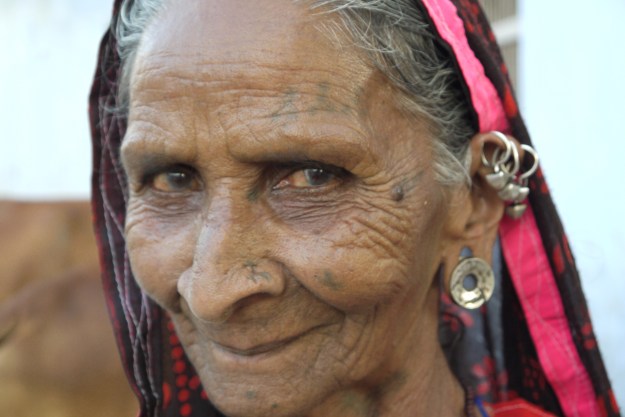
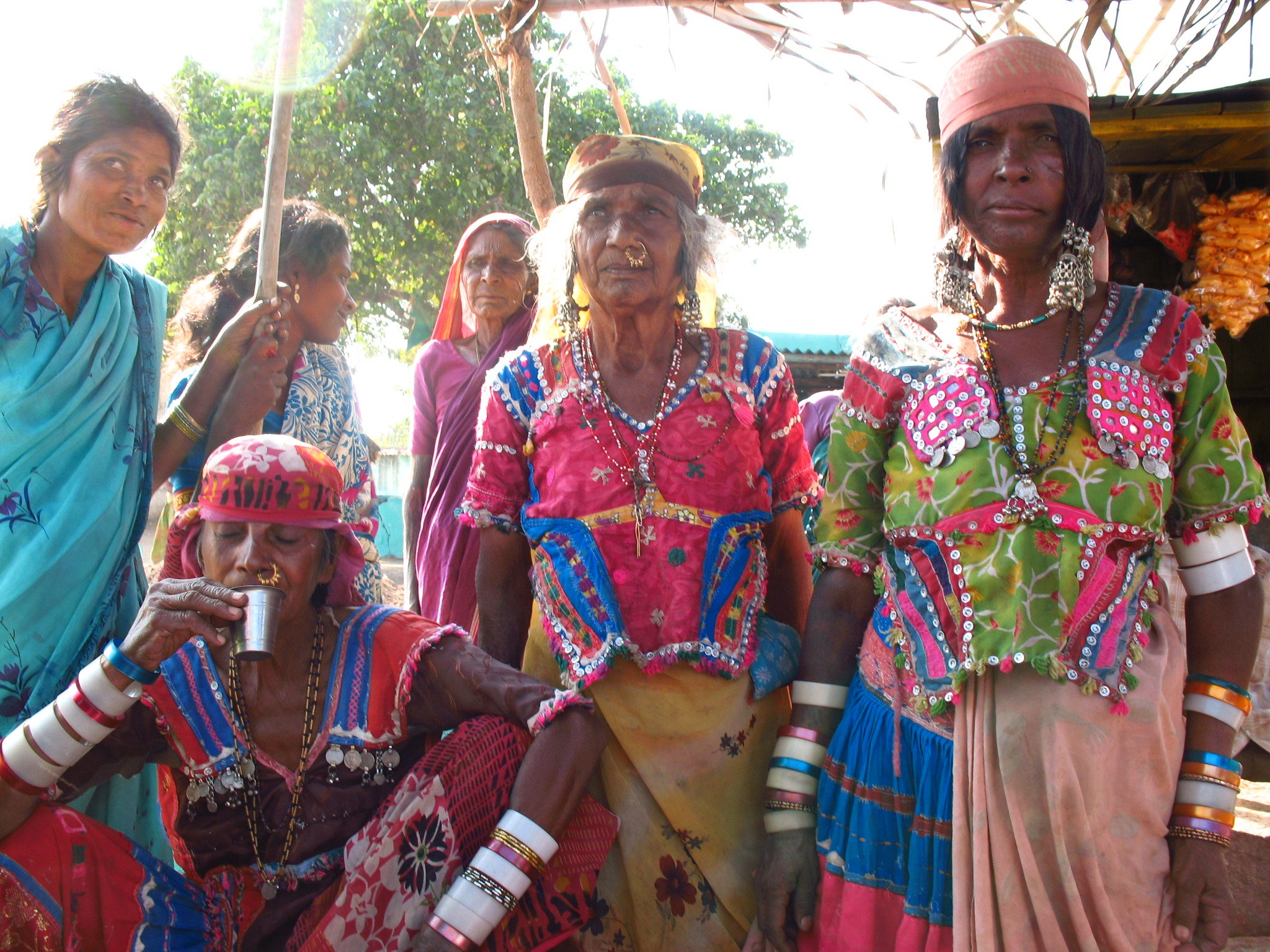
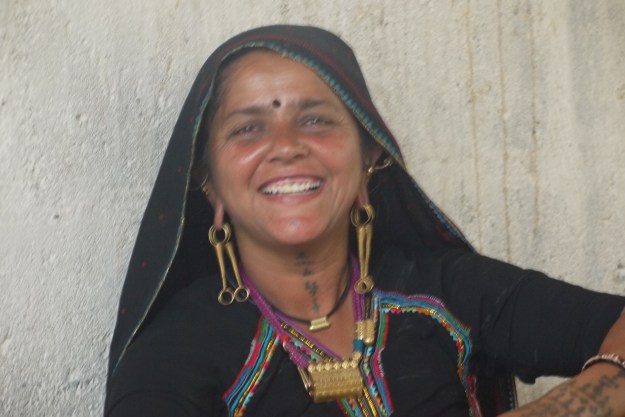
Rabari woman

image

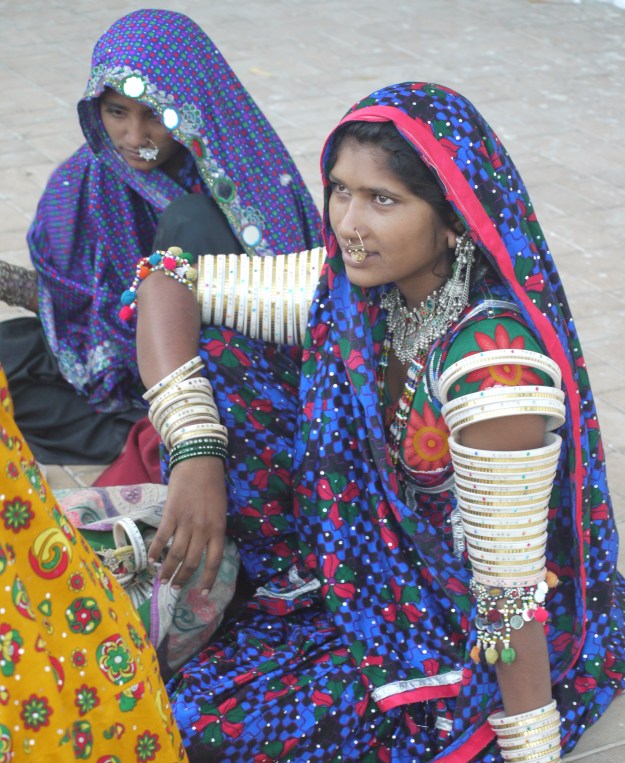
Meghwal women in Ludyia

image

Ahir woman

image

Meghwal girls

November 24

I smile and grunt as I point to the silver neck collars, ankle cuffs and earrings.  And so the ritual begins.

We are now in Kutch-a remote area in the north of Gujarat, which emcompasses a 17,000 sq. km long salt desert and is the home to a variety of colorful ethnic groups. Known for their skills in the traditional crafts of weaving, embroidery, tie dye, woodwork and leather, they are alternately reclusive and outgoing.

Wealth is portable for many of these tribes, and a tangible sign of prosperity.  Women wear ankle bracelets weighing over 2 kg, and the neck collars are no lighter. When we go into these villages I wear gaudy jewelry, bought specially for such occasions; and always my “mangal sutra” which is a sign of a married woman.  A common bond is formed by comparing our “wealth” and they want to know if I am wearing real gold. As a wedding gift, Meghwal women receive enormous gold nose rings which they proudly display. Gandhi called these people “Harijans”, or “Children of God”, but to the Hindus they are “Untouchables” and relegated only to certain professions.

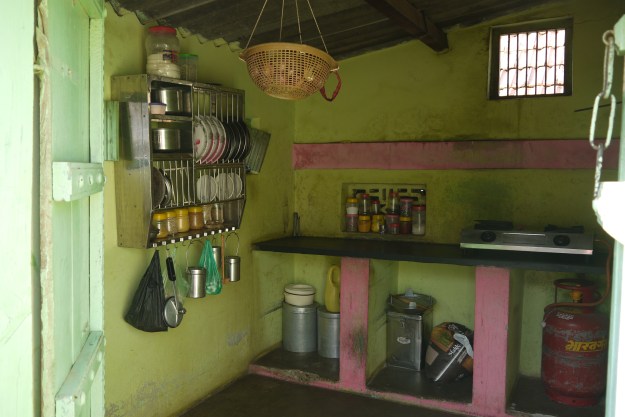
Originally from Rajasthan, Meghwal women are known for their intricate and colorful embroidery, embellished with small round mirrors and pom poms; the men work with leather. Meghwals usually live near Muslims so they can buy hides from their dead cows. Hindus are forbidden to work with leather. I find it ironic that these people are considered the lowest of the low, and yet their villages and homes are the most immaculate places I have seen in India.
P1060174

Kitchen

Rabaris are elusive and fascinating.  Herders, and primarily nomadic, they came from the deserts of Jaisalmer. Women are dressed in black embroidered bodices and wear two long brass earrings in each ear, so heavy that sometimes they rip the ears apart.  With cities encroaching on their grazing lands, the Rabari are forced to live in villages, and occasionally pack up their belongings to travel for several months.

We are with our resourceful driver/guide,Sheik, and like a good tracker, he is always on the lookout for my “women”.  On the highway we suddenly see a long caravan of camels and carts.  “Deborah, look up ahead, it’s Rabari on the move”.  It’s a rare site to see them traveling, and we speed up, looking for a safe place where we can stop and get out.  I am almost falling out of the car, trying to get my camera and myself out quickly before they are gone.  No need, the caravan is about 20 camel carts long.  I get a glimpse of the carts, filled with clothing, beds, suitcases and provisions.  Small children are placed high atop bundles of cloths and furniture. As we get closer, the women signal that they don’t want any photos taken, so I put my camera away and try to soak in this amazing sight and stamp it into my memory. (These days no easy feat!)

image

Nomadic Rabari herdersI

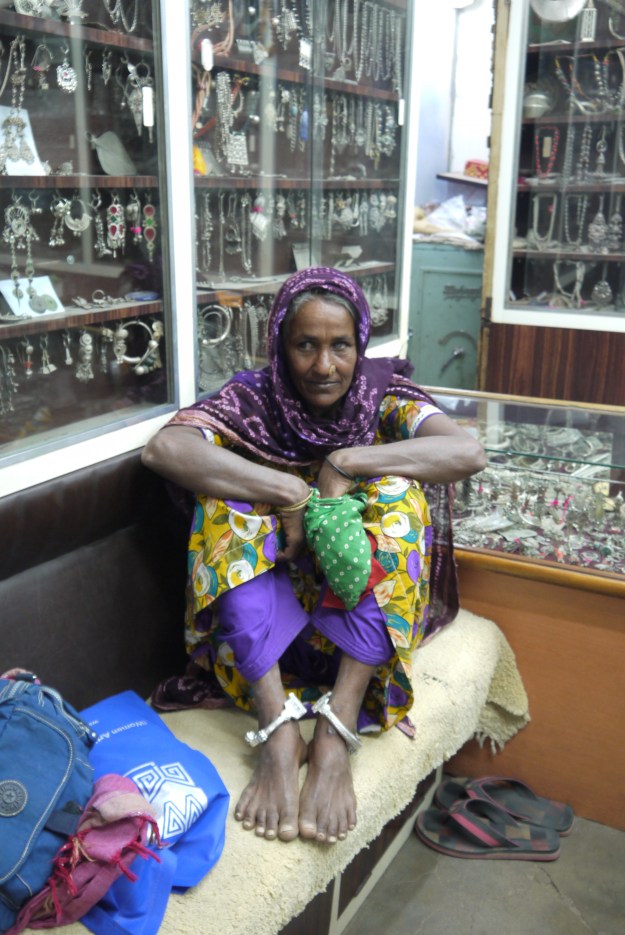
At the silver market in Bhuj (the largest and only big city in Kutch) I notice that there is a very booming market for these weighty body adornments.  I thought that many of these people were too poor to buy precious metals and had resorted to wearing plastic or nothing at all, but I’m very wrong.  Each booth displays rows and rows  of tribal silver jewelry.  I sit down at one where a Rabari woman is trying on a heavy silver anklet.  She motions to me to get one too, and the jeweler complies by placing one on my ankle. Alas, my ankles are too fat, and he offers to stretch it to fit me.  The woman is beaming with joy as she gesticulates that this is definitely my style.
P1060132

Buying silver ankle bracelets in Bhuj market

Older women tend to remove their jewelry and save it for their daughters, or just take a well earned break from being the familiy safe deposit box. Once they are married and have children, they no longer need to be beautiful.
Six Lions and A Yogini

image

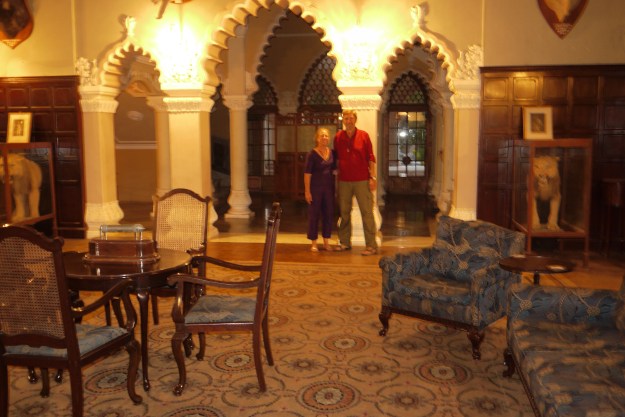
The foyer of the palace

November 19

“We’re going to see a lion this time”, Gerald promises.  I’m not really paying much attention to him, because we’ve been jinxed for years in our attempts to see rare wildlife.  In Sariska, known for its tigers, we learned on arrival that the last tiger had been poached six months earlier.  The elusive tigers did not make an appearance in Ranthambore,either, despite our three brave attempts.  Surely in Nepal, the one horned rhino would be more accessible in Chitwan National Park, but just to make sure, we booked the super expensive jungle lodge rather than go to the more plebian hostels.  Mounted on elephants, we trekked through misty jungle, mossy vines covering the thick overhangs, both at sunrise and sunset.  Nothing . It seems that they had just cleared out a large area by burning, and scared away the animals.  We didn’t enjoy hearing the ecstatic exclamations of the backpackers the next day of all the rhinos they saw.

Arriving at our “Jungle Lodge” did not seem like an auspicious event.  It was run down, our room had mold growing all over the walls,and a big bug dropped on my head.  All this at $80 a night! Our big break was meeting Ian. He looked like a bedraggled, aging backpacker, but turned out to be a fascinating British Professor of Eastern Religions and Ceremonies, AND he was first on line for the necessary permit to get into GIR LION SANCTUARY.  Six people fit in a jeep so off we went at 3:00 pm.

I am still feeling hopeful, trying not to have any expectations, as I quietly I hum “The Lion Sleeps Tonight”.  Two hours go by, and other than hundreds of spotted deer, and a spotted owl, the place is quiet.  Then it happens.  I am sitting in the back seat, raised up a little,when the tracker points up ahead.  Right in front of us, no more than twenty feet is a huge lioness.  We slowly follow, snapping away like crazy. I have my telephoto lens,so the pictures are blurred because we are too close.

image

Coming up from behind

The spell is broken, and each jeep we pass with Indian tourists (we are the only foreigners) wants to see our photos and then gives us the thumbs up sign.  Apparently we are the only jeep that saw any lions that afternoon.  We poke each other and giggle like idiots.  The next morning at sunrise we go out again with Ian (maybe he is our lucky charm). First we see two lions, one male and one female, again very close to the jeep.  I  get cocky and joke that next we’ll see three.  In the forest, lying down peacefully are three lions, AND a leopard a little further behind.  We are beside ourselves, and giddily  signal to each passing jeep how many lions we have seen.  “Lucky foreigners” they say as we pass.  The word has gotten out that the “ferengi” (foreigners) have seen lions.

Mission accomplished we head off toward Wankaner where we have been invited to stay at the Palace of the Uraj and Yogini of Wankaner.  At our favorite restaurant in Udaipur we met the hotel owner and his family visiting from Gujarat.  The Rani was his sister, and she gave us the name of her cousin, and insisted we must visit.  She herself had a smaller palace near Ahmadabad and offered to host us if we had enough time.  After independence many royals retained their palatial residences and turned them into hotels.

As we drive up the hill, a majestic palace comes into view with the top of the tower broken off.  Further down the hill is a 1930’s estate where we have a room reserved.  It is like something out of Downton Abbey, and as the only guests, we feel like royalty.  Our room is the “French Suite”, replete with art deco furniture, paintings, and a beveled blue glass bathroom.

image

The palace of Wankaner

The Yogini has invited us for drinks and a tour of the Palace at 5 pm. Her husband is away for the evening. The entrance hall is dominated by two spiral marble staircases.  Huge animal heads cover the walls, trophies of numerous hunts, with dates and countries of origin.  We learn that the earthquake of 2001 destroyed the top pf the tower and some of the exquisite chandeliers in the foyer.  Until 2 years ago, when she married into this family, they still lived in the palace.  Now they are trying to turn it into a tourist attraction, and they live in the adjoining Zenana building.

image

The foyer of the palace

Back in our suite I decide to take a bath, but when I try to turn on the beveled glass faucet knob, it breaks off and shatters.  Then the toilet leaks and the floor is soaked.  Honestly, I don’t really care, the atmosphere is priceless.  The suite has three rooms and opens onto a courtyard where there was once a lavish garden and fountains with colored water.

In the morning we eat our breakfast on fine china, with the waiters hovering over us.

The perfect ending to a marvelous weekend.

One Flew Over the Cuckoo’s Nest

November 14

Knowing that I like unusual rituals, our guide, Sheik, mentions that on Thursday nights there is a ceremony at a local mosque that would interest me, called LOBAN.  We arrive at  6 pm, just as the sun is setting.  Already hundreds of families are seated on blankets, while others are milling about. Inside the mosque an attendant has lit copal incense and the smoke is thick and pungent.  The mood is electric as people are walking around the perimeter of the mosque with their mentally ill family members.  Women and  young girls, with hair disheveled and clothing in disarray, are alternately shrieking and rolling on the ground in fits.  They come with the hope that they will be blessed and cured by the sacred smoke.  Sheik says that this can have an opposite effect on some people who lead otherwise normal lives, and become possessed during the ceremony, encouraged by the fervour of the crowd.  Although there are some men, the “crazy ones” are mostly female. Some very likely have easily treatable illnesses like epilepsy, but I fear that many are victims of abuse. Women have a low status in Asia are often subjected to verbal  and physical violence, especially the poorest ones.

I don’t dare take any photos, it’s too intimate and personal and I feel like a voyeur.

The next day, on our drive to Palitana, we pass a building and see men dressed in red shirts and black shorts, walking trance like in a circle around the courtyard. I am told this is a government mental institution.  Several years ago G read me the headline of an article in an Indian newspaper “INDIAN GOVERNMENT TO REHABILITATE WANDERING LUNATICS”.  We both laughed and thought it was a joke.  Apparently not.

Later that same day we see a modern, clean, complex where mentally ill people  are doing various chores.  This place is run by a charitable organization and seems a little more “pleasant”. Three places in two days- a coincidence?

I don’t know if all this is some kind of sign, but I will try my best to keep my wits together, at least until I get back home.

Return to the Village-Part II

November 9

It is our last night in Udaipur and  I am going to Noya Guda, where six years ago I witnessed a  hair-cutting ceremony of seven year old  Iswah, and stayed in the village for two days. (If you want to see some highlights from that ritual you can go on YouTube and look up “BHERU-haircutting Ceremony” by tembigirl)

Iswah, in the front, left, now 13 yrs old

Iswah, in the front, left, now 13 yrs old

Preparations have to be made well in advance after my previous adventure.  I have a large lunch, knowing that  dinner in the village will be eaten very late, at 10 pm.  Liquids must be consumed hours ahead of our departure, because there is no toilet,not even an Indian squatter. (Last time I visited, the headman drove me to his village where he had a toilet.  Then someone waited outside the door until I finished!).

At 4:30 I go downstairs to Prem and Kesar and we load into the car.  It wouldn’t be a proper Indian outing if there were only three people, so their 19 yr. old son, 13 yr. old nephew, and giant dog, Donny, come along as well.

It is only a forty five  minute drive from Udaipur, but centuries away .  We stop first at Prem’s village, where his family compound has an elaborate Bheru shrine, and with the help of the village priest, prepare offerings.  The family joins in gathering wood branches for a small fire, pours ghee into a vessel, places incense and marigolds, and prostrate themselves in front of the god .

Priest doing puja in front of Bheru Shrine

Priest doing puja in front of Bheru Shrine

Bheru Shrine

Bheru Shrine

Meanwhile a camel, carrying a load of grasses passes by, led by a wizened, turbaned man.  I feel as if I have been transported to another time zone a thousand years ago.

When we arrive at Noya Guda, I notice that nothing has changed  since my last visit.  There is no paved road, cattle roam in and out of stone houses, and the entry into Iswah’s home is inhabited by a water buffalo and some cows.

The two sisters, now 22 yrs and 19 yrs, are married and the eldest has a one year old son.  They are here visiting the family for a week.  One lives far away in Gujarat, and the other a few hours away.  It is the custom for girls to live with their husband’s family.  Prem tells me that the younger one, (who married at 16), is now  six months pregnant, and asks if I can look at the medical record she got from her  last doctor visit.  I am not surprised to see that her hemoglobin is low, but the size of her fetus is only 11 weeks, and she is supposedly 24 weeks pregnant.  I tell them that she needs to eat more and gain some weight.  The daily diet of dal and chapattis is not enough for a healthy baby.

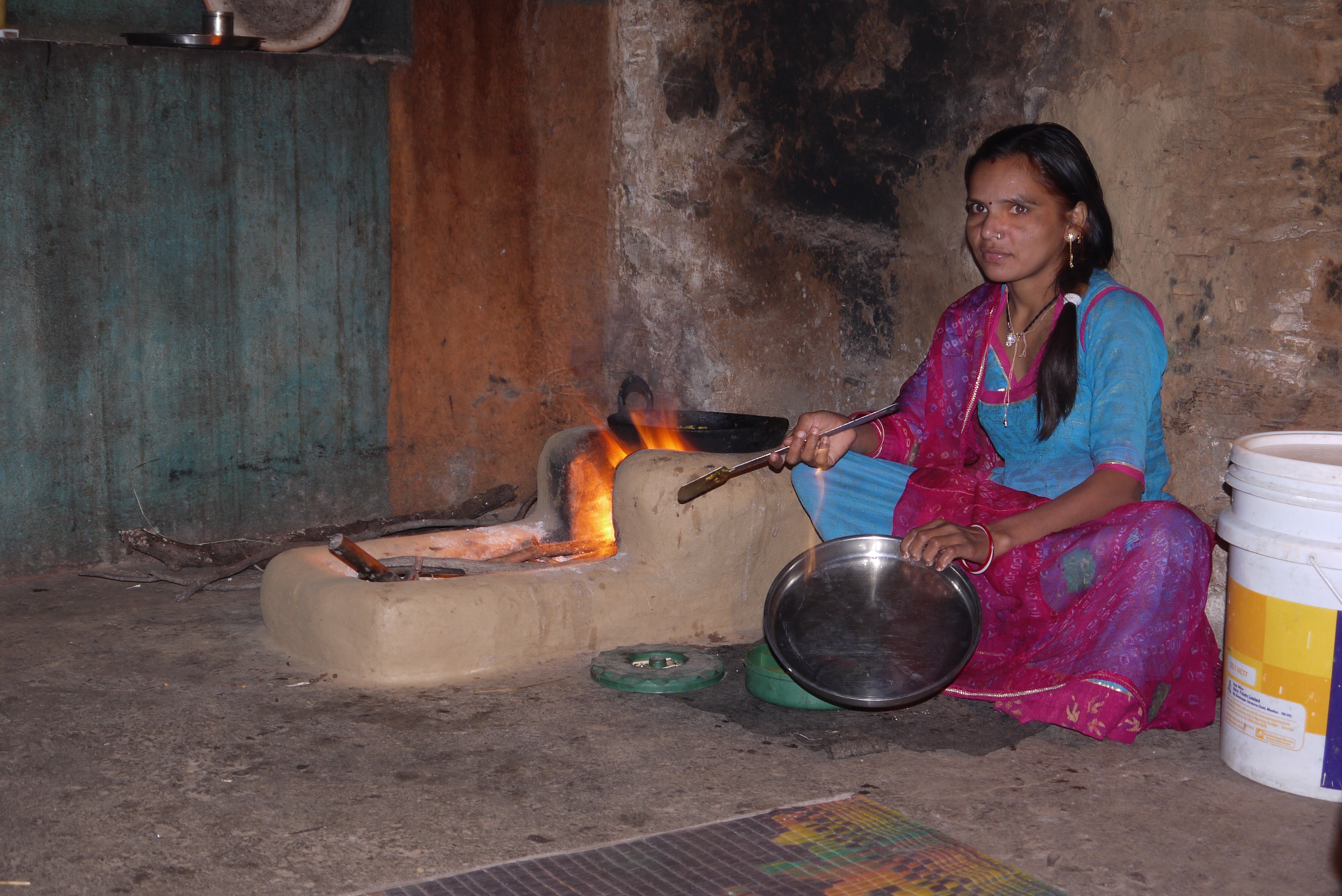
Making  the roti for our dinner on a clay stove at the village

Making the roti for our dinner on a clay stove at the village

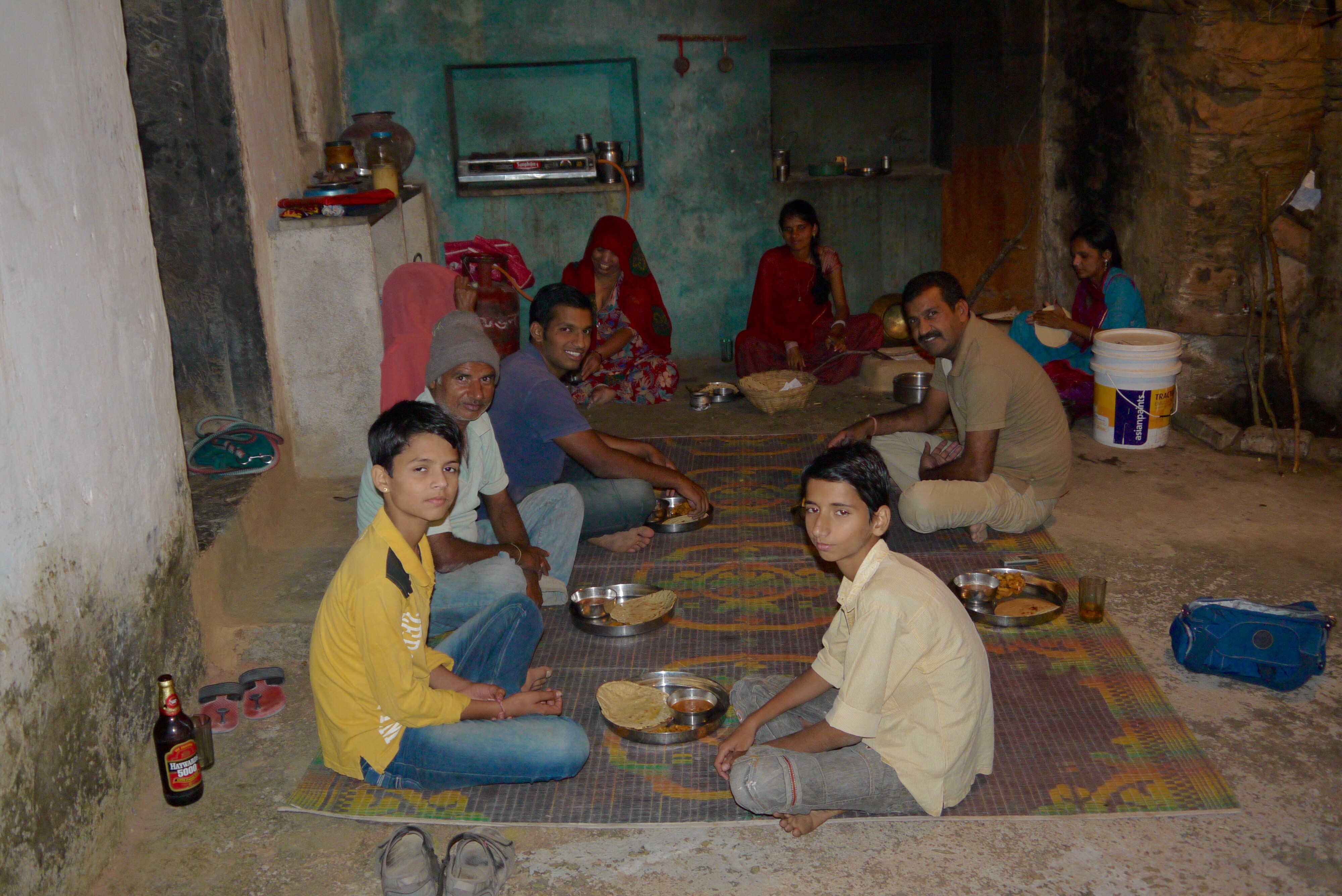
Dinner with Kesar and Prem and the family in the village

Dinner with Kesar and Prem and the family in the village

What concerns me more is a notation on her record.  Last year she had a “voluntary termination of pregnancy”.  India has 914 females to 1000 males.  Although female infanticide has decreased, female fetuscide exists unofficially.  The government has banned “sex determination” tests, but for baksheesh they are still available.  I discreetly ask Prem about boy and girl babies, and he insists that it is illegal to abort and is considered a crime.  I do not mention what I read.  Girls are considered undesirable because their families must pay a considerable dowry at marriage, and since the bride always lives with the groom’s family, a valuable helper is also lost.

Waiting for Muharram

The streets in the old quarter of Udaipur are eerily quiet. Shops are shuttered and people are milling around . The incessant ZOOM, ZOOM of motorbikes and rickshaws is not to be heard. Blue sky reflects off the City Palace and Lake Pichola, the result of a day without diesel pollution.

Today is the Muslim festival, Muharram. It commemorates the assassination of the Shia Muslim  Hussein Ibn Ali, a grandson of Mohammed, and is one of the holiest festivals of the year.  Gerald and I decide to forgo our plans to go out of the city and stay in Udaipur. We’ve been told that “sometime” in the morning and “sometime” in the evening there will be a procession. Each person we ask gives a different answer as to the starting time, and we find ourselves roaming back and forth on the the same streets following whatever seems to be a reliable lead.

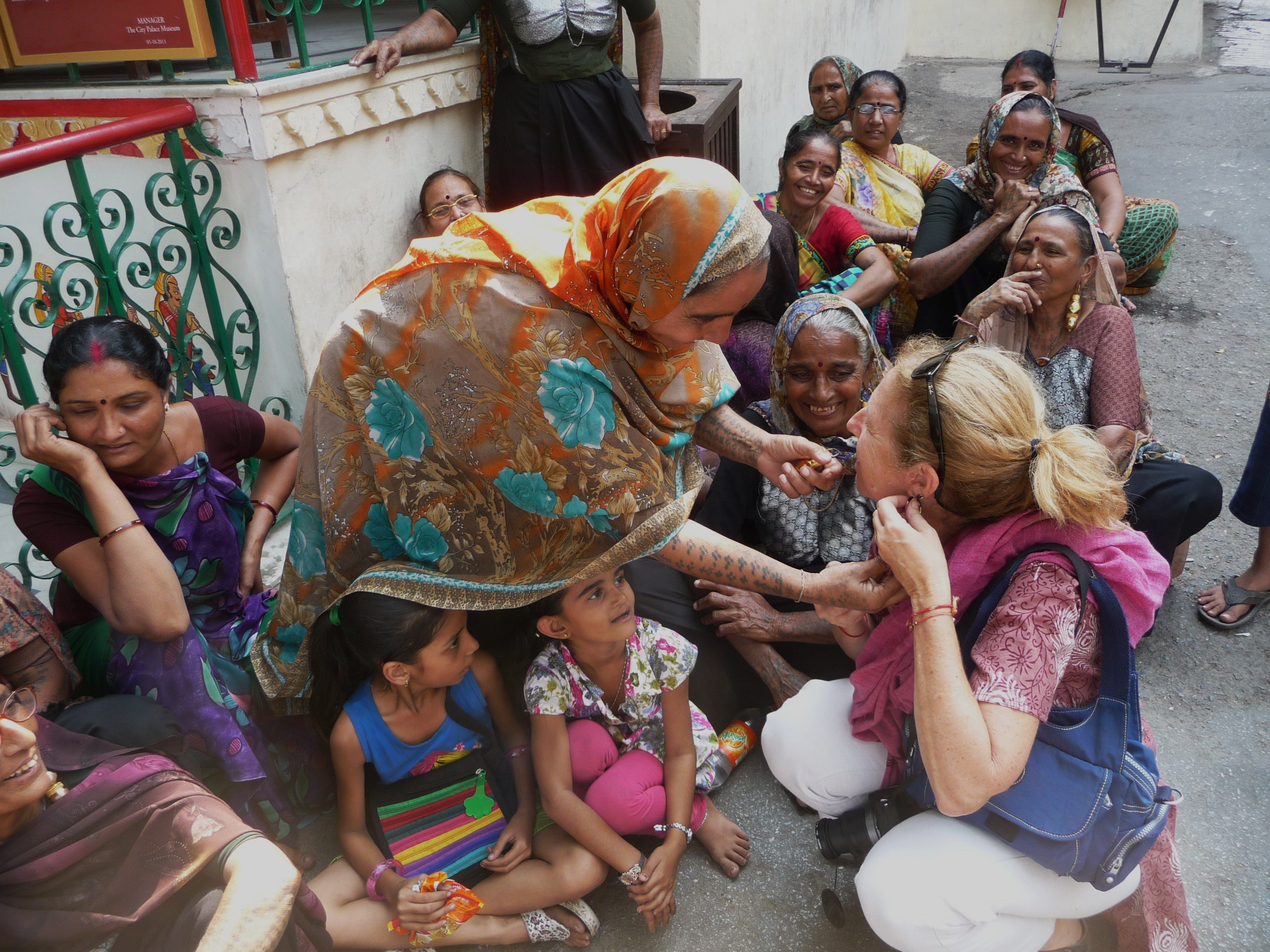
Finally we give in. It wil happen when it will happen.  Just then I spot a group of village women wearing huge gold earrings.  We saw the same ladies in Pushkar and I had all but given up hope of ever seeing them again, and being able to photograph them.  I am so excited about being given a second chance that I run ahead, trying to catch up with them.  They are moving faster, aware and amused that I am following them, but also afraid of losing the rest of their group. When they reach the entrance of the City Palace (their destination)  I squat down on the ground next to them and we compare earrings. Before I know it,one woman takes off her earrings and puts them on me so G can take a picture.

Me trying on the earrings with the ladies from Porbander(in Gujarat)

Me trying on the earrings with the ladies from Porbander(in Gujarat)

While eating a masala dosa we talk with a young Dutch couple, who tell us about this amazing procession they just witnessed!  Determined not to miss the evening one, we stake out a prime spot in a rooftop restaurant overlooking Jagdish temple, where the procession will pass.  It is only three in the afternoon, but policemen are already lining up, and women and children are setting out cloths to sit on along the route.  G thinks it  will start soon. “Believe me, they’re not going to hang around like that for another three  hours.” I think otherwise.

image

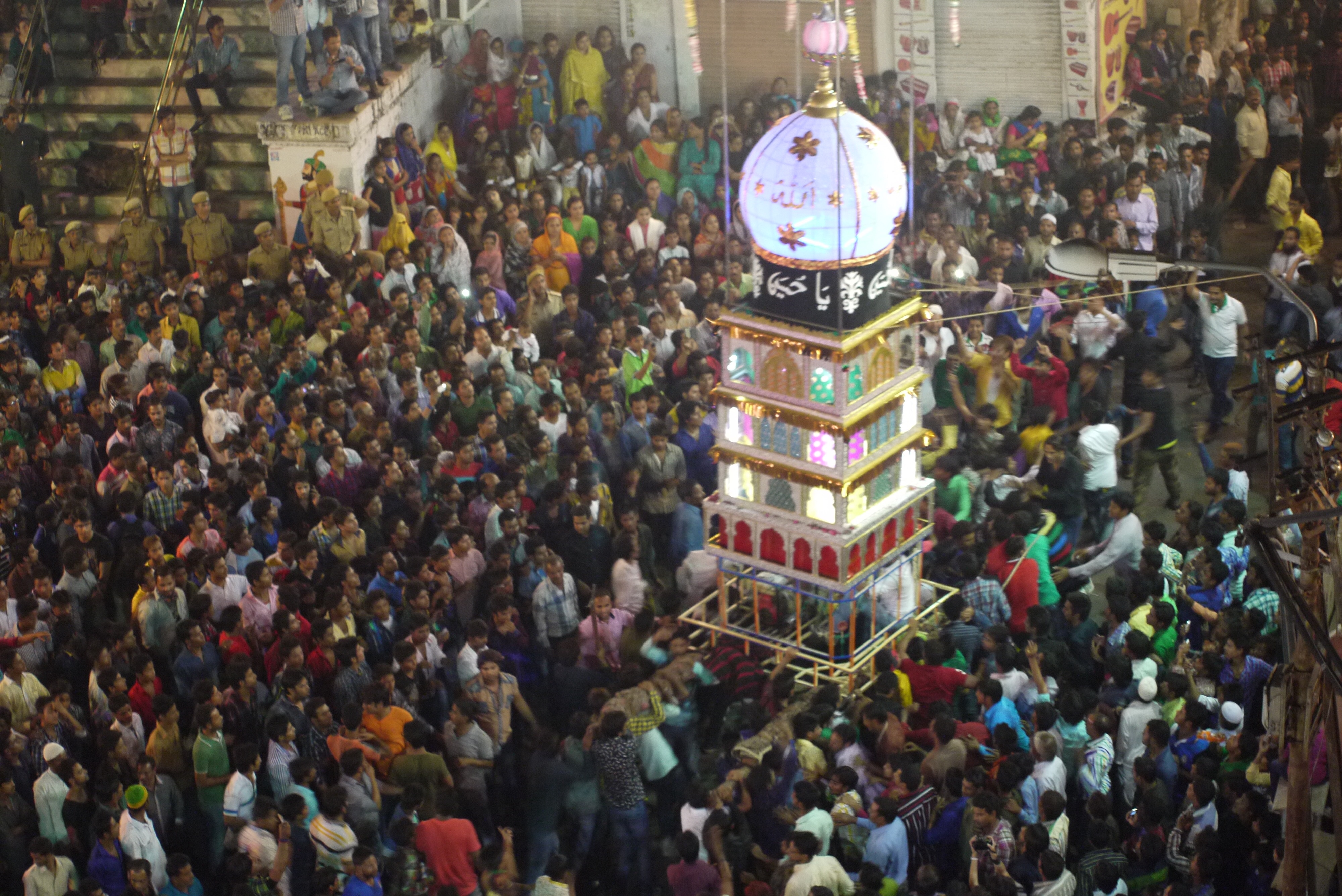
Preparing a float for Muharram

image

Crowds of men dancing in the square for Muharram

It is now almost six in the evening .We have eaten a chicken tikka masala, drunk numerous fresh lime sodas, and still nothing.  Down below in the square a sea of men is gathering.  Slowly we hear chanting getting louder and louder, and  see men forming small circles and doing a slow rhythmic dance with scarves waving in their hands . Then  a rush of boys carrying a giant float of a glittering mosque comes into view as they spin around severals times, to cries of “HOSEIN”,  followed by “ALI”. The procession continues, each float taller than the next.  Groups of drummers incite the men to a feverish frenzy.  In past years there has been some violence and the rows of police are on high alert. There are too many young men with nothing to do, and this can easily turn into a riot.  But it doesn’t, and float after float of varying sizes of mosques (some 4 stories high,)pass by, preceded by groups of drummers.

image
At 9pm the last float has made its way down the narrow street toward the ghat, and the crowd disperses peacefully.

What’s Your Caste?

“You have been to India many times”, comes as a statement, rather than a question from a shopkeeper in Udaipur. “I think you stayed here a long time”, he continues. Puzzled as to why this seems so obvious to him, I ask how he knows. “You wobble your head like an Indian when you speak”, he replies quickly.

India attracts several different “castes” of visitors. Of course there are the usual tour groups of Americans,French and Germans; cameras with huge lenses hanging off their shoulders, dressed in their R.E.I. safari clothes.

Then we have the individual travelers who can be distinguished by their dress as well. First timers, depending on the age group, will be wearing long skirts or harem pants and tank tops (the twenty to thirty year olds) or simple lightweight clothing with short sleeved tops ( the over fifty year olds). Frequent travelers will be in kurtas and long scarves of Indian fabrics draped in the local style.

Continuing down the scale is a group Gerald calls “The Tribals”. Blissed out/Bhanged out wanderers, with dreadlocks, nose rings, ear plugs and hippie era clothing. They can be of any age, and the younger ones may have their small children tagging along.

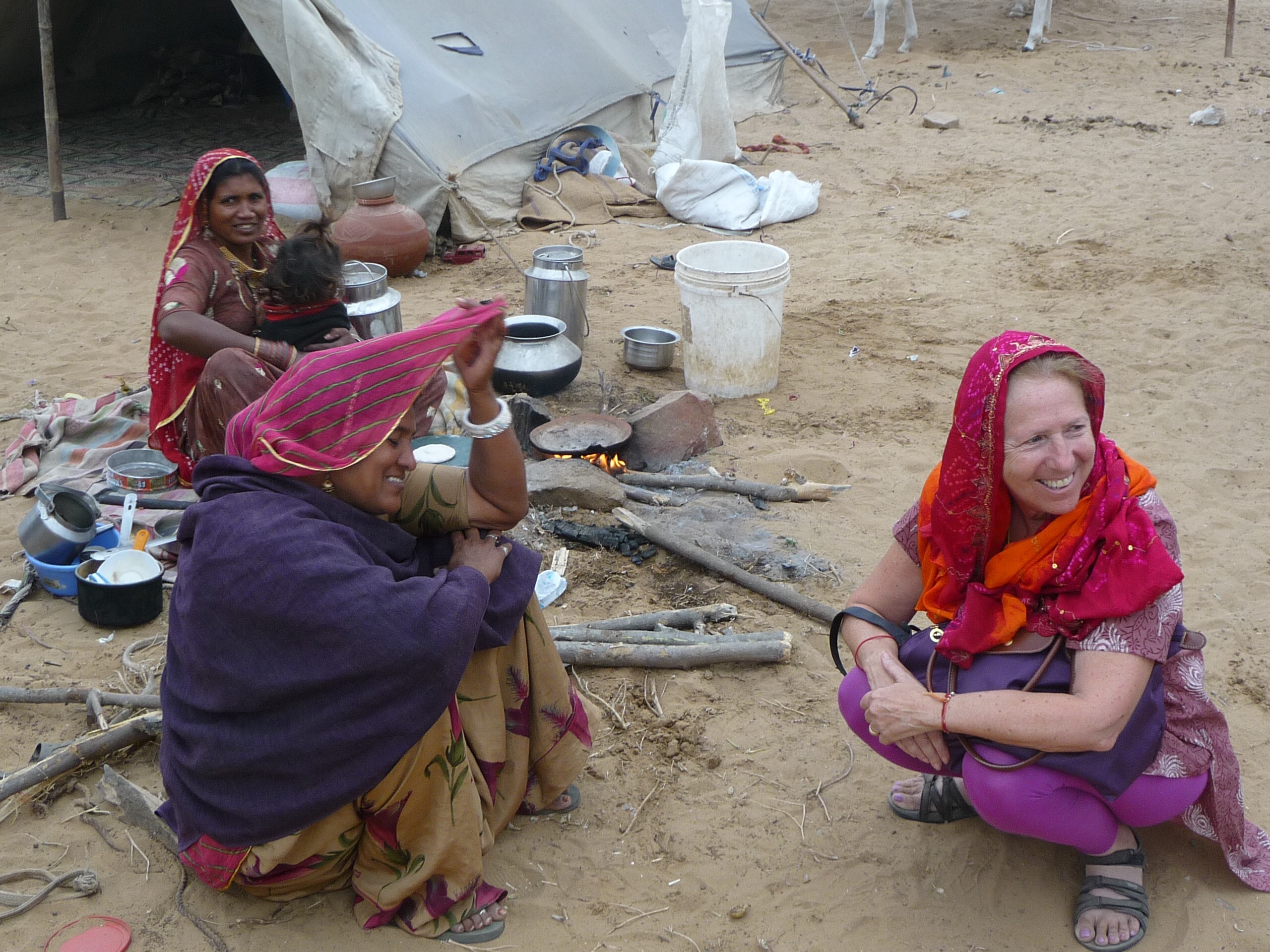
Where do I fit in? I’m always on the lookout for unusual tribal body adornments, so I try to wear some piece of Indian jewelry that will be of interest to local women. Add to that a beautiful, long saffron and red chiffon scarf with gold sequined flowers, and a head that is constantly wobbling, no matter what. It seems to work.

image

image