Monthly Archives: January 2018

Amy’s Story

I was born in Calcutta and adopted at three years old by a single woman from Utah. I have no memories of India at all and when I applied for a visa to come here was surprised to learn that I had to first renounce my Indian citizenship. I never knew I was still an Indian citizen.

img_0052

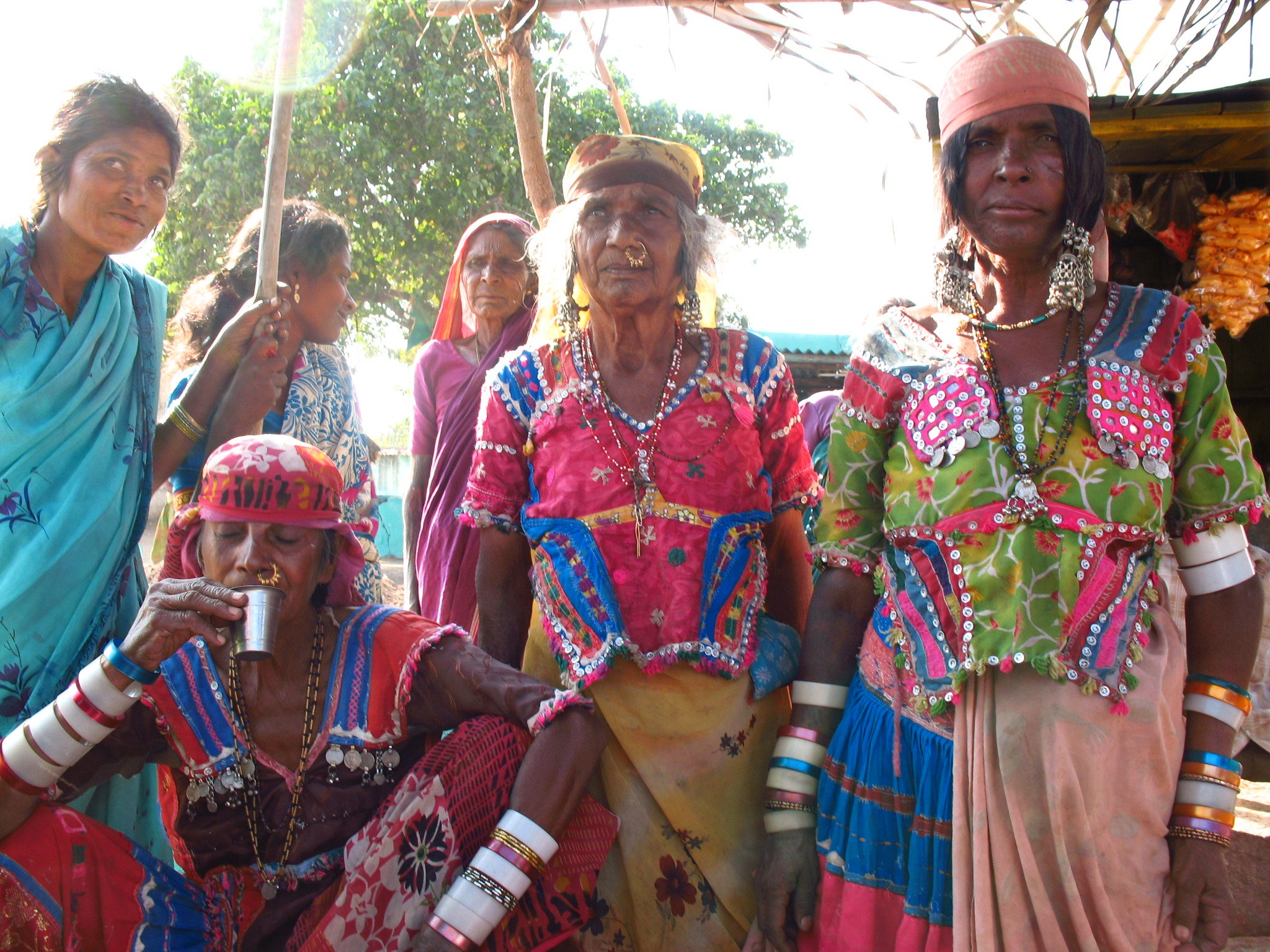
Amy has a big,beautiful infectious smile, with eyes that invite you to engage. When I asked if I could interview her she readily agreed. I’ve been curious about the motivation for so many young Europeans and Americans of Gujarati origin to come to Ahmedabad to live or work at Manav Sadhna for extended periods of time. But Amy’s story is a bit different because she grew up in the non-Indian, very white Mormon culture of Salt Lake City.

My mother was a non practicing Mormon, as were her parents. They enjoyed a lifestyle of cocktail parties and country clubs. My mom felt that she shouldn’t have to be married to have a child and was liberal minded. She picked me out from an orphanage photo.


Amy’s upbringing was filled with the love of her mother and grandparents, and when asked if she experienced any racism growing up, she replied simply “No”. I was surprised and pushed further. ” Maybe my mom sheltered me from that. When I was a junior in High School someone called me a “Nigger”. I told them I was Indian.” Amy’s mother exposed her to Indian culture as a young child and had a mural painted in her bedroom of Amy riding an elephant amidst landscape scenes of India. Four years later her mother asked if she would like to have a brother or sister, and soon after a boy from Bulgaria was added to the family.

Unfortunately this idyllic childhood ended with the untimely death of her beloved mother when Amy was twelve. Her mother’s niece and husband, who were childless, came to live and care for the two motherless children. Trying to cope with the loss of her support system Amy turned to the Mormon church. The idea of being “sealed”with her mother for life ( a Mormon ritual)was very comforting .

Sealing is the everlasting covenant from God to families that we will always be together eternally. All married couples are sealed to each other with their children being born into the covenant, but when a couple adopt a child, they take the child with them to the Temple for a sealing ceremony..

She had been spending almost all her free time with the local Bishops family as well as other practicing Mormons, a way of escaping her less than happy home-life. Becoming active in the church was a natural consequence. Although her family were “inactive” Mormons, Amy was baptized at eight according to Mormon practice.

For the next twenty years Amy was the ideal Mormon. She didn’t drink, smoke, practiced purity in thought and action and attended Church regularly. She never questioned any of the tenets of the religion. All that changed in 2008.

Amy’s brother had a much more difficult time adjusting to his new home, having lived with his mother only a few years before she died. He turned to drugs and alcohol and had a tumultuous youth. They lost touch for many years. When one day he called and said he was clean and sober, and had found a homosexual lover, she was delighted for him. The church up until this point had been vague on their position on homosexuality, and left the handling of the issue to local leaders. Meanwhile, Amy had been experiencing doubts about her own sexuality and began seeing a therapist. The legalization of same sex marriage in California in 2008 made her curious to learn more about homosexuality.

In 2015 when the Church came out with their official position on same-sex marriage, Amy was at this point identifying as a lesbian.The handbook stated that children of same-sex marriage could not be blessed or baptized until age 18 and at that point had to renounce their parents in order to join the church. The policy also states that those in same sex marriages would be considered apostates, a category that includes murderers and rapists.This was the final straw. It was time to leave.

I strongly believe in God because of my adoption story and other spiritual experiences I’ve had throughout my life. I also believe I will be forever with my mom and grandparents with or without the Church’s teachings. If the LDS Church reversed their policies on homosexuality I’d be an openly gay member. I still believe in the tenets of the church but I am also learning to have more faith in the universe, that I don’t need to worship in a church or temple. I can be close to God anywhere.

I’ve always known that my life was a miracle and lived it as such.
 

THE TOILET GARDEN/GANDHI’S DREAM

“It is health that is wealth not pieces of gold and silver.”-Gandhi

I wrote this four years ago but noticed that it was not published and had “disappeared”. For those that haven’t seen it before, it was this visit that inspired us to come back and work at Manav Sadhna.

More people in India have cell phones than toilets. The Toilet Garden was listed as #61 in the guidebook “101 Things to Do in Ahmedabad “, under the heading “Flushing Diversions“. Yes, there is one, I am not joking.  During our family visit to Delhi we didn’t have time to visit the Toilet Museum so we thought we would make up for this lapse.

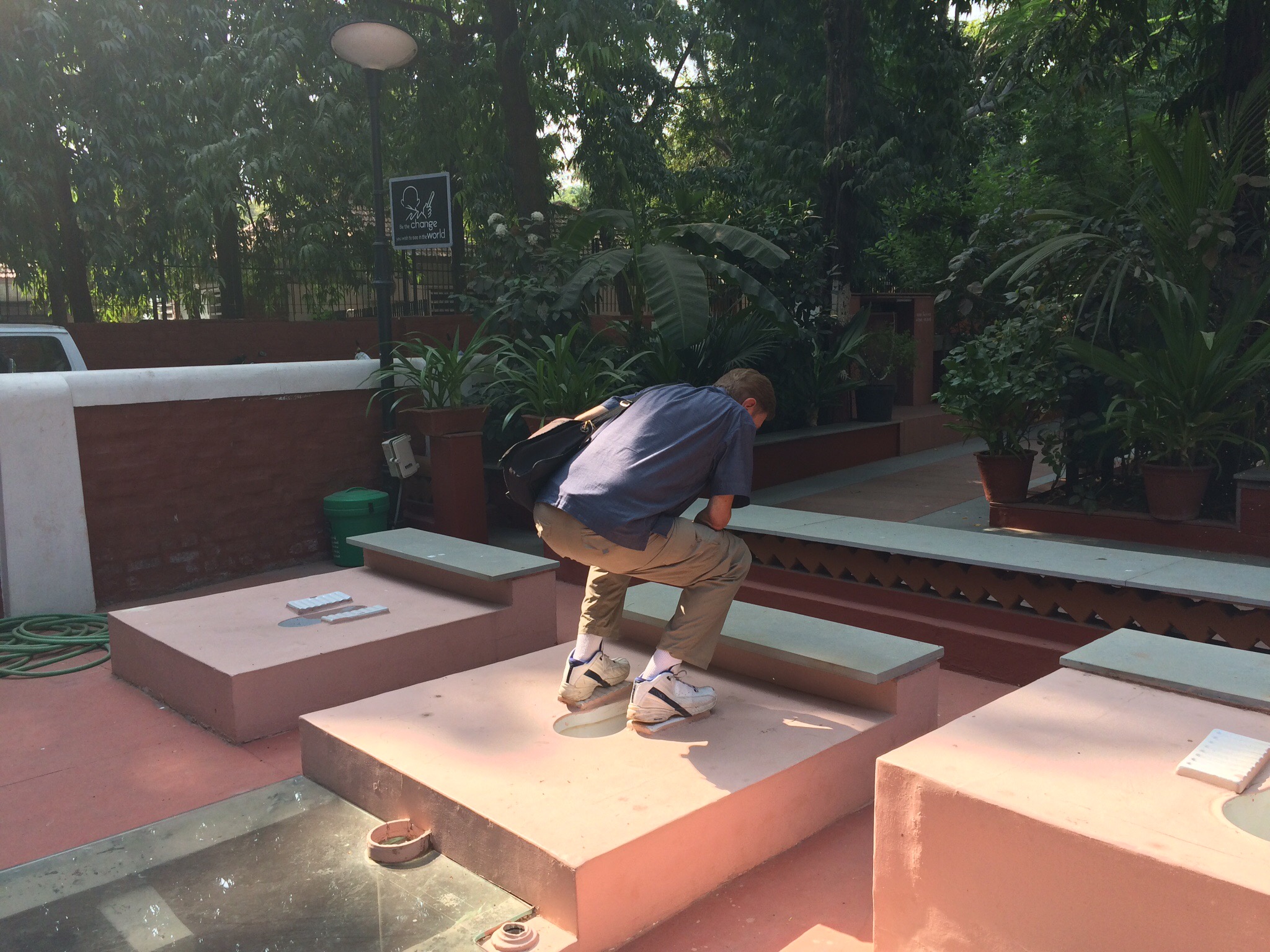
It is located inside the Environmental Sanitation Institute compound on the grounds of Gandhi’s former ashram. Founded in 1955 by Ishwarbai Patel, better known as “Mr. Toilet”, there are thirteen varieties of toilets displayed in a lovely garden.

Gandhi was horrified that one caste of people, the Harijans, formerly known as the “Untouchables”, were responsible for going around to the villages and collecting the waste. “Mr Toilet” distributed more than 30,000 toilets, and now 55% of the population have sanitary facilities , up from the previous low number of 8%. The garden was built in honor of this great accomplishment.

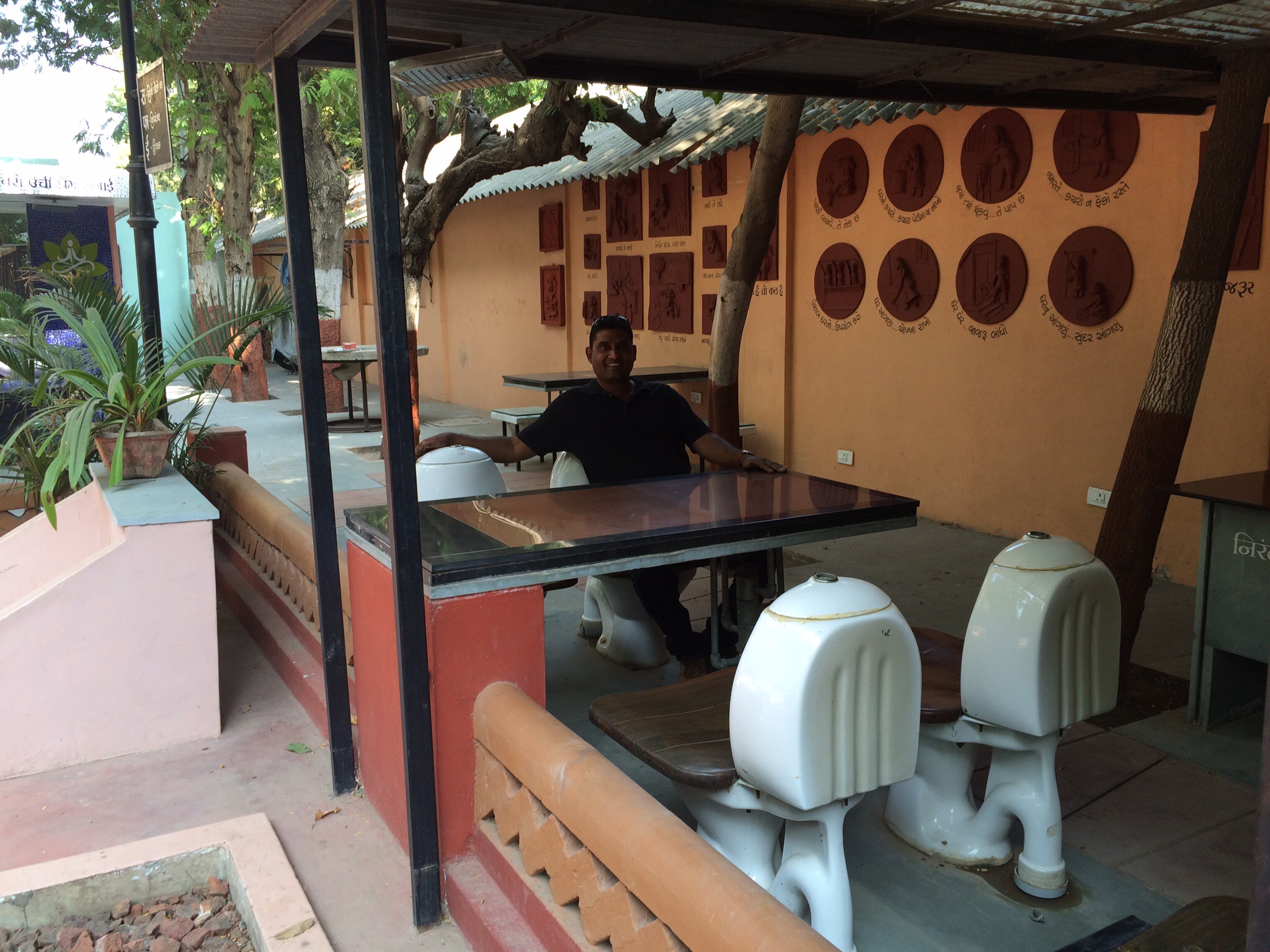
Gerald, of course posed in front of the “VIP TOILET” as well as one of the squatters.  I joked that it would be nice to have a  cafe with toilets as seats, and sure enough there was one. We sat down, had a chai, and used our toilet paper as napkins.

A figure of Gandhi was carved into a tree stump nearby and we went next door to visit his Ashram.

Manav Sadhna, an NGO that works with improving the lives of women and children in the neighboring slums has its headquarters here. Forty thousand women scrounge for garbage to sell to recyclers and these women play a vital role in the sanitation of Ahmedabad. This center is a safe haven for children to learn a skill, get basic health care and experience love and compassion. There are also various programs for the elderly,computer training , recycling and finance.  More than 9,000 people in the community are served.

What started as a lark, ended up as a fascinating and informative look at another side of India..

IMG_1631.JPGIMG_1628.JPGIMG_1626.JPG

How Uber Almost Saved My Life /Ahmedabad Revisited

Uber in India?! Well, sort of. On hearing that Uber had come to Ahmedabad we were ecstatic. One of our greatest challenges staying here two years ago was dealing with transportation issues. Now we could go anywhere in the city, explore new restaurants and be more social.

Traveling by rickshaw is at best a frustrating experience. First the haggling about the price, then the invariable blank stares when you give the destination, and last but not least, the blasting of diesel fumes in your face. Our 95 rated face masks were packed and ready for use, but now we wouldn’t need them. Maybe.

Our second challenge was going anywhere on foot. Crossing the road in India can be a life altering if not life ending, experience. Anyone who has been to Asia knows what I’m talking about. Lanes as well as travel directions are a mere suggestion. Cars, rickshaws, motor scooters, pedestrians and livestock “share” the road. LOOKING RIGHT, LOOKING LEFT (they drive on the right side of the road) WATCH OUT for the speeding moto driver, RUN QUICKLY between the rickshaws, WAIT, that car is going in the wrong direction. I was so freaked out last visit that we only went to the Foundation and back and then stayed holed up in our hotel room.

This time we felt confident that with Uber we could go anywhere cheaply and with ease in a nice air conditioned vehicle. We realized that in India it would not be the same as in the USA or Europe. Nonetheless our expectations were perhaps unrealistically high. Most drivers back home drive part time, in India it is a full time job. In 1993 there were 3,000 cars in Ahmedabad, today there are 300,000. Some drivers own their own cars, others work for fleets. Those that drive for others earn about $150 a month, those who own their own cars can make up to $1800 a month, minus the 20% Uber fee.


It will be your best friend.

This was confirmed by a young Indian woman we met at our first airbnb.

After being happily settled in our modern hotel room we were ready to go out for dinner at Tinello, an Italian restaurant at the Hyatt Regency. Not that I don’t love Indian food, but after three weeks I wanted something different.

I opened up my Uber app and it connected me immediately with three drivers in the area. It would cost 72 rupees (a little over a dollar) and our driver would be Manish , driving a Suzuki Echo. But wait a minute, what’s that in small print at the bottom?

Driver is deaf or hard of hearing.

Nope. Nix that one, it’s hard enough making yourself understood by someone with normal hearing.

Chandraveer would be our driver. As a white Suzuki Maruti pulled into the driveway, things were not looking auspicious. The car was old,dirty,dented and the driver looked like someone out of a gangster movie. We got in anyway. No more than two minutes had passed when we heard a bump, bump bump.

This car has a flat tire, let’s get out.

Gerald grabbed me out of the car and we went back to the hotel to start again. The driver was still flailing his arms trying to get us to wait and get back in the car. The third one was the charm and we arrived ten minutes later at the restaurant.

Subsequent trips have proven to be iffy. Once, while trying to find a major clothing store, Fabindia, the driver became totally lost. His GPS didn’t work, he became flustered and the car smelled like a diseased animal had recently died. We were forced to get out and walk. Even the polluted city air was better than remaining in his car another minute.

Our second problem was graciously solved by the hotel manager, after telling him about our apprehension crossing the road to get to the Foundation in the mornings.

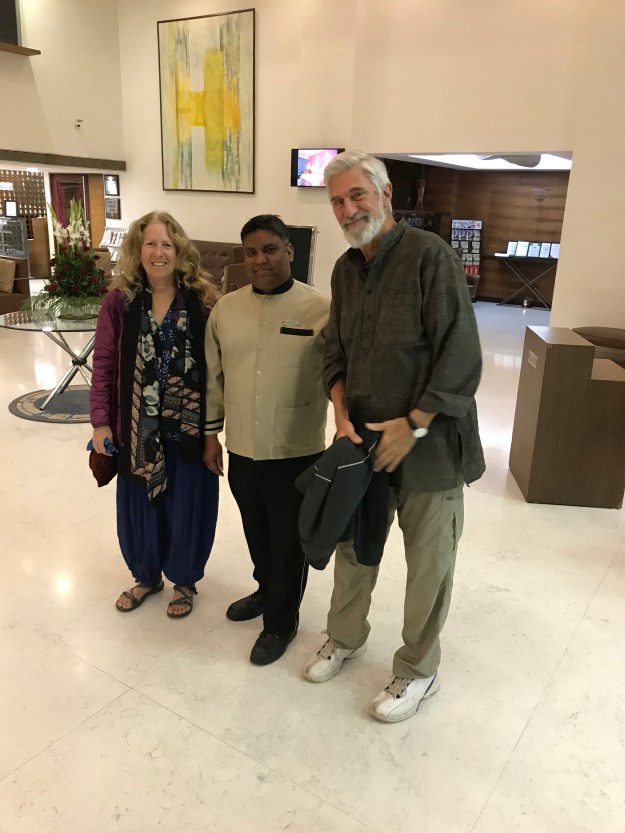
Welcome back, Mr. Huth. We will assign you and Madam one of our bellman as your private escort every day.

Luckily Hindus believe they will live many lives or no one would ever cross the road.

Close Encounters of the Holy Kind

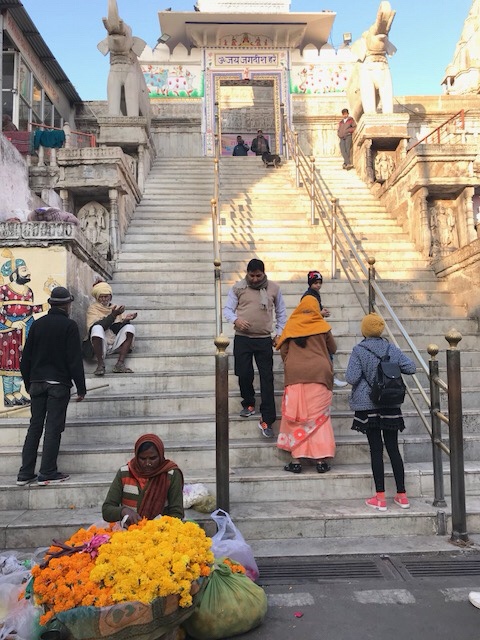
Early morning is a good time to visit the Jagdish Temple in Udaipur, before the incessant roar of motorbikes and auto rickshaws drowns out the melodic chanting of the faithful worshippers inside. Down below, two ladies are sitting cross legged, on the staircase leading up to the temple, arranging their baskets of marigold and rose petal strands. Business will be brisk later as visitors buy offerings to be blessed by the priests.

At the top of a steep, narrow staircase stands a rack where shoes are placed before entering the shrine enclosure, a custom practiced in every temple in India. Stepping onto the icy cold stone floor I make a mental note ( for the umpteenth time)to wear warm socks next time.

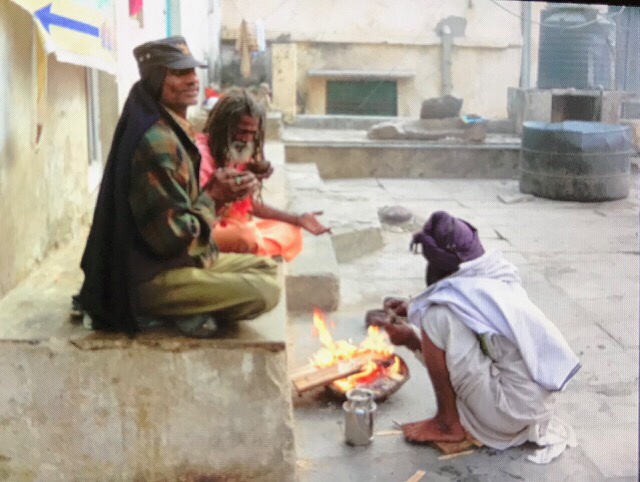
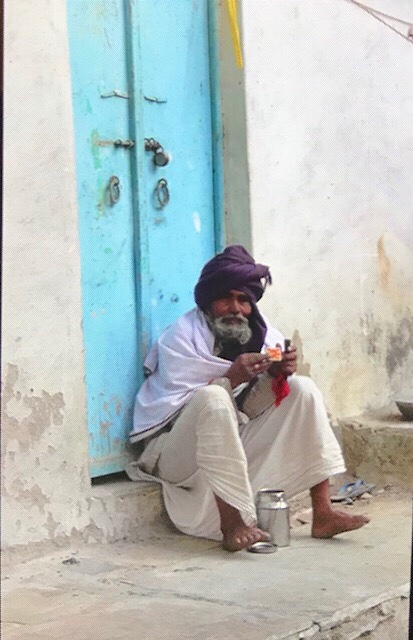
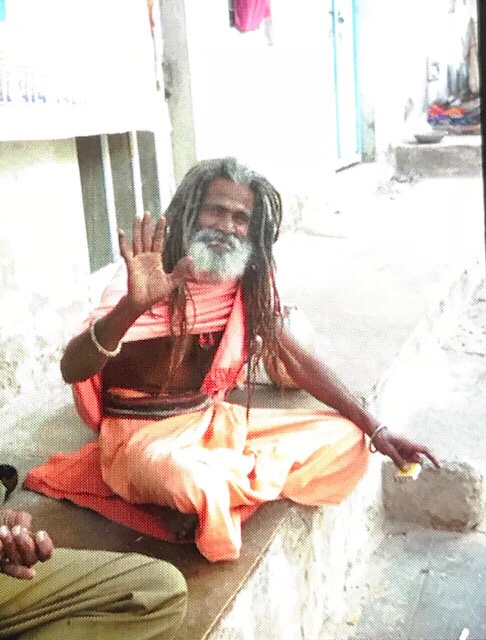
I decide to walk around the thousand year old shrine, carved with stone elephants,riders on horseback and sensual dancing figures. In the back of the temple there is an open courtyard, a private space for temple attendants and wandering saddhus, and I hesitantly enter,not wanting to encroach upon the sacred grounds. A tall, thin man dressed in a green military style uniform. beckons me to come closer. Seated next to him are two Saddhus- one with saffron robes and dreadlocks, the other in simple white rags, and they are both puffing away on their ganja pipes. The “official” surprises me by pointing to the Saddhus and announcing in clear, precise English.

Shankar Maharaj and Loden Maharaj- they are my gurus.

I smile serenely.

Shit, shit, shit, shit.

Am I hearing him right ? He is waving his arms around in an exasperated manner and I realize he is warning me about the piles of cow dung littering the courtyard. Cows are sacred in India and they non chalantly wander through the streets, highways, doorways, and temples, with the knowledge that they will not be disturbed.

I ask if I can take photos of the Saddhus, and they happily agree and start posing. My reward for not paying attention for two seconds, is to slide into a schmear of hardly visible cow manure IN MY BARE FEET! All of us start laughing. Holy shit!

When I finish taking pictures and want to show them to the “official”, he brushes me aside.

No,no. I don’t want to see the photos. Send them to me. Here is my address at the temple.

He hands me a torn piece of paper scribbled in Hindi script.

Everyone knows the Jagdish Temple in Udaipur. It will come here. 4″ x 6″ only. Now let’s have some chai.

Just then Gerald appears and rescues me from having to make excuses for not wanting to risk drinking from those “holy” cups.

I knew I would find you here.

A Perfect Chaos/An Ordinary Day in Udaipur

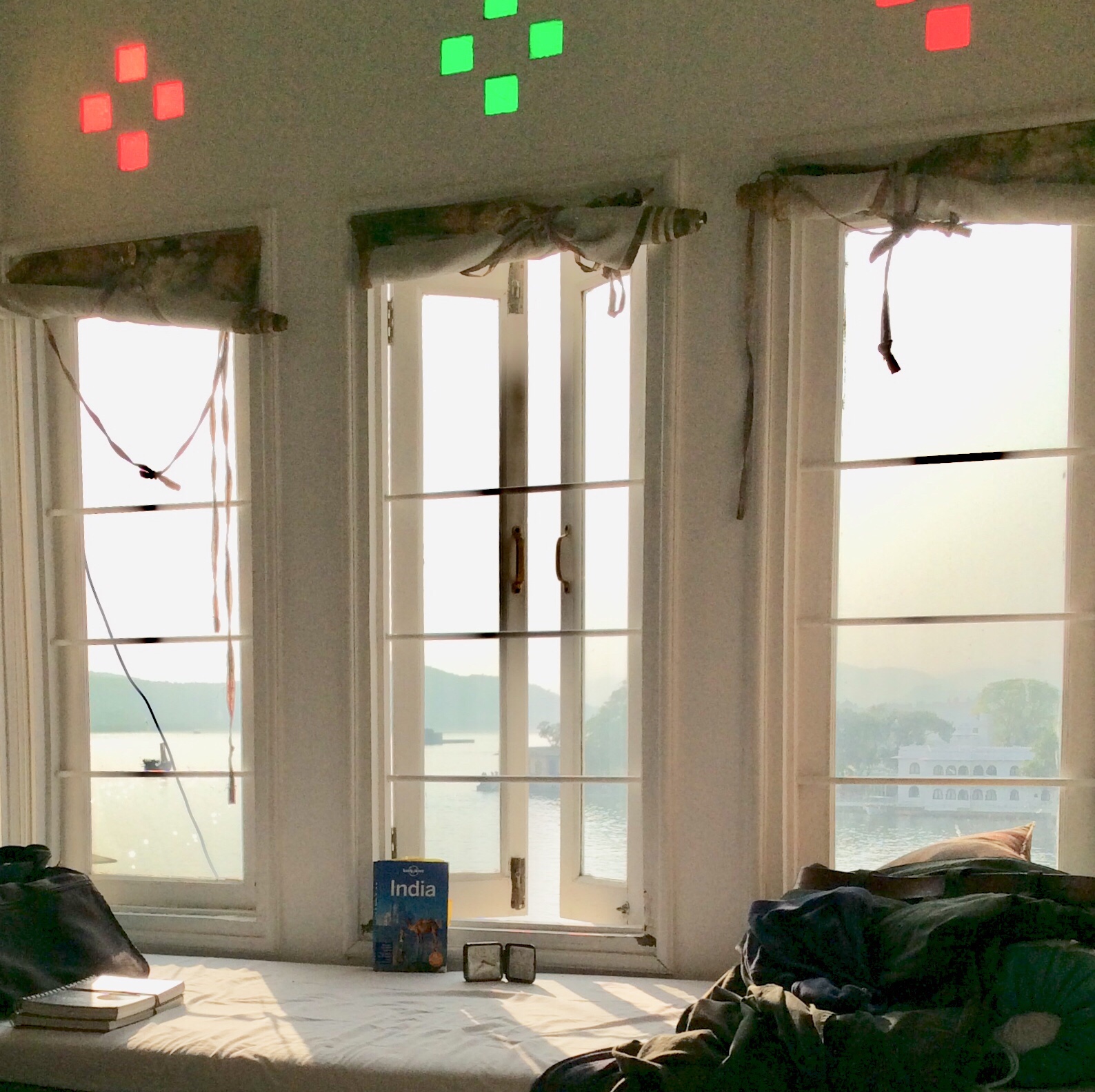
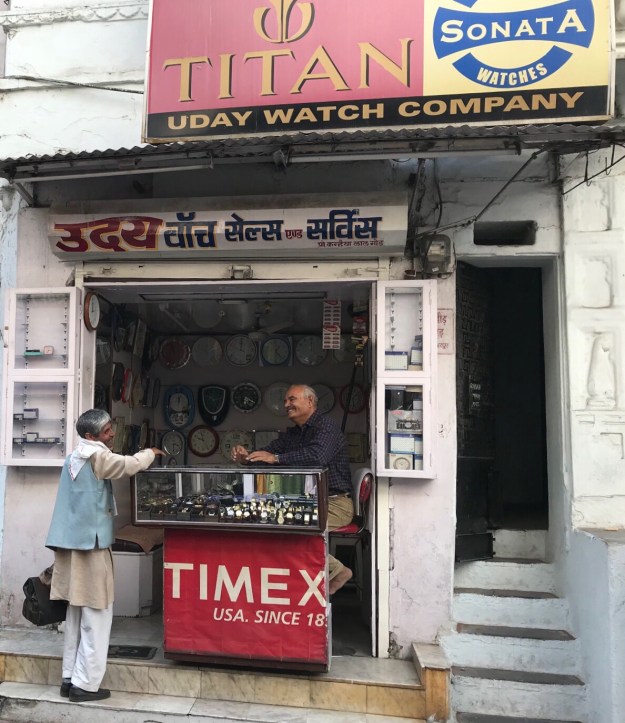
Nestled between the Artificial Jewellery Shop and the Medical Supplies corner an elderly man sat on a high stool, fiddling with watches. He was surrounded by all manner of clock and watch parts and a small glass case displayed timing devices for sale, costing between a few dollars and several hundred. Gerald lives by the mantra “In India anything is possible”, but hopes for repairing his twenty year old travel alarm were fading.
Its a really cheap clock but its been a lot of places with me over the years and has sentimental value.

We approached the gentleman, asked if he repaired clocks, and he seemed to think it could be done. Of course, in India no one will ever admit that they cannot do something. We had spent the better part of two hours trying to get my IPad keyboard repaired or replaced ( it died suddenly), with no success. Each new person kindly shepherded us to the next “electronic shop” (nothing more then a tiny niche off the main market street crammed with plugs,memory cards,computer cords,etc.), but in the end , no go.

Do you mind waiting ten or fifteen minutes? He thinks he can do it.

I knew how much that clock meant to Gerald and I was enjoying watching the action on that very busy main street, so I said “Sure”.

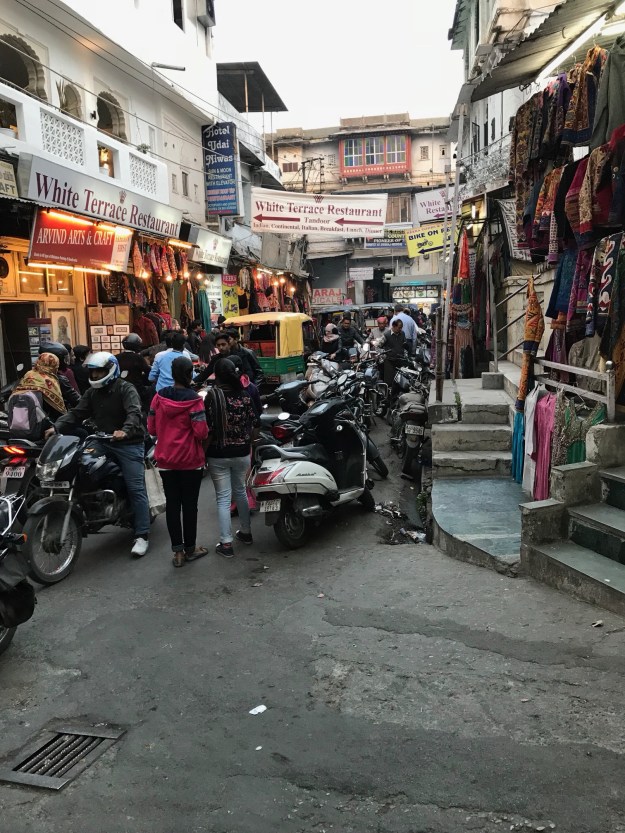
It was after our dinner, about 8:00pm, and most of the Indian families who were spending their holidays in Udaipur were rushing around in rickshaws at dizzying speed or walking single file to avoid being sideswiped by a car. The evening was just beginning for them and the mood was festive with the whole family in tow- young couples with their children, in -laws on both sides and the occasional lone auntie or uncle.

I had the advantage of being able to see everything from my slightly perched position but not get in the way of the rush of bodies and cars. The main road was narrow, windy and not made for all the vehicles and cows that travel through.
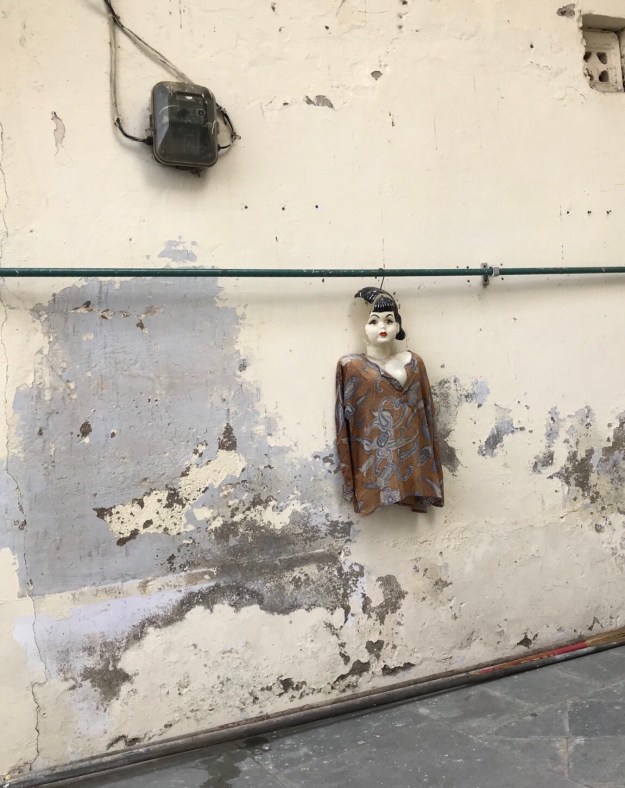
Suddenly chanting and drums came from a loudspeaker nearby, and I craned my neck to see where it was coming from- a wedding procession perhaps? The last call to prayer from the mosques was over an hour ago. When I looked up I saw a Hindu shrine on the upper floor of a building across the road, where an evening puja was just beginning.

In the midst of all this frenetic activity, the clock man smiled at Gerald and said:

Clock fixed now.

The charge was 70 rupees (about a dollar) and we left, knowing that the clock still had many thousands of miles to journey in the future.