Monthly Archives: January 2020

A Change is in the Air

The more things change the more they remain the same


A gentle wind is blowing throughout India, it’s not yet a gust, but its effects can certainly be felt.

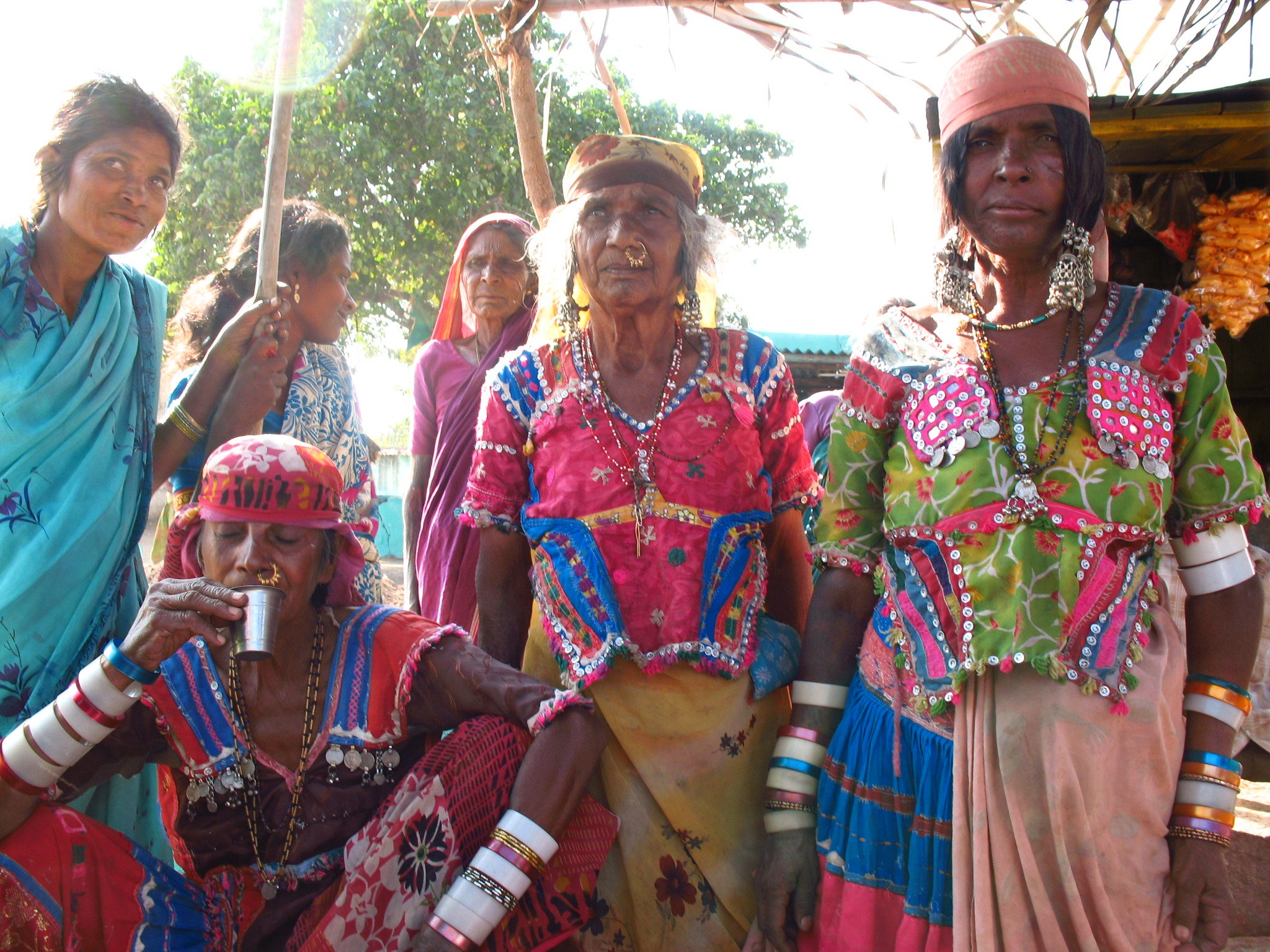
What do an architecture student from Gujarat, a chartered accountant from Kerala, and an illiterate villager from Rajasthan have in common? All are women and have or will be having an arranged marriage.

India is a fast growing economy with over one billion people and many are entering the growing middle class. Being thrust into the modern digital age has created new possibilities for work opportunities and social communication. But how has it affected one of the most important aspects of the society, marriage?

Ninety-five percent of all marriages in India are arranged, however the method in which this is accomplished has evolved dramatically. Traditions die hard and so these changes are mainly visible in urban areas.

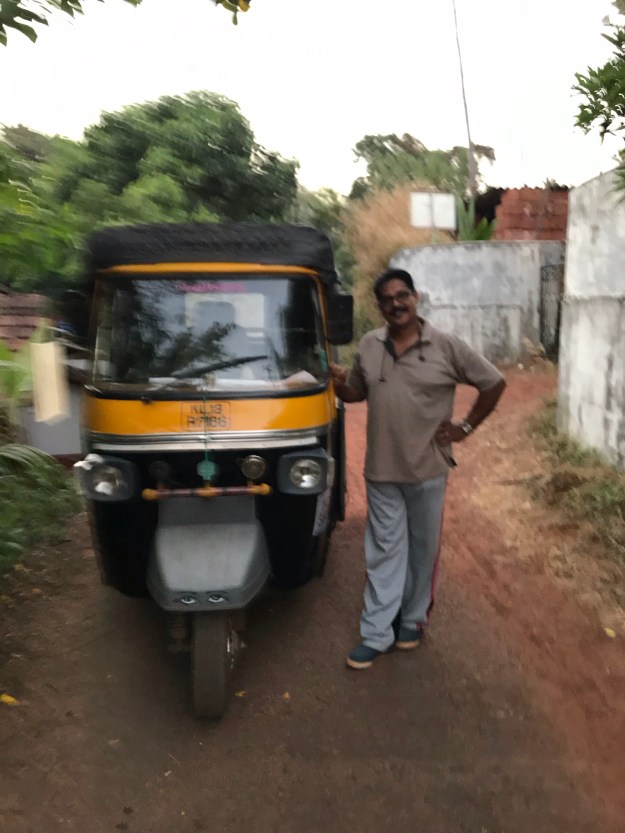
Vineeth, our rickshaw driver/guide in Kerala has two daughters. Although he and his wife have been exposed to modern ideas and both his daughters have Masters degrees, his girls will only meet their husbands on the day of the wedding, not before. Attention is given to choosing a compatible spouse in terms of education, values, economic promise, and of course, horoscope. One daughter is already married,and her husband, like the majority of Keralan men, works in Abu Dhabi (a fertile ground for Indians to earn high salaries). The second daughter will be married once she completes her chartered accounting program. I asked her how she felt about not meeting her husband. “It’s the way I was brought up. We are accustomed to it since childhood and I accept the tradition. “

Marriage in India is about devotion, duty to the family, sacrifice and permanence. It is seen as a contract that needs to be fulfilled. Love is expected to develop and flourish only after marriage. I don’t have any statistics to back me up, but from casual observation it seems to work fairly well in many instances.

Shaikh, our Muslim driver/guide in Gujarat,also has two lovely daughters and one son. Many of his clients are highly regarded experts in Textiles or Cultural Anthropology and he is well versed in any number of academic subjects. Yet his wife and both daughters wear burquas, and his daughters also will not meet their husbands until the wedding day.

In both these instances although the marriages are arranged in a very traditional manner, the chosen husbands will be ones who will accept an educated woman as their equal. This is in stark contrast to the arranged marriage system in conservative Rajasthan. Prem Singh, our longtime Driver/friend in Udaipur has three sons. He too, is exposed to contemporary thoughts and leanings of the day, but his sons have married illiterate village girls who were promised from birth, all from the same village as his wife. Their roles are to take care of the household and have children(preferably males).

We have come to India just as the auspicious time for weddings has arrived, proclaiming itself with a flourish of loud roving brass bands and long processions of women in glittering gowns and dazzling sarees.

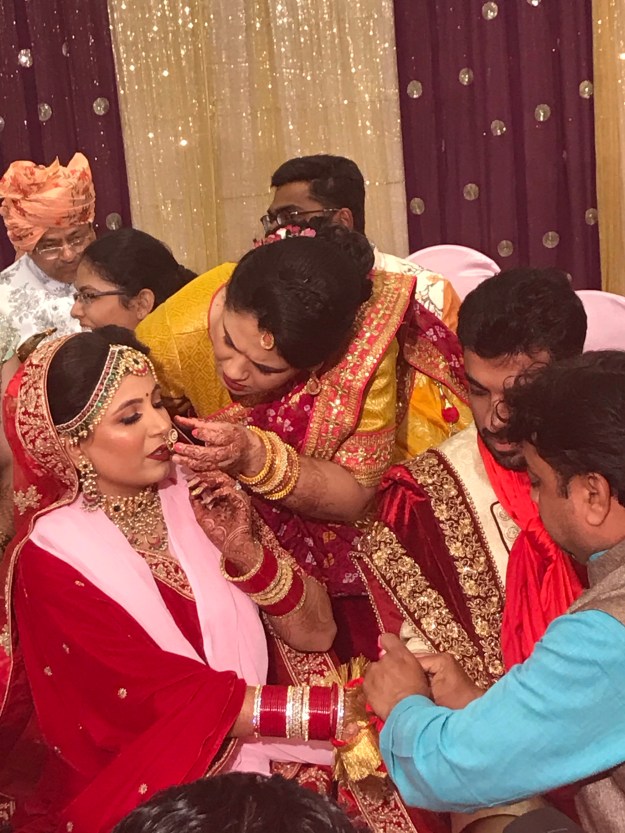
Our hotel is a magnet for such events and there has been a steady stream of wedding activities. This has given me an excellent opportunity to interview some couples from the most recent one which involved a betrothed pair in their early thirties from the cosmopolitan metropolis of Mumbai. Although in rural areas marriage takes place in the teens or early twenties, Indians from big cities tend to postpone marriage until they are well established in their chosen careers.

We watched the comings and goings for the preparation of day one of the marriage festivities and struck up conversations with friends and family members who all spoke English perfectly. They were smartly dressed and were obviously well educated. Immediately we were invited to participate.

I dove right in with my questions on marriage.

Hardik and Nainpreet proudly told me:

Ours is a love marriage. We’ve known each other for twelve years and have been married for six. He is Hindu and I am a Punjabi Sikh

I asked if this had caused any problem with their respective families.

One day Nainpreet rang to say that her family wanted to meet me. I asked when that would be so I could arrange for my parents to accompany me. She said “RIGHT NOW, and ALONE”. I quickly showered and changed clothes and went right over. I was very nervous, but I had prepared a small speech to win them over. When I arrived and opened the door, the room was covered like wallpaper with people. I was then ushered into another room where the important decision making elders were seated. I gave my speech. Your daughter was my first girlfriend and will be my last wife. I guess it worked because he we are!
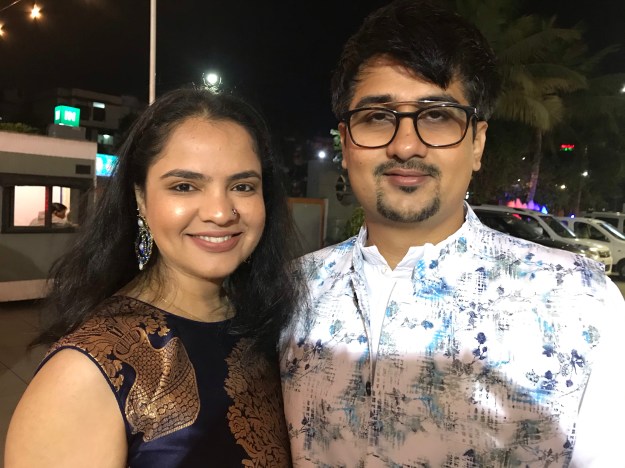
Hardik and Nainpreet

Nikhil and Deepali’s wedding had been arranged but they had a year to get to know each other. The parents had a list of eligible partners and both the prospective bride and groom had the right of refusal. They seemed well suited.
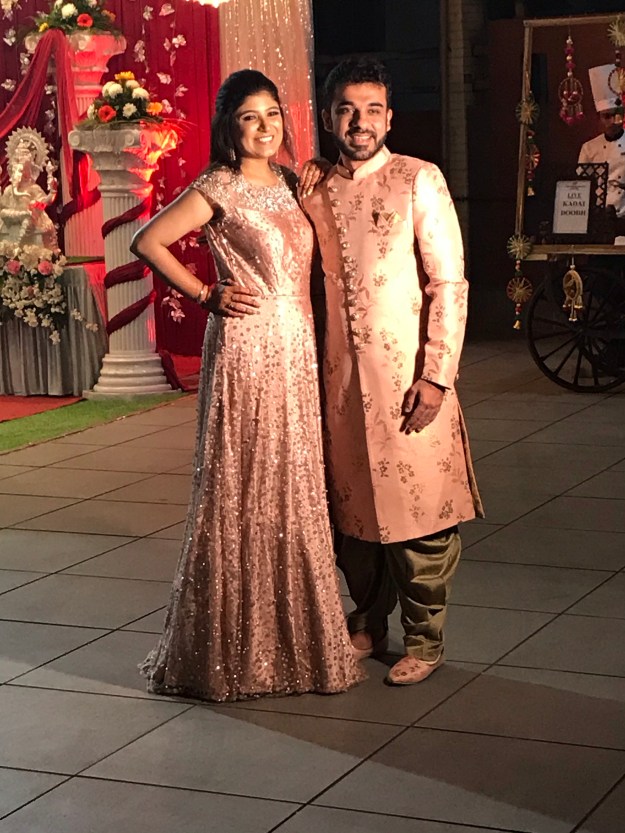
Nikhil and Deepali

I remember vividly the discussion I had some years back with two young people I had gotten to know at a travel agency I frequented in Udaipur. At the time I was doing casual research on the phenomenon of arranged marriage. Laxshmi was almost thirty and told me she would prefer not to marry at all, but the pressure was too great and she would have to give in soon. She had already refused several acceptable matches. Abishek was thirty two and had been unhappily married for ten years to an uneducated village woman. He only met her the day of the wedding.

We have nothing to talk about. I hate going home. She is not a bad woman. We have three children and she is a good mother, but I am bored.

I could tell that something was going on between him and Laxshmi although they were very discreet. It was a difficult and sad situation. I saw on Facebook, many years later that she did indeed get married and had a son.

The more contemporary version of arranged marriages is not so very different from online dating and matchmaking, except that in India the whole family is involved. Divorce is still rare but does exist and can be a way out for an abusive or particularly mismatched couple.

The institution of marriage in India, although constantly evolving, remains one of the most complex social systems in this beguiling country.
The Last Theyyam in Kannur

The alarm goes off at three in the morning and I jump up quickly and quietly so I don’t wake up Gerald. He insists it is not early morning but the middle of the night, and has decided to forgo this last Theyyam ceremony before we leave Kannur.
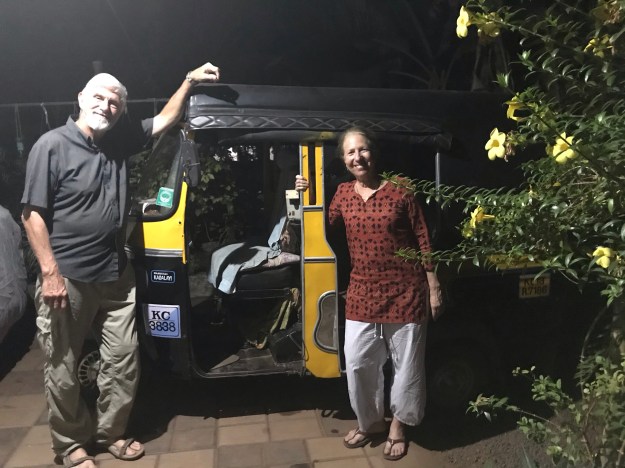
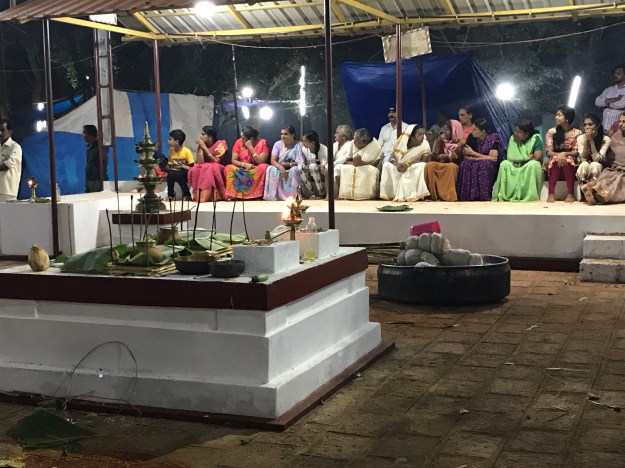
Vineeth, my trusted rickshaw driver and guide is already waiting for me outside. I put my pink cloth carry bag on the seat and off we go.

What’s in my bag? A banana and some biscuits, my camera and telephoto lens, iPhone, and last but certainly not least, a handy water spray bottle which brings down my body temperature quickly when the steamy tropical heat threatens to break my resolve to remain any longer.

The temple I am going to today is only 17km away but it not a paved road so I have no idea how long the journey will take. I ask myself if I should try to sleep on the way and I lie down in a fetal position on the plastic padded bench seat in the rickshaw.That idea is quickly abandoned after the first few bumps.

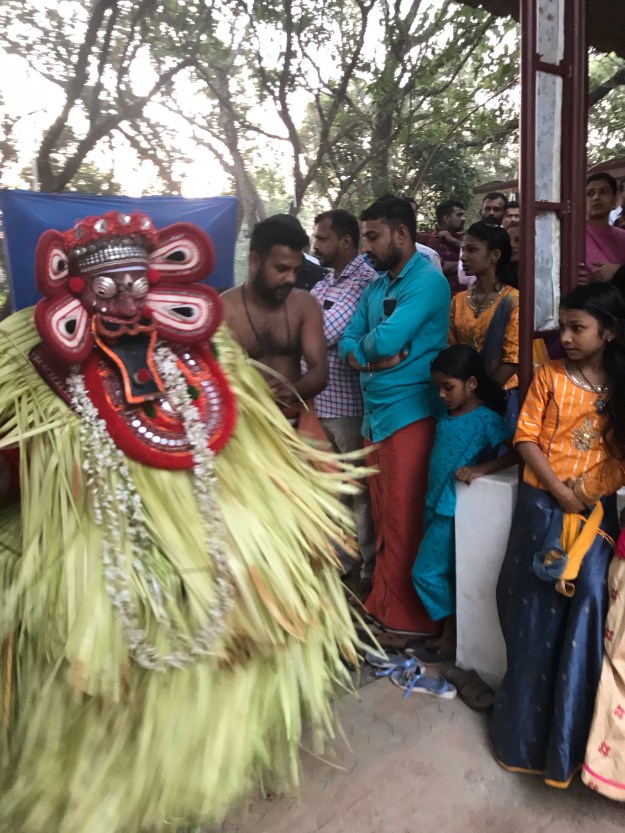
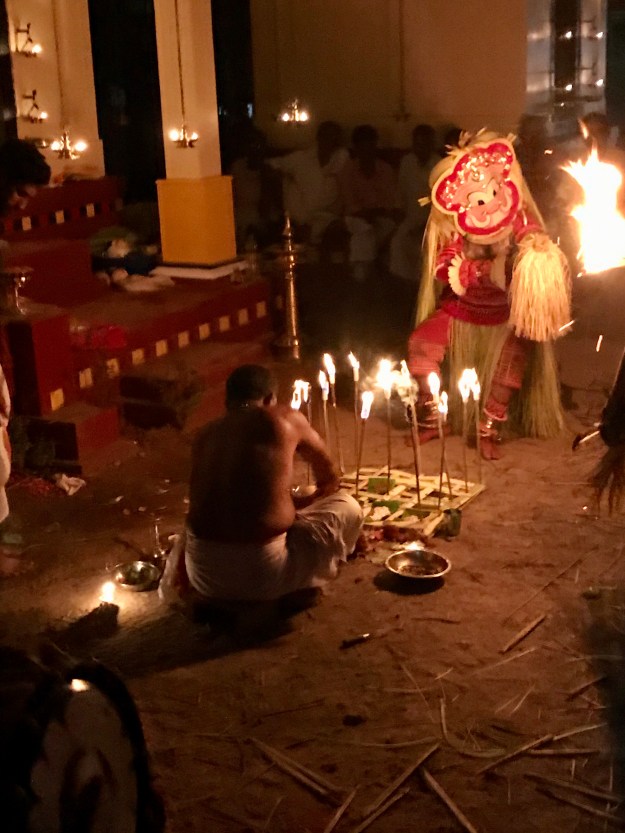
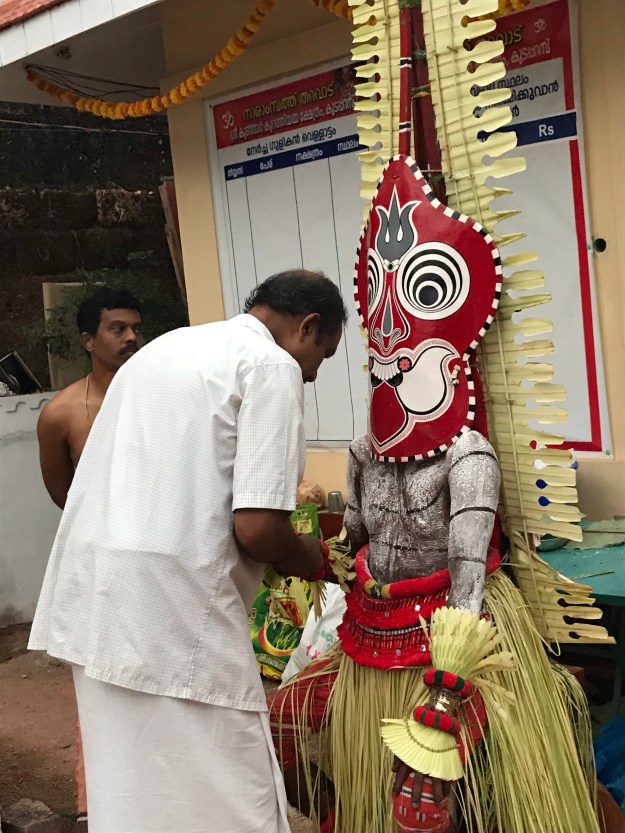
Forty minutes later we arrive and Golikan, the first deity, is making his appearance. The priest motions for me to wait until the blessings for putting on the mask are finished before I take any photos.I have seen this deity at other temples but this performer is more engaged and active than the others, walking on stilts and leaping around the courtyard wildly.

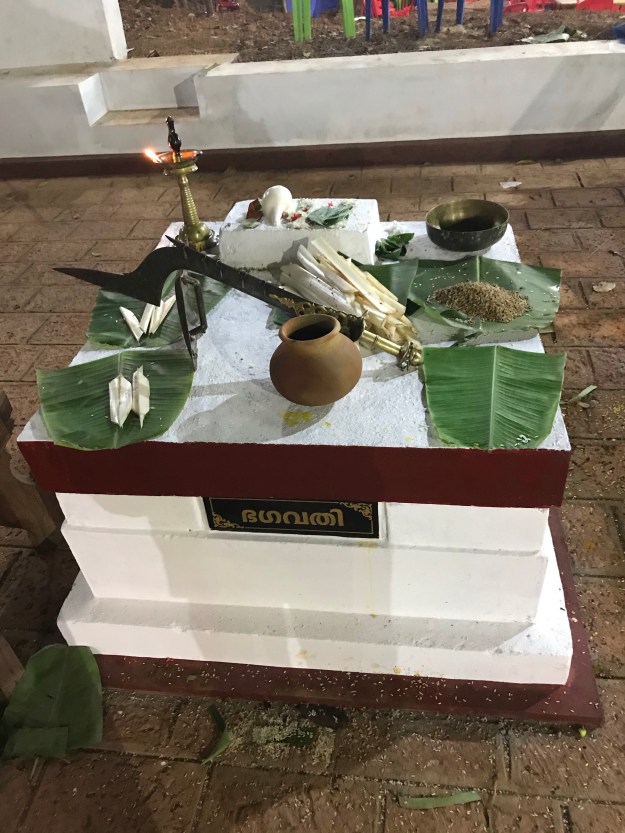
This temple is an older one dedicated to Shiva, and there are small shrines with offerings of rice and coconut.

Quite a crowd has gathered by now and there is an informal men’s and women’s section for seating.

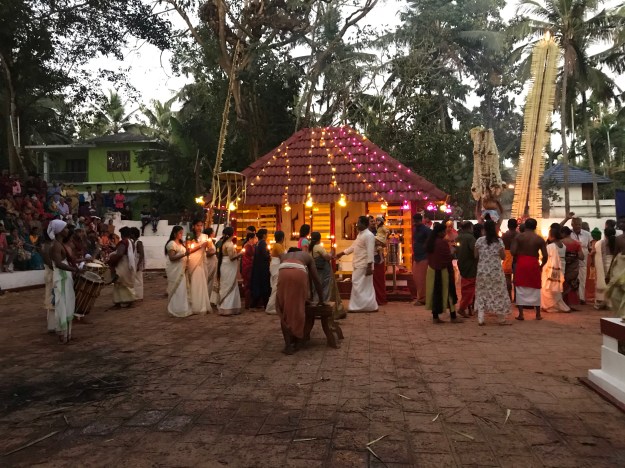
Beautiful traditional Keralan white silk saris banded with gold are worn by the older women, who have brass oil lamps which will be lit and blessed by the spectacular fire dancer deity who will be performing later.

After the first three Theyyam have finished their performance there is a break. Seated on small thrones in the courtyard the Theyyam bless the villagers as they line up. Meanwhile, a loud speaker is advertising services by companies who have sponsored this ceremony. and like all things in India, is at high volume.

An aura of anticipation and excitement is in the air as we await the entrance of Agni Kandakarnan, the son of Shiva.

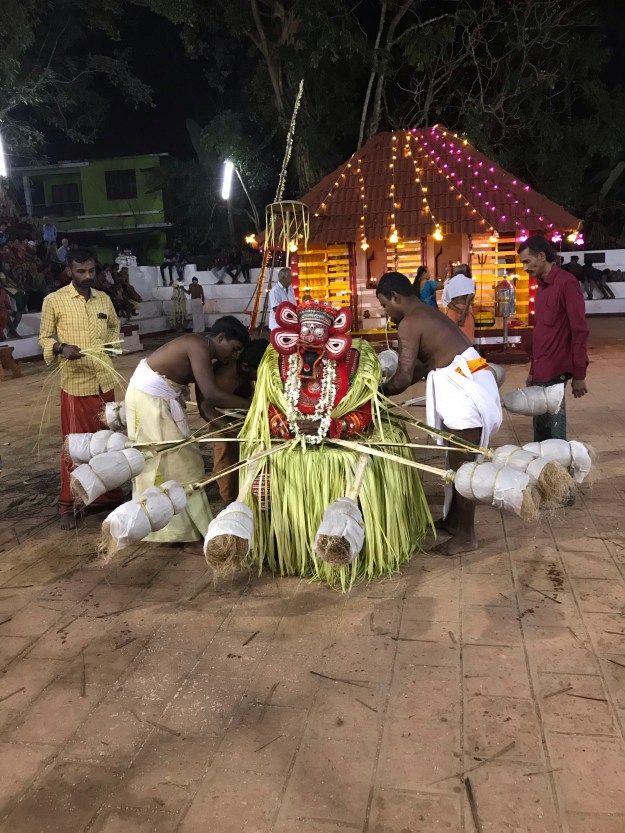
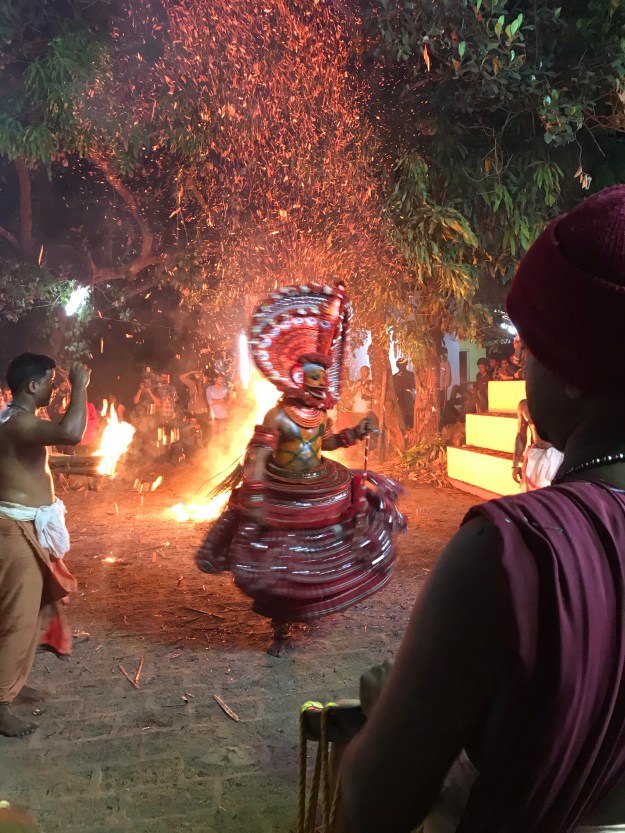
I am seated directly in front of the temple so that I have a prime view of the entrance of each deity. Agni Kandakarnan arrives and the temple attendants place the eight poles, each with a torch at either end, around his young coconut leaf skirt. When they are lit there is an audible hush and then a gasp.

Each time Theyyam is performed, even if it is the same character, there is a sense of unpredictability. On this particular occasion it is both terrifying and playful. As the fiery Theyyam spins around, spreading balls of flames on the ground he is yelling angrily, running through the stands, stopping now and then to bless a man, woman or child. Then just as suddenly he leaps up to where a gaggle of young men are seated and grabs someone’s cell phone.

He runs around gleefully and mischievously displaying his prize, until he finally gives it to one of the drummers. The owner of the phone runs hurriedly to retrieve it.

By now the sun is rising and Vineeth has to bring his daughter to school and signals to me that it’s time to leave.

I arrive back at the guesthouse exhausted, exhilarated and unable to speak.

I will be forever grateful to my dear husband Gerald, who introduced me to India sixteen years ago. I could have never imagined what a profound impact it would make in my life.

In the Line of Fire/Between Man and God

Theyyam– An individual attaining a divine state of existence as a living god and morphing into a power that provides solutions for mans mental and physical problems is something that sets Theyyam apart and above all the other ritual art forms in India. –Shreekanth Trikaripur

To say that I am obsessed with Theyyam would be grossly understating my relationship with this unique ritual, and the emotions that I experience in its presence. During a visit to Cochin on the Malabar Coast of India in 2014, I first became aware of this annual ceremony that takes place in northern Kerala between November and April .Since then I have been returning to Kannur every two years . What can explain the magnetic draw which compels me to leave my beautiful guest house before sunrise every morning at three-thirty and again at six in the evening.? The unspoiled stretches of deserted beaches which draw visitors to spend days on end lying in the sun, only vaguely aware that such a powerful event is happening so close to them, is not my first priority. (Although we do enjoy a long walk and swim after returning hot and sweaty from the morning Theyyam) Is it the intense drumming that pulsates through my body as six or seven drummers vigourously pound out the rhthms that will help induce the trance that the Theyyam will experience in order to inhabit the body of a deity? Or is it the depth of emotion that can be seen and felt as the villagers approach the deities for blessings and advice, truly believing with all their heart that they are speaking directly to a god? Or could it be the gracious welcome with which the locals accept strangers and non-believers to this very intimate and emotional observance? I think it is all of these.

The ceremonies are a way for villagers to receive blessings for their temples and to consult directly with a god who can answer their questions and offer advice. They take place before sunrise and sunset in the courtyard surrounding a village shrine. There is a strict regimen to be followed for the Theyyam performer,-the prayers, face and body painting and the costumes. I arrive early so I can watch the preparation of the performers and become immersed in the entire process. Enormous physical and mental stamina is required both to wear and dance in the costumes, which can easily weigh fifty pounds or more, and to withstand the heat of the fires that some of the deities will endure. This tradition is passed from father to son, and although some of the thirty-five deities represented are women,performers are always men.

These rituals are being transformed with the changing times. At the weekend ceremonies there was a contingent of big city Indian tourists with expensive cameras around their necks, pushing and shoving their way to the front, blocking the view of others. They were more interested in getting that one “great shot” than the sacredness of the moment. A French woman held her selfie stick which went off with a flash in front of the eyes of one Theyyam in the midst of his deep concentration to achieve the trance like state necessary. Theyyam ritual is not a performance and should not be reagrded as such no matter how elaborate or spectacular it may be. I have heard talk of a tour company wanting to open a theater and bring in paying tourists to watch the “spectacle”. This purification and benediction ritual can only be experienced in its original venue with the local community. If it is isolated and performed out of context it loses its significance and power. True performers are dedicated to their roles as bearers of tradition and will perform only in kaavus (village temples).

Will the next generation of young men continue to have interest in maintaining this tradition or will they be lured into working in Abu Dhabi and Bahrain where many of their contemporaries go to earn high salaries?

My prayer as I leave Kannur is that this beloved ritual survives in its pure form for many years to come.

NB: For more information on Theyyam you can read some of my previous blog posts- Bonfire of the Deities, Burning Man Kerala and Seized by the Gods

A Tale of Two Nuns

Sonam Laamu

Sister Helen


-Sister Helen

India has long been a magnet for those seeking a spiritual path. My travels have exposed me to varying degrees of religious fervor, which has been a source of  both wonder and enlightenment.

I shared a sleeper compartment with Sister Helen while traveling from Goa to Kerala. She wore a light colored Salwar Kameez ( a traditional tunic and pants set worn by Indian women) and looked very much like any other middle aged Indian woman.By the time Gerald and I arrived  she had already been on the train for twenty-six hours, coming from Mt. Abu in Rajasthan. I thought it odd that she was alone but it was only after we struck up a conversation that I found out she was a nun.

A traveler in Asia gets used to the typical questions asked of a stranger “Are you married?” “Do you have children?”When I asked those questions of her, she pulled out a large crucifix hanging on a long gold chain that had been hidden underneath her Dupatta (shawl) and said “I’m a nun.” She went on to clarify that she was a “sari nun”, one who wears traditional Indian clothes rather than a habit. The Salwar Kameez was her traveling outfit because it was more comfortable for train travel.

That same evening upon arrival at our guesthouse in Kannur, a tall European woman with a shaved head was sitting at the dinner table.Her burgundy and orange robes revealed that she was a Tibetan Buddhist nun. She introduced herself as Sonam Laamu (Goddess of Merit), the name given to her at ordination in Bodhgaya about a year ago.

This got me wondering. What motivates a woman to dedicate her life to religion? A desire to serve God, personal unhappiness or lack of fulfillment in their lives? Were they content with their choice years later? Two nuns in one day following divergent paths. Both had an ethereal aura of peacefulness and joy which was manifested in their serene smiles.

Sister Helen went to Catholic School and at a young age decided that she wanted to be a nun. I asked her if it was because of her devotion to God.

No. I knew I wanted to be a nun at fifteen but Daddy wouldn’t allow it. When I heard that nuns serve people and do good deeds I knew that’s what I wanted to do. My Daddy forbade it and said that I had to wait until I was twenty-one, finished school and got a job. He was hoping by then I would change my mind. But I didn’t and at eighteen I left home to join a nunnery. For four years he wouldn’t talk to me. That was hard.”

She has been a nun for thirty five years and is Mother Superior at a Catholic Girls schools in Mt. Abu. Educating young girls and giving them a chance at better lives is what brings her the greatest joy. When asked if she regrets not getting married and having children she answered quickly.

Not at all. Men are too much problems, and being with one man your whole life, no no. And children? I am happy teaching them but not having to take care of them. I have no regrets. I am living my best life.”

Soonam Laamu came to her decision much later in life, at age 30, after having lived a very normal life in Germany. On an earlier trip to Sri Lanka she first became interested in Buddhism. It was in 2004 when she went to India with a friend, after breaking up with her boyfriend with whom she had been living, that she became introduced to Tibetan Buddhism. The attraction was immediate.

I knew right away that this was for me. Tibetan Buddhism was the first type I encountered in my travels ,but it just clicked. I stayed in a nunnery in Dharmsala for eight years.”

In the interim she learned to read and write Tibetan. In Germany she was a Speech Therapist, and while living in the nunnery was asked to work with a young Tibetan boy who had speech impediments.

I asked her the same questions I posed to Sister Helen. Is there anything that you miss from your old life and how do your parents feel about your choice?”

It’s been fifteen years since I decided to devote myself to Tibetan Buddhism.My parents were skeptical and worried at first, I’m any only child. But now they accept it. I don’t really miss anything. I’m kind of embarrassed to admit it, but the only thing I miss is dinner.You see we only eat breakfast and lunch and sometimes, only sometimes, I wish I could eat dinner. Other than that I don’t miss anything at all.  I love being a nun.


“THE TRUTH IS ONE, THE PATHS ARE MANY”


Give Us This Day Our Daily Samosa

I dream about them at night and then fret that I may oversleep and miss out on being the first one in line at the shop.
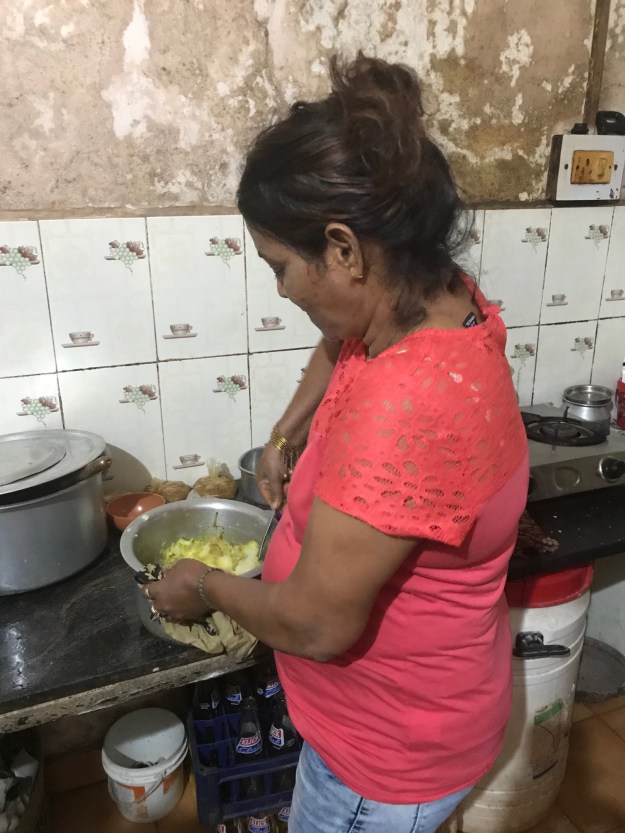
The object of my adoration is Frances’ wifes’ divine fish samosa.-best eaten hot before the frying oil has a chance to settle into the crispy dough. If I haven’t remembered to put in my order the night before, I’m SOL if I get there after 8:00 am.

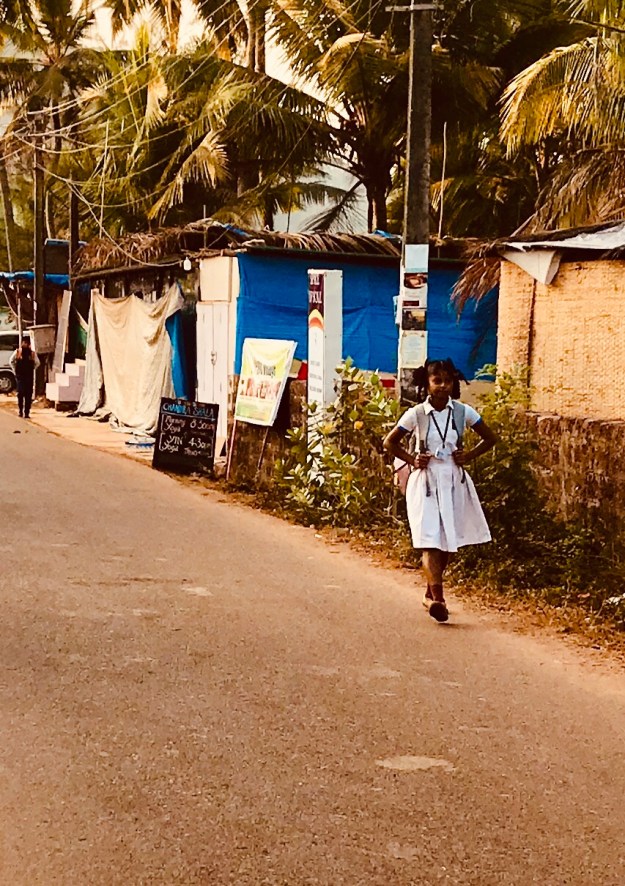
Schoolchildren clutching 20 rupee notes in their small hands scurry to buy a few on their way to Catholic school in the morning.

I savor each bite lovingly as I make my way leisurely through the village to meet G at the beach for breakfast. I’ve bought four of them for us to share, but the chance of having any left by the time I reach my destination is slim.

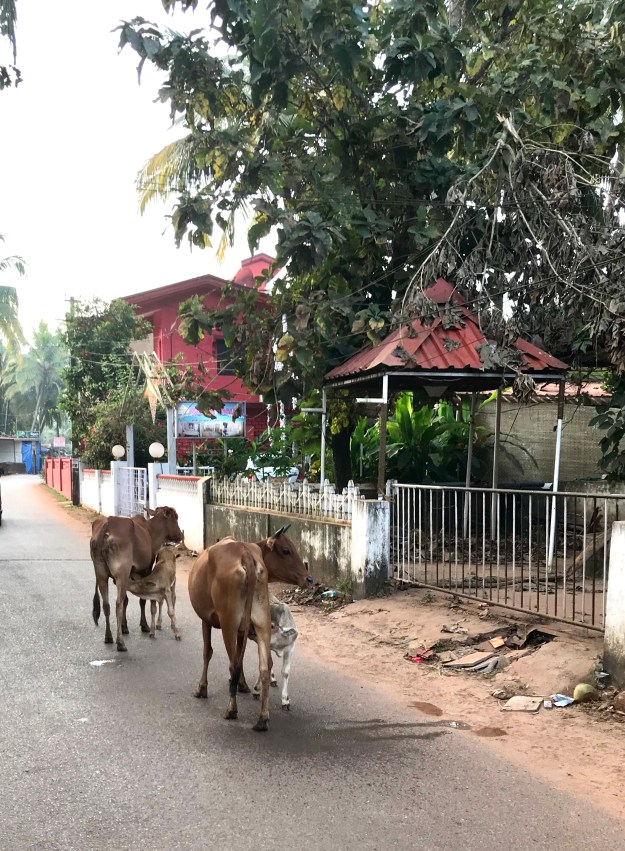
I love being out in the early morning before the sleepy village starts to come to life. Young girls with long black hair neatly braided in loops like pretzels,walk briskly in their freshly starched white uniforms, not wanting to be late for school and risk the ire of the schoolmaster. Motor scooters zip by while cows roam lazily in the middle of the road secure in the knowledge that no one will disturb them no matter how pesky they may be. ( Even in Catholic Goa cows are sacred).Today there are two cows busily nursing their calves.

On the way back I pass barber shops, not yet open, advertising the latest Bollywood hairstyles for men. There will be lines later as hair seems to be an important fashion statement.)

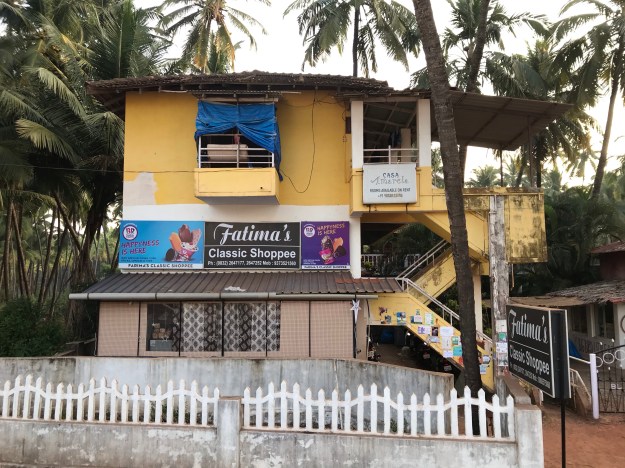
Brightly painted homes double as rooms to rent and Beach Huts display sign boards with menus, (often with funny spelling errors).

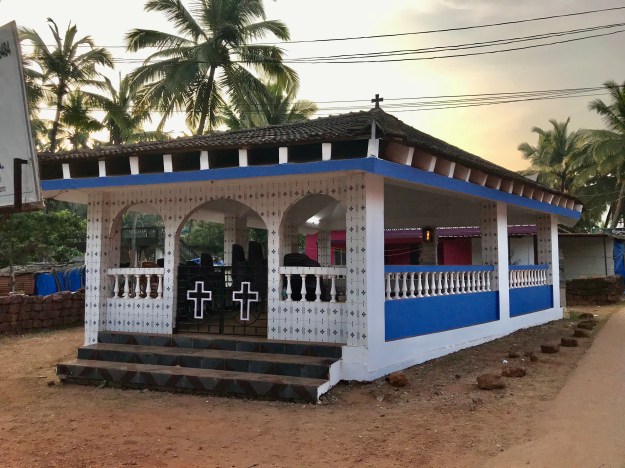
In the center of the village is a Gazebo for local celebrations. The church plays a major role in all social activities.

I arrive at the beach just as the shimmering warmth of the day is beginning to make its presence felt. G is ecstatic that I haven’t eaten all the samosas and that I’ve saved some for him, knowing what incredible self control that took.

Even the dogs appreciate the pungent aroma and sniff around wildly, following us to our seats and not leaving until they are sure that all the food is gone.

Trouble in Paradise/The Turtles are Coming

It’s chaos now in Agonda. What with the new Turtle Nesting Legislation and the 28% tax! Nobody knows what is going to happen. – Terry Fernandes, owner of our resort

Agonda beach in Goa has been our secret retreat since we first came here ten years ago. Most savvy travelers eschew Goa because of its reputation for overcrowded beaches,noisy bars and general mayhem. But Agonda is different. It is a small fishing village made up mostly of descendants of the masala mix of Portuguese and Indians. Its quiet calm and absence of discos and nightclubs is the major draw for Indian and European visitors looking for a peaceful escape. There is an easygoing balance between the locals and the tourists.

Last year it was discovered that some Olive Ridley turtles had nested on the beach. Each of them lays hundreds of eggs between November and April and the incubation period is forty to fifty days before the babies can swim out to sea. The government decided to set up “Turtle Nesting” zones for eventual development as tourist attractions and enacted legislation prohibiting any and all structures within two hundred twenty meters (about 700 ft.) of the shoreline. Marine turtles are considered “vulnerable species and have the highest protection status.”

Agonda’s economy is primarily based on tourism. Local merchants protested to the government and managed to get a temporary stay order. If the stay is overturned Agonda will effectively cease to exist, as almost all of the lodgings, stores and restaurants are within this arbitrary boundary, and will have to be razed.

I saw no signs of turtle nesting anywhere on the beach and the constant zipping around of the beach patrol truck certainly doesn’t do much to show that the government is serious. It is astonishing that they would imperil a flourishing community.

Living in California I have the utmost respect for environmental protection, but the priorities seem a bit lopsided in a developing country like India where human needs are overwhelming.

After our exhausting thirty six hour journey we experienced some initial disappointment at the changes in our beloved beach experience. We were saddened to hear that our favorite chef and friend,Frances,was in a motorcycle accident and was was forced to close his restaurant where we dined nightly. (Notice that I say “dined” not ate- he was a master chef and a true artist in the kitchen and I looked forward to his nightly creations.) The political demonstrations due to the new citizenship laws enacted by Prime Minister Modi, as well as the bankruptcy of the travel agency Thomas Cook have also had a major impact on tourism.

Our disappointment was short lived as the wonder that is India kicked in.

Last night was a “live music” performance featuring a father and his eight year old daughter, Meghan,visiting from Bangalore. While he calmly played the guitar, this diminutive energizer bunny belted out “Purple Rain” and “This Girl’s on Fire”. She was enthusiastically enjoying the attention of being in front of a crowd of appreciative listeners. She was cute and she knew it.

When her set was over she came over to the table where I was sitting with a young Belgian couple because she saw me mouthing the words to a song her Dad was singing. “How do you know the words?” she gushed. Satisfied that I knew a bit about music she then started jumping up and down, flicking back her long black hair like an MTV diva, and proclaimed “I want to be a singer!” Dressed in a pink flowered jumpsuit her attitude belied her eight young years, and she didn’t stop jumping for an instant. I asked her how long she thought she could keep on jumping up and down and her response came quickly with a mischievous smile- “Forever”.

The audience was made up of first time visitors to India, long time expats as well as young and old Indian families.Everyone was having such a good time that we didn’t care if sometimes her voice didn’t quite hit the right notes. This sense of family and community is the Agonda that I love.

Thankfully the old adage “The more things change, the more things stay the same” proved true.