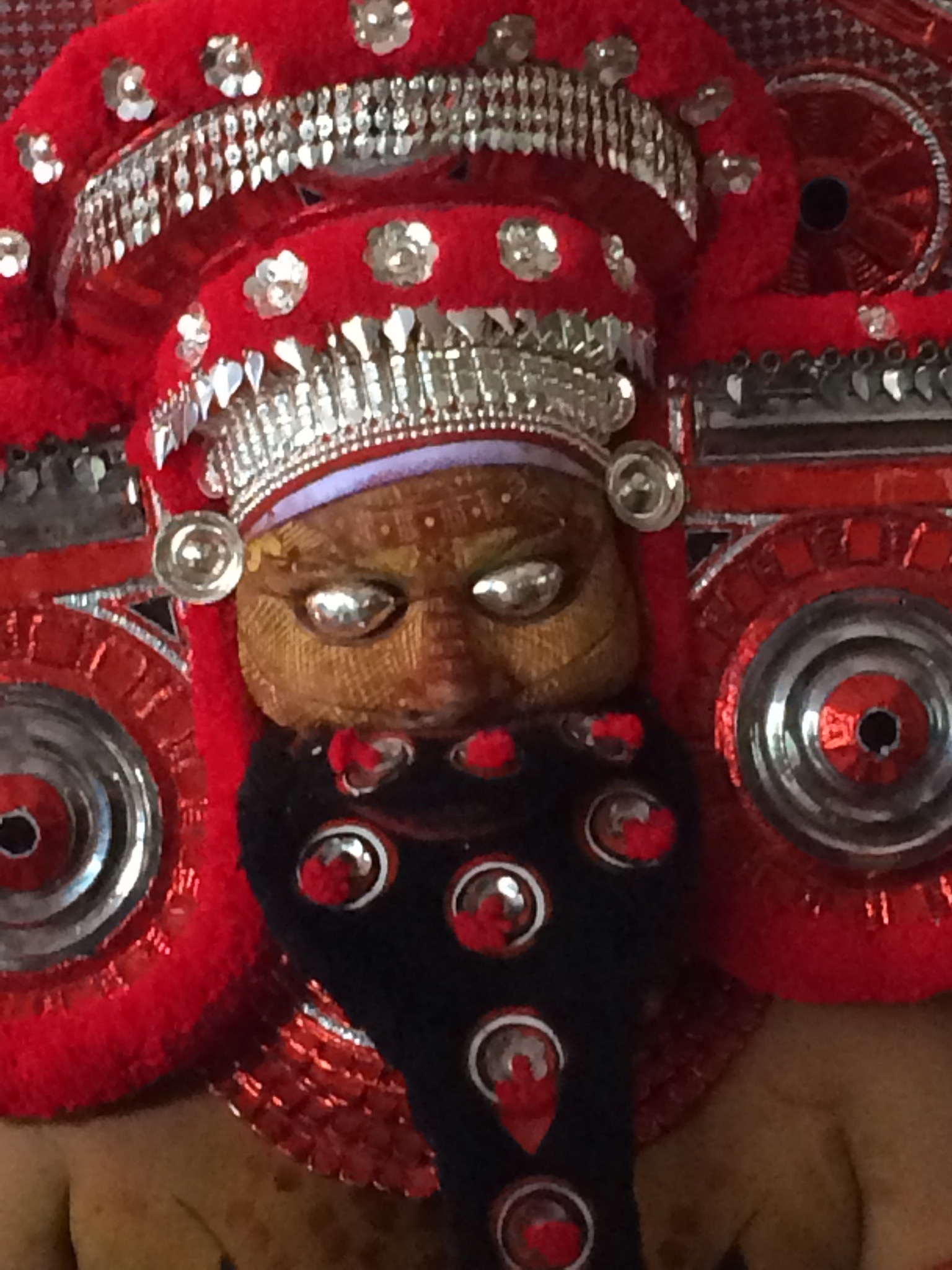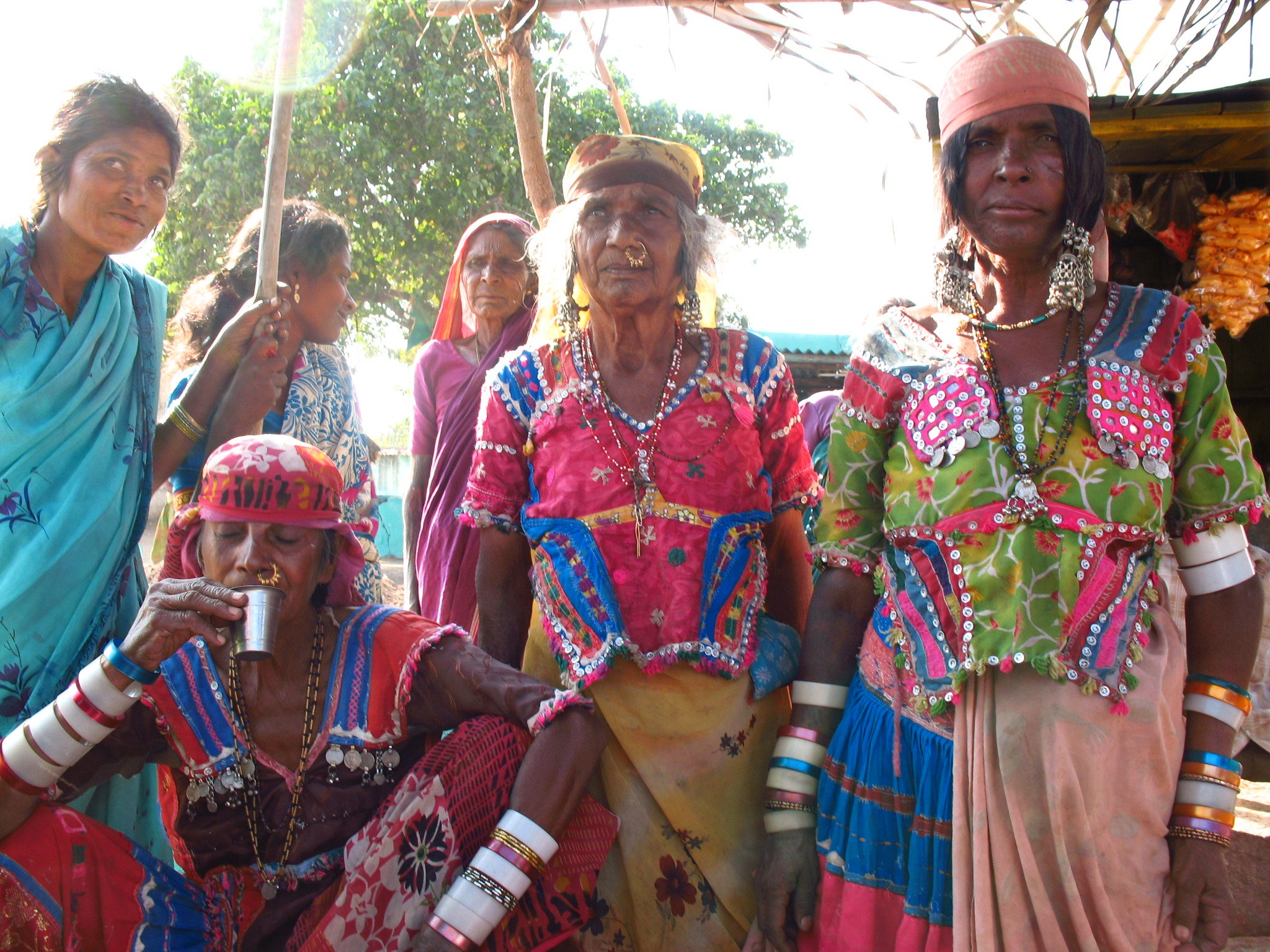
Author Archives: jazzyfille

Unknown's avatar

About jazzyfille

A distant drumbeat, powerful music, a religious procession, and the pungent aroma of spices......all beckon me to distant lands and I follow, jubilantly and expectantly with a sense of wonder at the beauty of life.

Thursday’s Children

Monday’s child is fair of face,

Tuesday’s child is full of grace,

Wednesday’s child is full of woe,

Thursday’s child has far to go

Friday’s child is loving and giving

Saturday’s child works hard for a living

And the child that is born on the Sabbath day is bonny and wise and fair and gay.

caption id=”” align=”alignnone” width=”538″] The community Center at Manav Gulvar[/caption]

The  classroom is bright and airy, a ceiling fan is turning slowly, and the children are seated on the floor in two rows, one against each side of the wall. Eighteen pairs of shining, black eyes follow us as we move through the space, getting the room ready for today’s project.  There is a hushed silence that feels like being in a church; each word we speak, each gesture we make, is observed with intense concentration by the children. We decide to make an accordian book of buildings with the children’s collages.  Five, ten minutes go by and I notice that no one has put anything on their board yet.  Nilam, the teacher, pulls me aside. “The children have never seen a real building, so they have no idea what to draw.  All they know are the small shops in their community.  I told them to just draw their favorite shop.”  I am stunned,speechless.  It never occurred to us that this was beyond their scope of experience. Gerald, whose heart is bigger than his size, is forever the optimist.  “Just wait.  Give them a chance, they’ll come around. All they have to do is look outside the window and copy the shrine or mosque, I’ll get them started.”
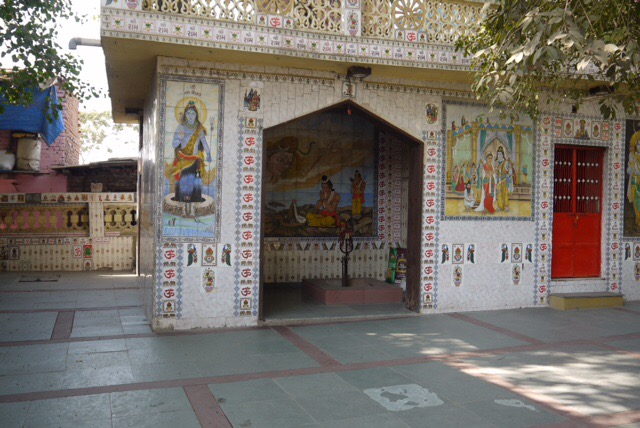
Hindu shrine in the community center
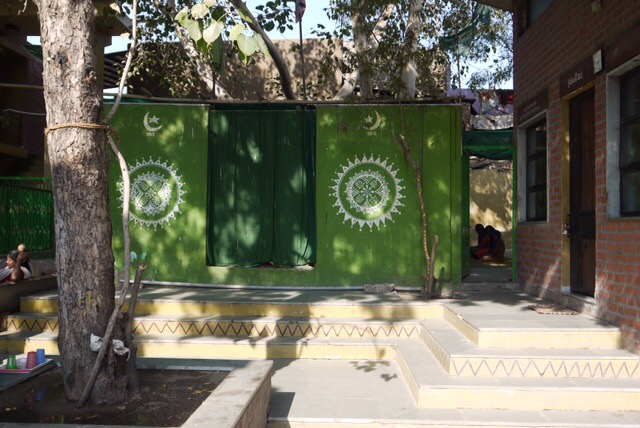
Mosque in the community center

Bea, one of the Spanish volunteers is in the room with us, as well as two Indian Americans who are there to translate from Gujarati.  None of the children speak either Hindi or English. We  go to each child and gently prod them to pick from the beautiful selection of colorful hand made papers we have brought with us, and paste something on the board. They are more comfortable with rulers and erasers and pencils, freedom is a luxury they have not experienced.

One of the older girls,Monisha,has already started to paste papers on a Hindu Shrine she drew.  Soon the others follow suit, some more slowly than others, but all becoming engrossed in the work.  Two small Muslim boys motion to me to come to them.  I don’t quite understand what they want from me,but the adoring look in their eyes has me almost in tears.  I think they want me to help, so I cut up some shapes and give it to them for their Mosque.  As Nilam passes by I ask her what they want.  She says they think I want them to put these shapes on the board, and they don’t want to do something wrong!


Two hours pass by quickly.  Children from other classes peek inside, smile, shake hands, give hugs, and even another teacher comes to join the project.  Bea and I decide to entertain them with Spanish songs.  I only know a few lines of “Malagueña” and “La Cucaracha”- but it does the trick.  They are all holding their bellies and laughing,shrieking and rolling on the ground in glee.

It is amazing for us, even after six visits to India, to be reminded how cut off some of the locals are, even in big cities. For a few hours a day, these children exist in a safe, protected, joyous and loving bubble. Maybe they do have “far to go” but it brings to mind Mother Theresa’s words

We can do no great things, just small things with great love
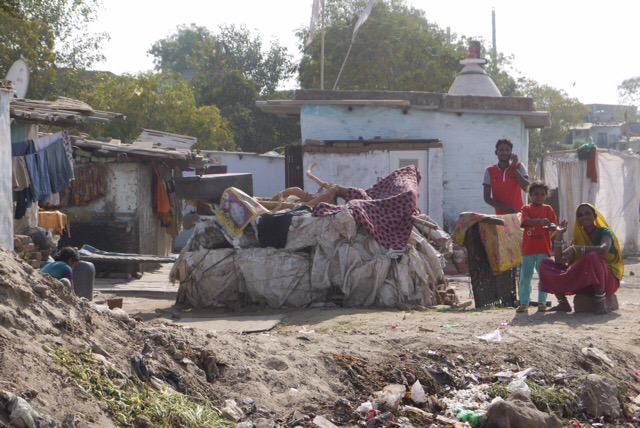
Gulvar slum

A very happy group with their finished project

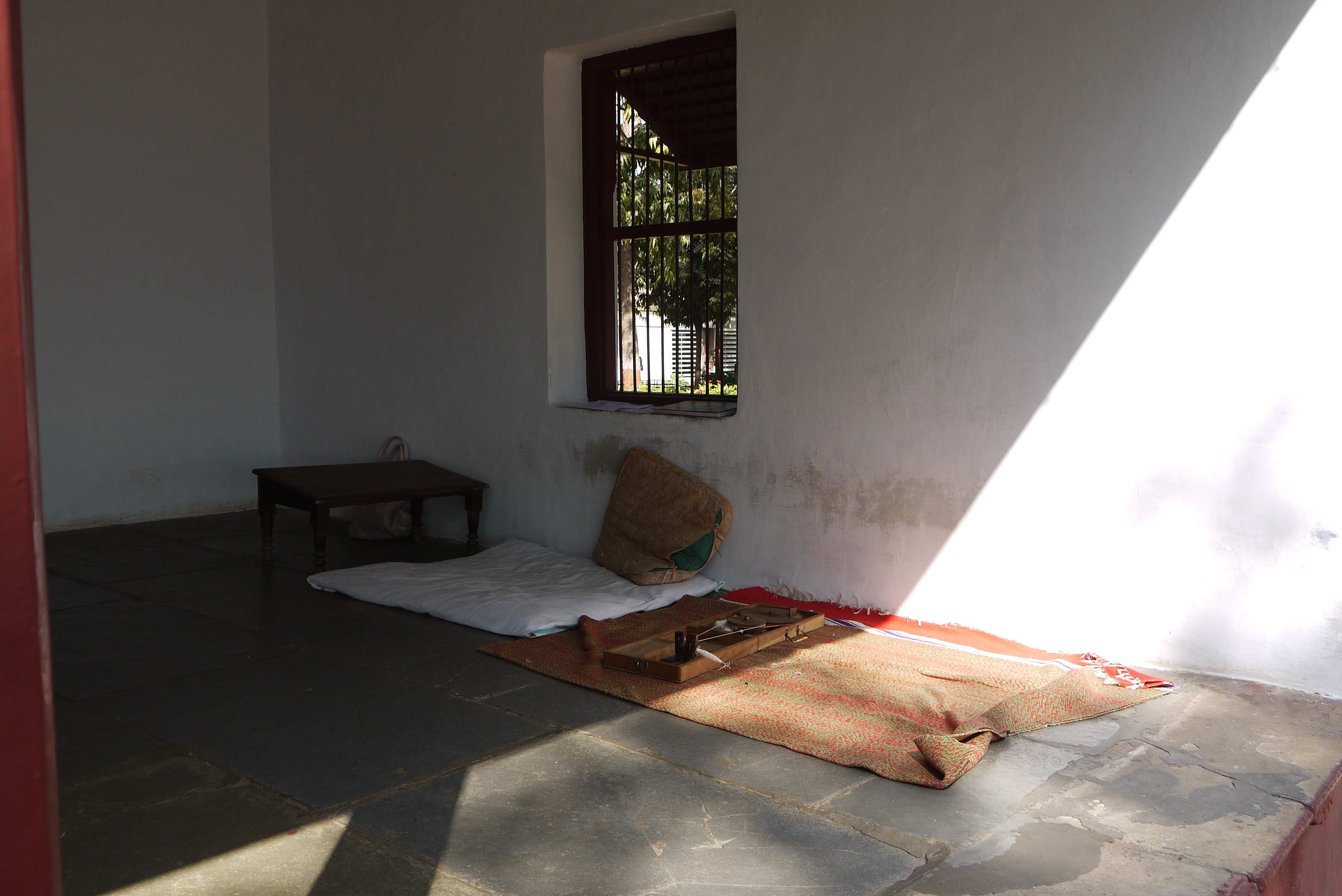
Gandhi’s Dream is Alive and Well in Ahmedabad 

  It’s been almost two weeks since we started working at Manav Sadhna, a non governmental organization (NGO) located on the grounds of Gandhi’s former ashram. I’ve struggled to put my feelings into words. This has probably been the most difficult project we’ve worked on to date. A feeling of love and  compassion envelops you upon entering the ashram grounds, but the world outside is difficult to digest.  The negative things that people fear about visiting India are abundantly evident in Ahmedabad- the pollution, the poverty, the congestion, the beggars and the chaotic nature of a metropolis that is overpopulated and under developed.  We have never stayed long in big cities because of this, but were moved by the work we saw being done at Manav Sadhna last year.

The scope of the organization is mind boggling, and every program is organized in keeping with Gandhi’s principles of loving kindness.   The original buildings on the banks of the Sabarmati river, where Gandhi lived for twelve years from 1918-1930, have been converted into a living museum.  It attracts flocks of visitors, mostly Indian,to relive a period in history that changed India and the world forever.

Gandhi’s living quarters

The banks of the Sabarmati River

Manav Sadhna- worshiping each individual as a service to God– was founded in 1990 based on Gandhi’s philosophy of “Love all, Serve all”. Walking through the grounds , the peaceful nature of the place  creates a meditative environment . Shoes are removed and left at the entrance of the main building , as a sign of respect.

Three women who work in the kitchen, sweep and clean the dirt and dust from the day before, as the entrance room fills up with  volunteers from around the world,many  of whom are  non resident Indians who have grown up in the USA . We  sit cross legged on a mat , and by now the workers have also joined the group. A tape plays excerpts from Hindu,Muslim,Buddhist,Christian and Jewish prayers, while the group bows their head in silent meditation. Each new volunteer is acknowledged with an introduction,drums, and a tikka (traditional red dot made out of vermilion paste)placed on the forehead.  A hand made paper garland is put around their neck.  In the center of a flower it says “Be the Change”, and each petal has one word written- “Beauty”, “Truth”, “Hope”, “Compassion” and “Love”. The volunteers talk about what they will be doing – teaching, arts projects,medical work,marketing,environmental, social welfare, women’s issues, etc. Many are repeat volunteers and have been coming for years-bringing supplies,skills and most of all,their complete dedication to the values of Gandhi.  And then everyone scatters to their respective projects.

Main entrance hall of Manav Sadhna

I am in awe of the work being done and the manner in which it is carried out.  There is a camraderie among the volunteers who work here in the various programs. Laura and Catherine are Pacific Islanders who live in California.Laura left a lucrative multi million dollar financial enterprise to start a charitable foundation. She is here to build homes in Nepal,Afghanistan and Pakistan. The lively contingent of five Spaniards have come for four months to do whatever is necessary, and organize yoga classes and silent spiritual meditation retreats. This weekend they are cooking  a Spanish meal for  Seva, a “pay it forward” cafe. It promises to be filled with music, laughter and lots of garlic. Ashish, a software engineer from Delhi, has come to set up a recycling operation as a profit sharing enterprise for some of the 40,000 women who spend their days scavenging the garbage dumps in the hope of salvaging enough junk to make a few pennies to buy food. We visited the program and felt his passion, as he described how each of the “sisters” is treated with respect,given health care, a fair price for their work, and a day (Saturday) which is reserved for some well deserved pampering.

Our work with the children has been mixed. The first group was very talented, and are employed doing part time work for the ashram, making paper goods to be sold at their retail store. Creativity and enthusiasm were both in full measure.  We were sorry to have to end our time with them and move to another group. The next class was at a brand new beautiful community center, built by a famous Indian architect deep inside one of the nearby slums. As we passed through the narrow lanes, with tiny, cramped cement block homes, feelings of sadness, despair and  wonder filled me. Living in these conditions is a daily struggle to survive, yet the smiles were bright and forthcoming.We visited homes where five or six people lived that were no larger than my bedroom and the walls were covered with mold and mildew.  Always we are offered chai, some snack, and as people wander in and out, it is obvious that family and neighbors are important and account for their incredible resiliency. What would be intolerable living conditions for us, is for them a daily reality.

It’s strange to feel “stuck” in our lovely hotel , rather than being out and about exploring the city,but all attempts  have been abysmal,frustrating and terrifying. Rickshaw drivers don’t seem to know where anything is, traffic is  at a standstill, and the belching fumes of exhaust are sickening.

Today was a great day. We worked at a new community center in a slum that is 60% Muslim and 40% Hindu.  To get there we had to drive on an unpaved road and then clamber up a dirt hill.  It was much poorer than the other two locations where we worked.  Again, the center was an oasis in the midst of extreme poverty. A Hindu temple and a small mosque were built  on the grounds., and this was an experiment in harmonious living between the two religions. The children obviously  had little previous outside contact and treated us as a curiosity.  It took a while for them to open up to trying something new, but then it was all smiles and creative energy. It’s really such a small thing we do with the children, a few hours of having fun and exploring new ideas- but they are so happy for the attention and respect.

Manav Gulzar slum

We finished the day by going to the Sabarmati Riverfront Festival, where Gerald had created and organized an interactive collage mural and an exhibition of the work done by the children at his workshops. Next week is the kite festival.

Manav Sadhna- An Oasis in the Desert

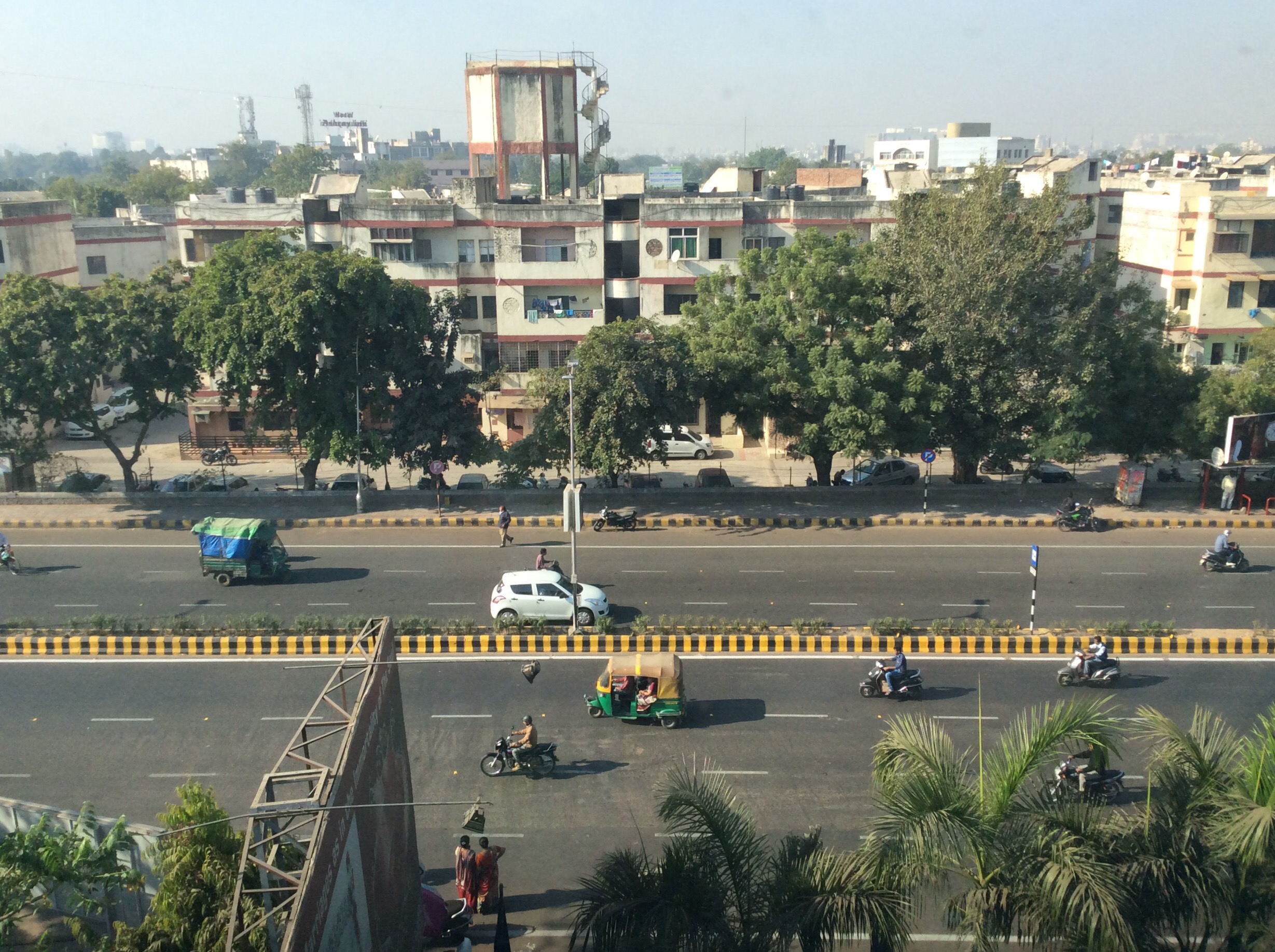
Early morning view from my window

Today is a day like any other in a big South Asian city. Early in the morning, just after the sun rises at 7 am, people slowly start to appear- on roof tops flying kites, hanging out the wash, sweeping dust off the streets-all without any sense of urgency. Streets are eerily quiet at this hour, since shops open  informally at 10 or 11- even the banks don’t open until 10:30. As the day progresses,Ahmedabad, the capital city of Gujarat,becomes increasingly congested, with auto rickshaws belching their thick smoke, ancient buses rattling along, emitting intermittent blasts of exhaust. And there there are the people- three million of them. Crossing to the other side of the road from our hotel is a life-threatening proposition.  Each day 382 people are killed in traffic accidents in India. There are occasional traffic lights, but they are a suggestion, rather than an imperative, and few drivers pay any attention.  “Challenge the motos not the cars” is Gerald’s mantra.

We’ve come here, not for the sights, but to volunteer at Manav Sadhna, an organization on the grounds of Gandhi’s ashram.  Their mission is to serve the thousands of slum dweller families who live in and around the city. Our first day, Christmas,is a typical Indian experience.  Sharish, the volunteer coordinator at the ashram, has sent us an email. “The children are doing a Christmas celebration from 3-6.. Do come and you can see what the children are like that you’ll be working with”.  However,when we arrive at the ashram it is surprisingly deserted.  A young woman tells us “Oh, Sharish isn’t here, he’s at the riverfront for the Christmas celebration.”  No one has thought to tell us that the event is not at the ashram. By a twist of fate we meet the director who is heading that way in a van.

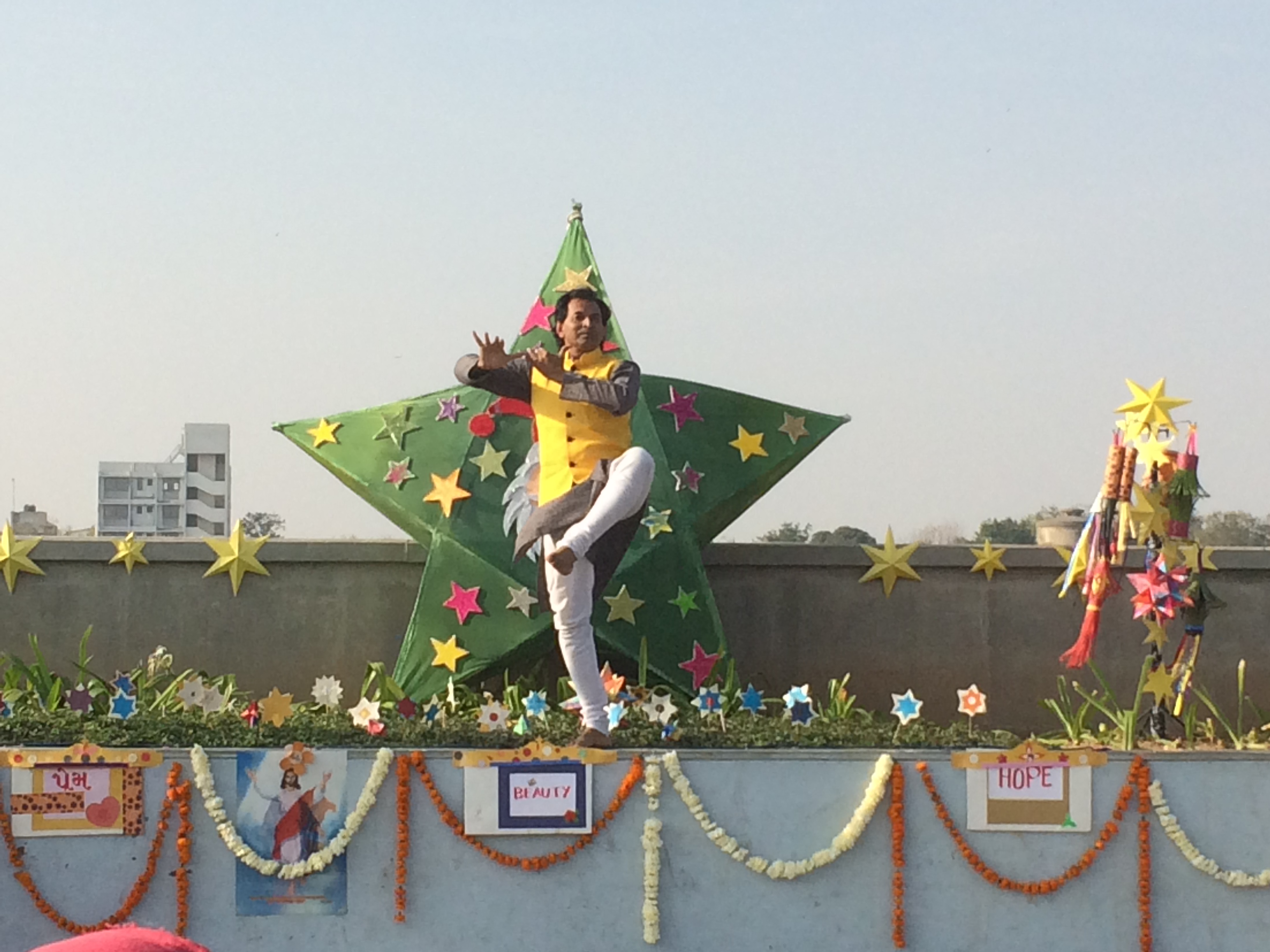
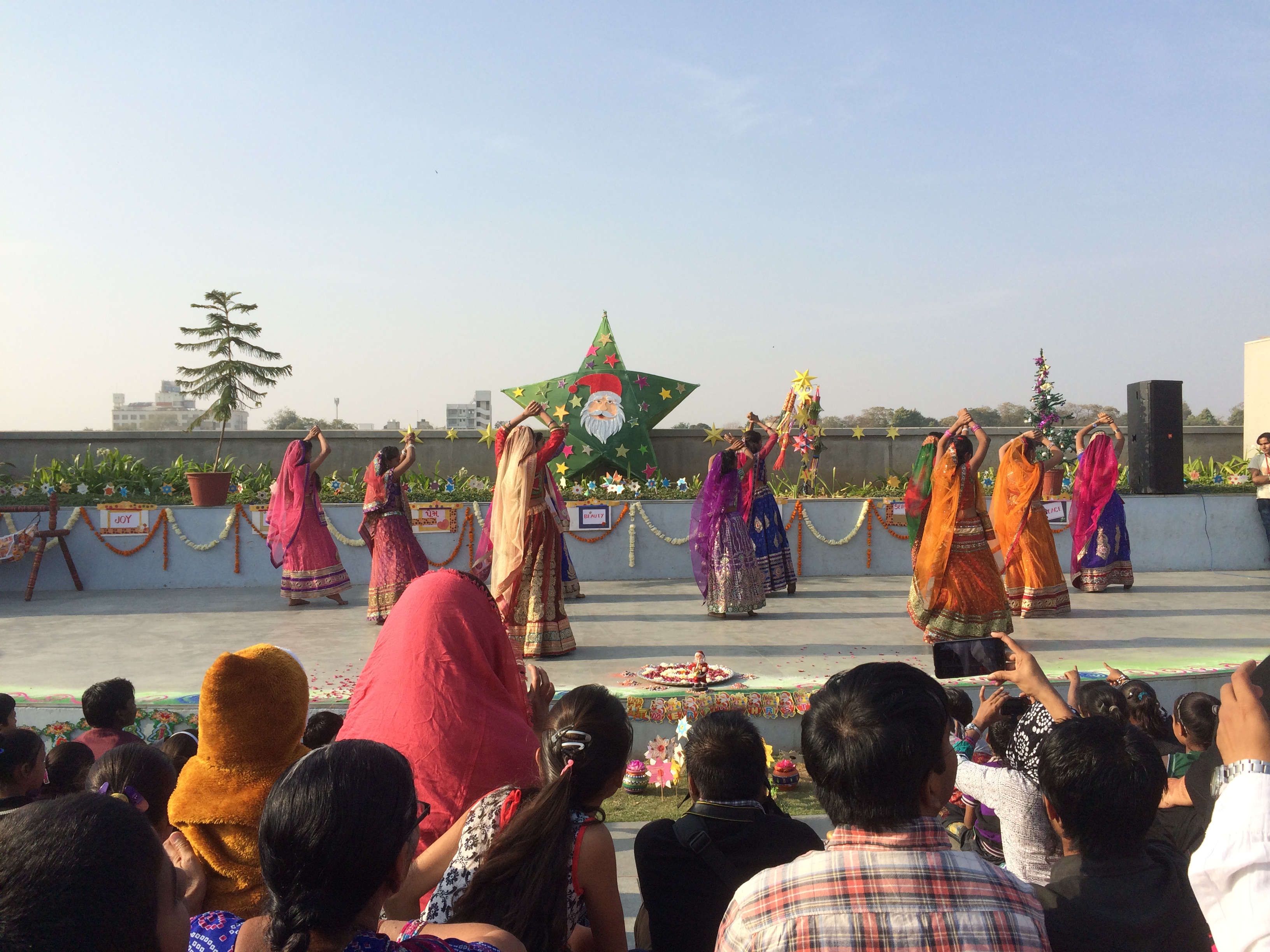
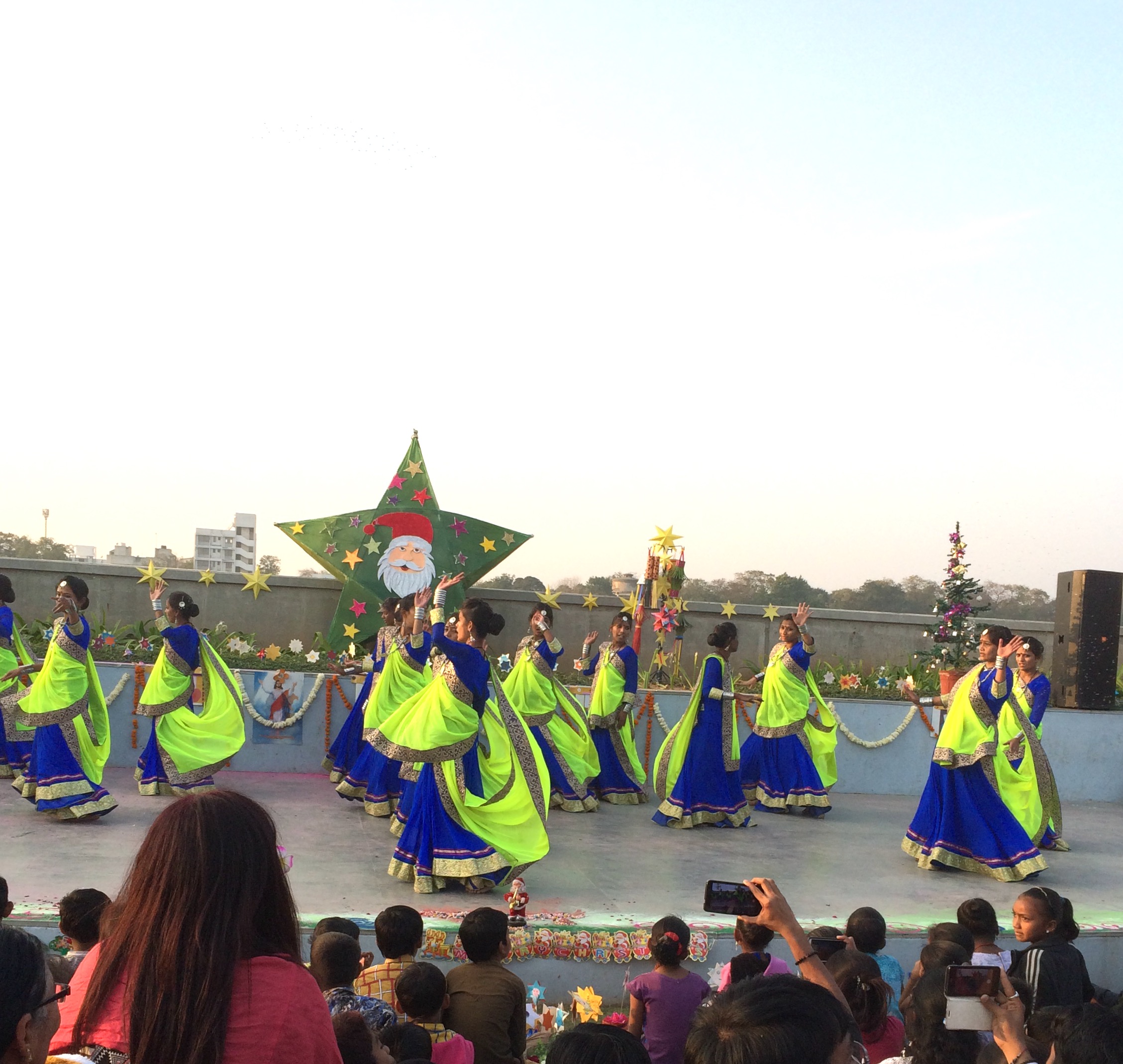
When we arrive at the venue there are easily a thousand people, mostly women and children, seated on the terraced concrete steps by the riverfront promenade. We are then introduced to Sharish onstage, and are shown to prime seats. These are children who spend their days scavenging garbage heaps looking for something they can sell for recycling. Manav Sadhna has organized recycling centers, cutting out the middle man and giving the women the money directly. By looking at the collected group you would never suspect their impoverished condition. Smiling, clean faces, groomed hair, and for the most part, nicely dressed. The show is amazing! Costumes have been rented and the dances are choreographed by an alumnus of the program- easily rivaling a Bollywood production. All this has been underwritten by a software company. An addendum to the program is a group of blind children singing and drumming.  Unfortunately there is only one microphone which gets passed back and forth between the drummers and the dancers, rendering each group mute alternately.

  1. imageimageimageAn auspicious beginning.

Bonfire of the Deities/Burning Man Kerala

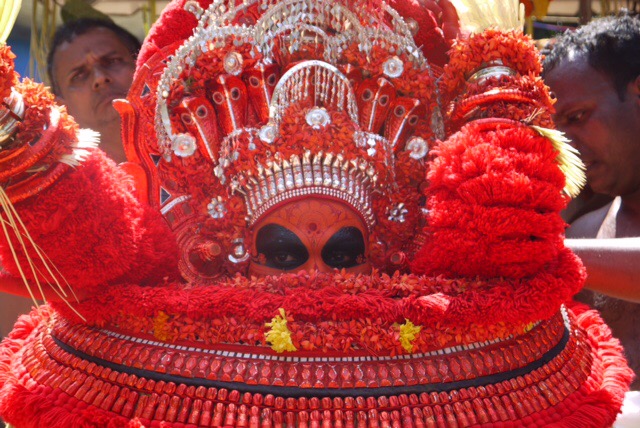
A bonfire is blazing as we arrive at the village at 4:30 am. The stage is being set for what will be the most spectacular Theyyam we have seen yet.  The Kavu, or sacred shrine,in the courtyard of a wealthy Keralan landowner, is the setting for a seldom seen fire dance.  The three day Pottan Theyyam he has ordered as a blessing for his family and their new home is an expensive undertaking, and I am thrilled that we will witness this event. Theyyam looks similar to the more famous Kathakali dance theater of Kerala, but it is a religious event rather than a performance for entertainment. These rituals take place once a year during the months of December through March.

As dawn begins to break on this second day of the ritual,the temple attendants, dressed in lunghis(wraps), throw in another log each time the fire seems to be dying down. Sparks are flying and I move some distance away so as not to have my carry bag catch fire.  We are with two other westerners, who have been staying at our guest house, Angela and Annette from the UK.

It is still dark and the sun will not start to peek through until 7:00 am. The four young drummers, who played so vigorously last night for two solid hours, are snuggled together sweetly in the spoon position, on a blue plastic tarp in the “green room” ( the sacred space for Theyyam preparation).


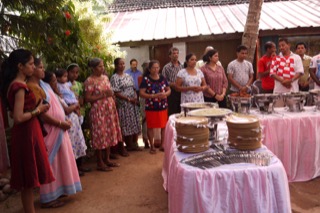
Enormous pots are boiling in the back area of the house where a festive meal is being prepared for the throngs of villagers  who will attend the ceremony.We are offered tea with a typical Keralan sweet, and an invitation to enter the house.

Theyyam performers traditionally receive money from each person who lines up to ask for a favor or prayer, or  to thank the gods for wishes fulfilled. Last night two men personifed different aspects of the deity,Golikan.  Today there will be four deities,including the famous Vishnumoorthi  who will perform the fire dance.

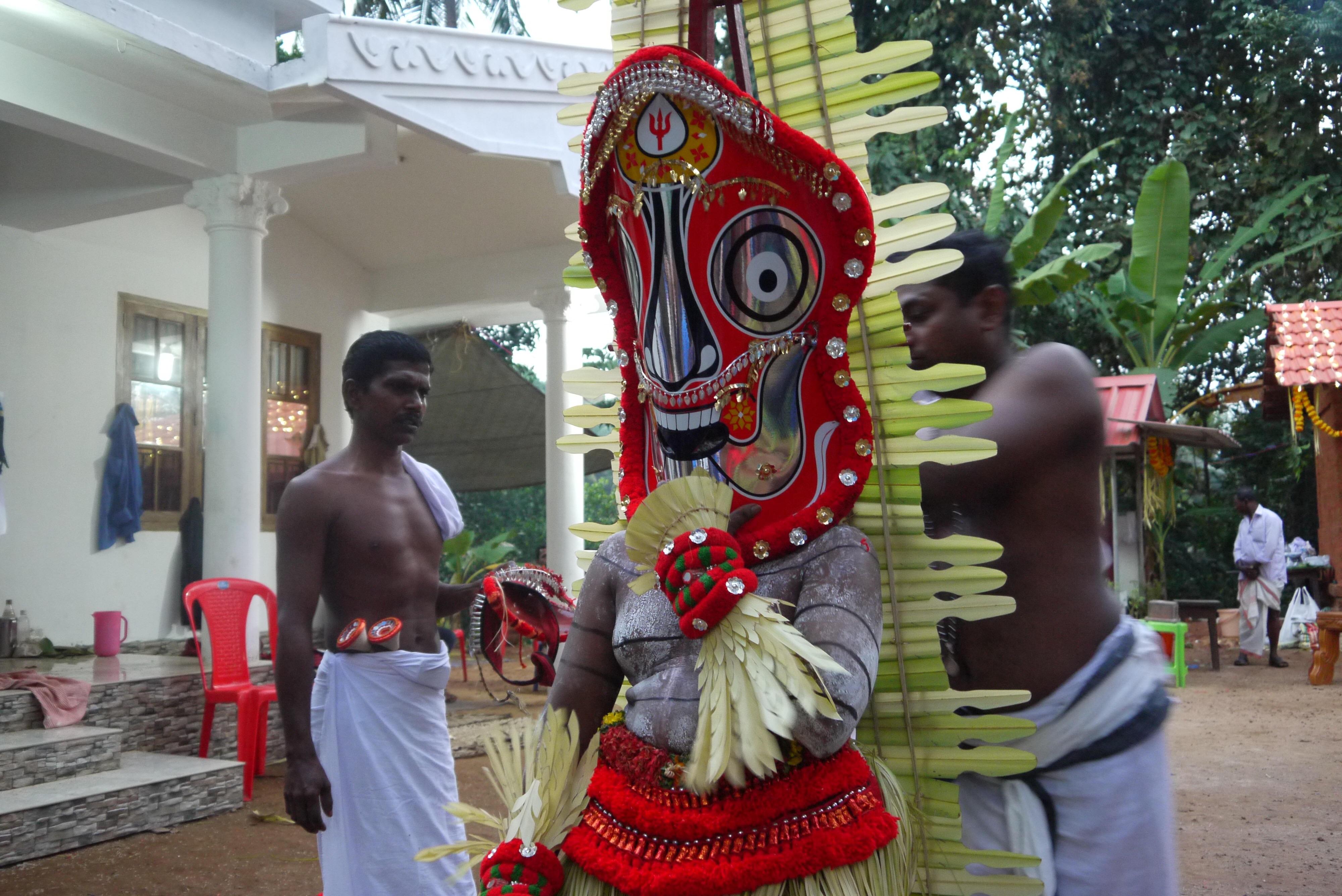
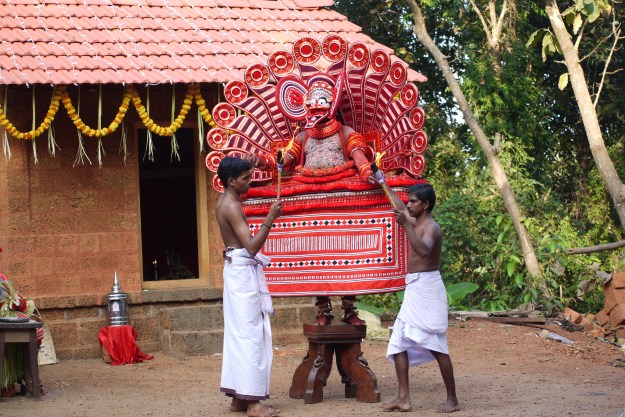
The first dancer comes out with a  20 foot headdress made out of banana leaves in the shape of a ladder.  He is wearing a large clown like mask painted a brilliant silver,red and black. First he blesses the shrine, then he encircles the Kavu,with the drummers leading the way. After an hour of dancing which includes highly skillful stilt-walking and recounting his story, he is seated on a type of throne, with his headdress resting against the wall.  Next comes a Theyyam with an elaborate red hemispheric shaped headdress bordered with peacock feather designs,a mask with large ear flaps and mouth,and  a skirt created over a rectangular frame.   I remind  both Annette and Gerald to make sure not to forget to stand when the deity passes by (a sign of respect).  The night before, Gerald was so engrossed in his drawing that he didn’t notice that Golikan was right in front of him, remained seated, and an angry deity glared and threw rice in his face.  The same with Annette who was so in awe of seeing Theyyam for the first time, that she,too,didn’t get up. She got the stink eye.


p1080119

Meanwhile the fire has been smoldering and the attendants make a neat pile of the burning hot coals, getting ready for the arrival of Krishnamurthi who will lay down on the ashes.  His mask has been resting in the house after having been blessed, surrounded by ghee lamps burning all night. Both the first and second deity are now seated, receiving villagers and talking with each one individually. The tension mounts as the drummers continue their fierce drumming, jumping in unison high into the air from time to time.  I can’t imagine how they can keep this up- it is now 10:30 in the morning and they have been going at it since 4.


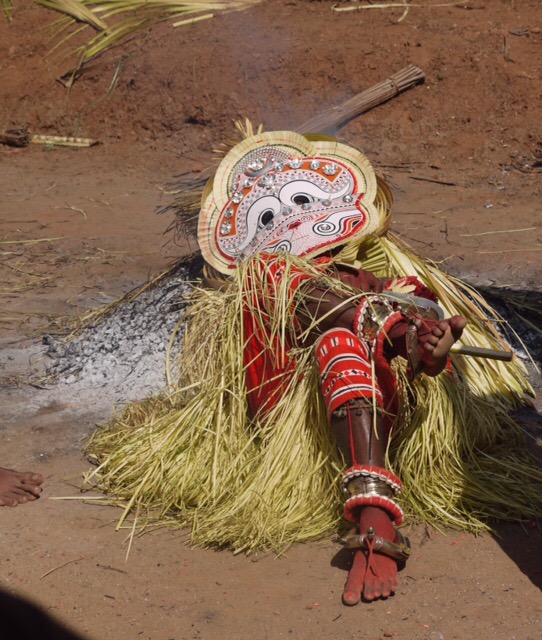
Krishnamurthi arrives in a grass skirt made out of young banana leaves, heavy metal ankle and arm bracelets, and a mask. When the moment arrives, he is led to the burning coals by the temple attendants, one on each arm.  I think it will be quick, but no, I am wrong.  After a bit of positioning, he lies down, crosses his legs, and makes himself comfortable.  Each of the other two deities approach, bend down and have a few words with him.  Then, suddenly he jumps up, changes direction, and lies back down.  This is repeated in all four directions.  The intensity of this Theyyam requires the performer to prepare for forty one days. Complete abstinence from sex,alcohol,tobacco and meat. His mind and body must be sharp and focused.


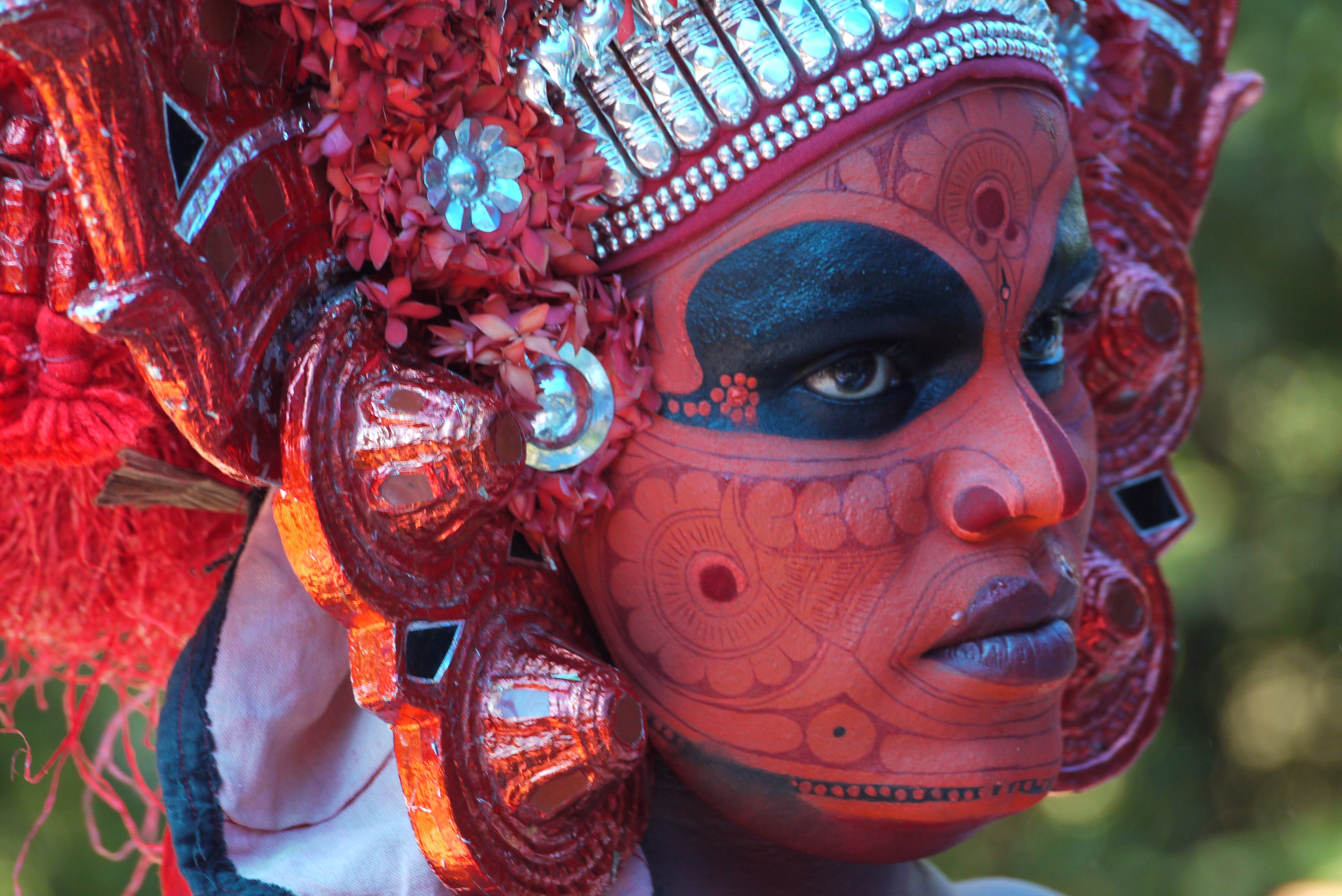
Preparation for the final dancer reveals a completely different facial design- with orange colored turmeric paste and black charcoal around the eyes. An intricate pattern, called “face writing” is drawn with a brush made from banana leaf. Only his head and arms stick out of a huge grass skirt. Red cloth bands are on his forearms and silver bracelets on his wrists.


The climax arrives with all four Theyyam interacting and dancing around the courtyard.  By this time it is noon and the sun is beating down on us until we feel like we will collapse.  It reminds us that although our minds and spirits have been transported  to an alternate reality, our bodies are still very much in the tropics of the Malabar coast. Hundreds of villagers are mulling about, eating, drinking tea, talking on their cell phones or standing and taking close up photos. We are treated as honored guests due to my blond hair, and Gerald’s size.  Chairs are set up for us directly in front of the action to ensure the best photos, and we are made to feel included at all times.  The women beckon to me to come on the steps of the home in order to get a better view, and push me almost directly into the path of Vishnumurthi as he enters to bless their home.

I am sad to leave tomorrow, but we are heading north to Ahmedabad where we will start our teaching at Gandhi’s ashram. The Theyyam has left an indelible mark on my psyche which I can never forget. And I will carry the vivid red of their costumes and the pulsating rhythms of the drums with me throughout the rest of the journey through India.

The Wedding


image

Decorations for the engagement party

Dressed in jeans, with a baseball cap covering his shaved head, Dixon introduces himself to us at the engagement party.  “I hear you’re from California.  I studied oenology  at Napa college for four months a few years back.” That’s India. Just when you think you’ve heard or seen everything, you haven’t. Wine and India are not two words you expect to hear in the same sentence.

Dixon worked many years on Carnival Cruise ships and was paid by the company to take the course. “Wine Professor “is his new title and he teaches classes for hotel personnel in wine appreciation. “I’ll be the MC at the wedding” he tells us.

image

When we arrive at the church, the pews are already full to capacity- women elegantly dressed in their best saris and satin dresses and men wearing black suits and ties. Gerald is in his safari shirt and cargo pants and I am wearing my wedding attire and  the silver, sparkly heels Francis’ wife lent me for the occasion. We discretely seat ourselves in the back, and listen while the ceremony is conducted in Concani ( the local language).The church is beautiful.  It is a large white building with stained glass windows and chandeliers.  The congregation is alternately deep in prayer or singing hymns along with the choir.

img_0015

After the ceremony people line up outside the church to greet the newlyweds. At the far end of the courtyard it appears that after the guests congratulate the couple, they are receiving something. We are motioned to join the line.  I’m feeling a bit excited about the prospect of getting a “wedding treat”. It turns out to be a box of mango juice and a hot dog bun filled with shredded lettuce and mayo. So much for local delicacies.

Greeting the bride and groom

The bride and grrom arrive

The invitation states “reception commences at  seven thirty  in the evening at Dr. Neville’s Wedding Hall” but we are told that IST ( Indian standard time) dictates that guests  start arriving closer to nine. Nonetheless, we arrive promptly at 7:30 pm and enter an enormous outdoor wedding venue, lit up like Disneyland. Tables and chairs are set up around a lake with fountains and lush landscaping.

image

True to form,  with the band playing “Rhinestone Cowboy”,people start trickling in  at about 9:00. “Ladies and Gentlemen, please come onto the dance floor and welcome Mr. and Mrs. Cordozo appearing for the first time as a married couple.” It is Dixon with a microphone, standing in the center of the open space. I don’t recognize him at first,dressed in his snazzy suit and dapper hat. From there it all proceeds as on a cruise ship, with Dixon exhorting us  to clap, cheer and dance, first the Mexican Hat dance, then the Bunny Hop and eventually some Goan dances. The place is rockin’. Once the music starts ,I get up and step out onto the dance floor, forgetting about my growling stomach. The music is mostly pop and some Goan contemporary, and alternates with the MC announcing what exactly we should be doing. ” Happy to see California doing our Goan dancing”, I hear from the microphone while I dance with Francis, his wife and daughter.


When the announcement comes that the buffet room is open, it is almost 10:30pm.  The food looks impressive and abundant, but unfortunately isn’t  much better than the pre dinner appetizers of little white bread peanut butter and jelly triangles and minced meat rolls which looked like miniature dog turds.

Round midnight I need to rest my weary bones ,  so I drag myself off the dance floor,and look for Gerald, who is sitting at a table and chatting with some local guests.

Its been a great evening and we decide it’s probably time to go.  Another glimpse into incredible India.


Whose life is it anyway?

image

While buying train tickets to our next destination in Kerala, I bump into Catherine, a long time British ex-pat we met last year. “If you want a good story, go down to the end of the beach to the “maharajah’s place”, she grins mischievously.

The face of Goa has changed dramatically since independence from Portugal in 1961. Goans were offered the possibility of a Portuguese passport, and many jumped at the chance.  Catholics now account for only 25% of the population, down from 60%, due to the diaspora of Catholics, and the increase of Hindus and Muslims with their large families.  Cruise ships,the Merchant Marine and the Emirates offer high paying jobs, which is reflected in the unusually small size of Goan families. (Men are away  for long periods of time.)

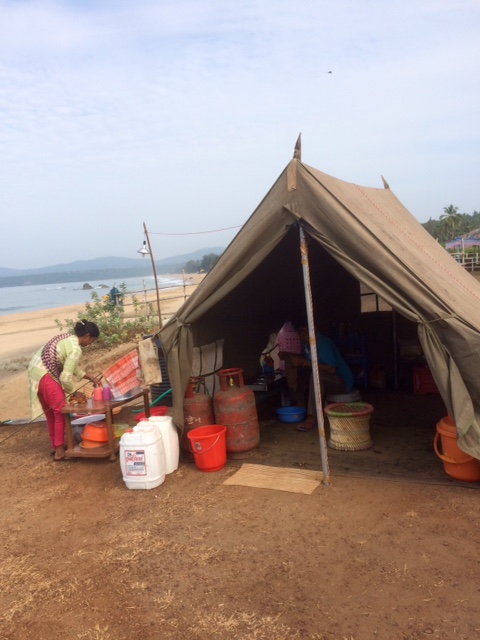
For our morning walk we decide to check out the “maharajah”. At the end of the long sandy stretch of beach  there is a small cove, and we see a cluster of tent structures and a trailer. A man and a woman are busily washing and cooking inside a “work tent”.  They are obviously the servants. In front of the elaborate trailer with solar panels on the roof, sits a neatly bearded man with a gold earring in his left ear. He looks relaxed and carefree in his lounge chair.

image

The servants working

As we hesitantly approach, he beckons us to come closer. ” I’m Nenni”, he says with a broad grin as he extends his arm for a handshake. Rather than being the “maharajah” himself , he is the driver. “It took us nine days to drive down here from the north. My boss arrives tonight. He is from a royal family, you know. He owns many agricultural farms and businesses. Every year he comes down with his wife and stays for three months”.  We get a tour of the complex.  The blue oblong tent is the outside shower for the servants.  Inside the trailer there is a bedroom with flat screen tv, fully equipped bathroom and shower, and room for lounging.  The outside is fitted with fold down shelving, and storage bins. The dining gazebo is covered in white canvas material, and an electric fan is is blowing the air around the neatly set table. There are two other tents which are for the servants.

Shower tent

Shower tent

image

dining gazebo with ocean view

NENNI’S STORY

Nenni is a man in his early forties and was born as the only son into a Sikh family. At the age of 17 he decided he wanted to go abroad to work, so he cut off his hair, and removed his turban.  Sikhs have a religious obligation to be unshaven and let their hair grow, covered by a turban.  His fear was that he would be mistaken for a Muslim, and  he wanted to avoid being conspicuous.  Because of this act of rebellion he was disowned by his family. After some years living in Europe, he returned home and was accepted back, and  soon a marriage was arranged. ” We just didn’t get along, so I got a divorce.  Now I will get married next week to a Hindu lady.  I am happy and will open my own chicken restaurant in my village”.  When I asked if he had children, he replied that he has two but doesn’t see them often as they live with their mother far away.  We left with handshakes and hugs all around and our promise to visit him and eat at his restaurant when we pass through that area at the end of our journey.

Marriage Goan Style

” Whose wedding are you going to?”asked the young shop girl with a twinkle in her eye. I had already been asked the same question twice before as I scoured the shops of Agonda for a “wedding envelope”(used to place money as a gift for bride and groom). Agonda is a village in  southern Goa, which has managed to maintain its small town character and warm,family atmosphere, despite the influx of tourists to this wonderfully idyllic seaside. It is predominantly Catholic, which is evidence of the Portuguese occupation from the early 1600’s until as late as 1961. The church and its activities play a central role in the daily life.

At first glance one would think that the women are all pregnant – -a small “bump” protruding from their flowered, waisted house dresses. Upon further inspection it appears to be a body type rather than a condition. Their wavy, black hair is tied back into a bushy ponytail , and their smiles are broad and welcoming. Almost everyone has Fernandes as a surname and is somehow related to one another. The few Hindus that remain wear traditional saris  or salwar kameze(a long tunic top with pants), but for others this has been long ago  been replaced by western wear, due to prolonged contact with missionaries.

“My cousin’s daughter is getting married next week and the brides family is having a luncheon here on Sunday, do you want to come” asked Francis, our chef friend. (I wrote about him last year-The Sailor and the Saint). I’m always up for a wedding, but that also presents the challenge of finding clothes and shoes for the occasion. When you travel with only a carry on bag, there’s not much room for such luxuries. I did bring my “acceptable” wedding outfit, hoping  that I would get the opportunity to wear it, but I forgot my bling flip flops. I figure no one will look at my feet anyway.

Sunday arrives and Gerald asks if he has to wear long pants. It is hot and humid and he’d much rather wear shorts. I say that out of respect he should. I put on some make up, my best Indian costume jewelry, a blue paisley skirt and my clunky black Tevas.

Decorations for the engagement party

Decorations for the engagement party

We arrive early, hoping to get a good seat, Francis says they are expecting almost 200 guests. The night before, the restaurant was a flurry of activity as the “aunties” decorated the courtyard with sparkly,gauzy fabric and greenery and the men started setting up the chairs. Of course we are the first ones to arrive,in time to watch the last minute preparations.

image

the “aunties” overseeing the food preparation

As people start to trickle in, Gerald turns to me and says sadly “All the men are wearing shorts!” And yep, it’s true. There is a sprinkling of men in long pants, and women in satin dresses, but for the most part it’s casual. I’m told that the wedding party on Tuesday night will be a formal affair and despite the heat, the men will be wearing suits and ties.

image.jpg

women and children section

A table has been set up where the westerners congregate, and the rest of the chairs have women and children in one section and men in another. There is a dj playing pop music and drinks are served. I decide to have a Feni, a local brew made from cashews, and quite potent. I meet the bride, who is an atypically thin young woman of thirty. The marrying age here is between twenty five and thirty-much later than the rest of India. Appetizers of marinated beef, roasted pork and chicken are passed around while we wait for the buffet.

image.jpg

Jama or “Emy” the bride-to-be

At the right moment all the aunties and family members line up around the buffet table and we stand as prayers are recited.  When the time comes to start eating,I am amazed at the restraint and calm that follows.  After eating, people get up and leave immediately, until all that is left are a few western stragglers.

image.jpeg

It’s been quite an un-Indian experience without the wildness and ritual of a Hindu engagement party .  Tomorrow night is the wedding in a village 35km from here and we will see what happens.


“I’ll Never Do It Again” Redux

Some people say that the letters I N D I A mean “I’LL NEVER DO IT AGAIN”, and yet here I am,ready to embark on my fifth (or is it sixth?) journey to that fascinating and infuriating land of enchantment. I must admit that after each one of my first three sojourns I returned with that same sentiment. While I’m there, days pass when I want to tear my hair out, or just find a nice, quiet place to chill. And then something happens…..a colorful procession replete with music and ritual, a delicious meal,-fragrant with pungent spices, or maybe just an invitation to visit someone’s home.

This last trip I was fortunate to enter the mysterious world of Theyyam in northern Kerala. I was “seized by the gods” in their full glory of painted bodies and faces,as they immersed themselves in the spirit of a  god, dancing and moving as one possessed. It was this mesmerizing experience,which takes place at sunrise and sunset during the months of December- February that draws me back. As soon as we returned from our last trip in December 2015 I was planning the next.

Pullurkali

Pullurkali

Yes, we will also be volunteering to work on an art project with scavenger children at Manav Sadhna, Gandhi’s ashram. How that will turn out, I know not.
We are also planning to go up to the mountains at Nainital and see tigers at Corbett National Park. How that will turn out, I know not.

Many friends are as anxious for our return as we are to rekindle their friendship. Gerald is excited about teaching more collage workshops at the Universities in Ahmadabad and Udaipur. How that will turn out,I know not.

IMG_2238

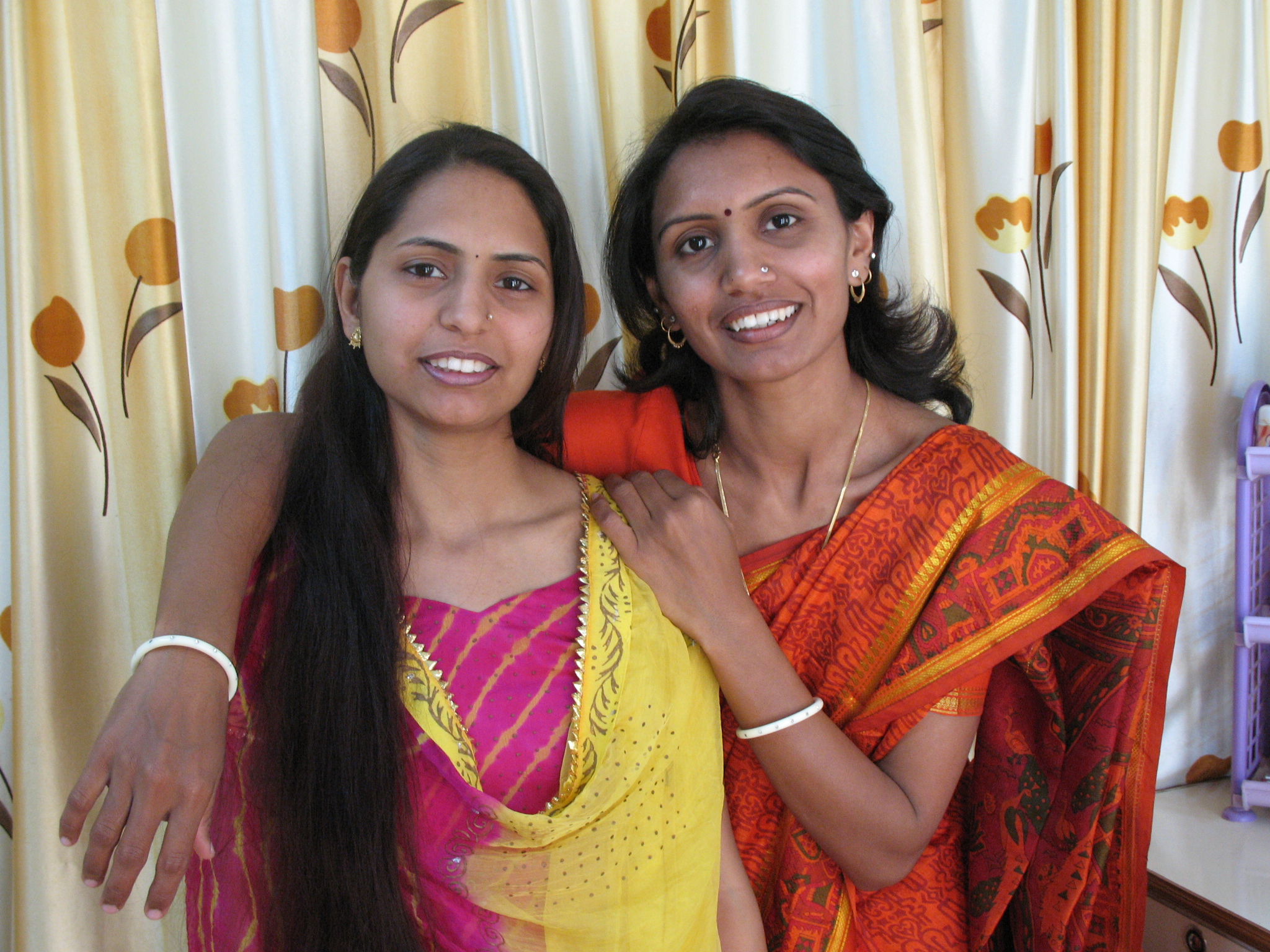
Shalena and her sister- my delightful Hairdresser in Udaipur

IMG_2160

Raji- the Puppetmaster of Udaipur

Francis at work

Francis- our master chef in Goa, at work

What I do know it that we are embarking on another adventure, and that is good.

Namaste

“In India, Anything is Possible”

We’ve returned back to the USA, but the emotions and impressions still linger.  I am sharing G’s last thoughts about the trip, because they reflect my own.

We arrived in Delhi after a thirty two hour trip, during the festival of lights, Diwali.  The owners of our guesthouse, Devna and Atul, immediately invited us to celebrate this wonderful holiday with their family.  The next evening in Jaipur, the director of an Artists Residence, whom we had never met, invited us to her home for dinner.  At our hotel in Pushkar, they managed to find me a real birthday cake and two bottles of beer, even though eggs and alcohol are forbidden in that “holy” city.  When we arrived in Udaipur, a city where we have visited many times, we were welcomed by our hotel owner/friend as long lost friends, with garlands of marigolds.  We ran out of evenings to accept all the dinner invitations from various friends.

This is the India I love-the people so open,welcoming and gracious.  There is nowhere that I have been like it.  And then there are the events-“The Greatest Show on Earth”. Diwali is the Festival of Lights and buildings are ablaze with lights, fireworks are exploding, and everyone is wearing their finest clothes, in this country of dazzling colors.  The Camel Fair in Pushkar, an annual extravaganza of camels, horses, and colorful tribesmen, was the impetus for this journey.  A few days later in Udaipur  it was Muharram, a major Muslim holiday commemorating the death of Hussein Ibn Ali, grandson of Mohammed; and celebrated with a procession of giant floats, late into the night. Then came the Full Moon Festival,Kartik Purnima.  In Palitana we sweated our way up thirty six hundred steps, a solid two and one half hours, to the great Jain temples-the pilgrims do it ninety-nine times in fifty days. We saw Asiatic lions in Sasan Gir National Park, were invited to a Maharajah’s palace in Wankaner, and crossed the caravan routes of Rabari nomads in Kutch.  In Goa it was the festival of St. Francis Xavier and in Kerala there was an arts Biennale, and the incredible Theyyam spirit rituals in local villages.  In India, the hits just keep on coming.

This was my seventh time here, and the country has become a part of me,- and in some small way I am a part of it.  The outrageous colors,the amazing history and culture, the fabulous food and above all the wonderful people I have met, have made this trip my best since my six month journey of discovery in 1976.  On the US Customs form we fill out upon return there is the question”Have you been in close proximity to livestock?”  In India that happens every day on every street.  But I still answer “no”, to avoid being quarantined.  If one of the questions was “Have you been in close proximity with the wonders of life?”, my answer would be an unequivocal “YES”.  For in India, truly, anything is possible.

NAMASTE

Seized by the Gods

image

Pullurkali

December 13

The sound of the waves crashing on the shore lulls me to sleep, but it is a fitful sleep. I am anxious for the day to begin, and wake up before the 3:00 am alarm.

We are in Kannur, six hours up the Malabar Coast from Kochin, and known for Theyyam ritual. It is performed during the annual festival of village temples in the region. Dancers who become “possessed” by a particular deity go into a trance and take on their persona. Once the deity has entered the body of the Theyyam dancer, the priest and the temple are blessed, thus purifying it for the coming year. This ritual is important for the spiritual and physical well being of the community, and the whole village pays for the temple and its maintenance

Theyyam is a unique supernatural event which allows villagers to have direct personal contact with a deity. It is interesting that only the “Untouchable ” caste is permitted to perform this ritual. Training starts at an early age,and is passed down through the male line in the family.
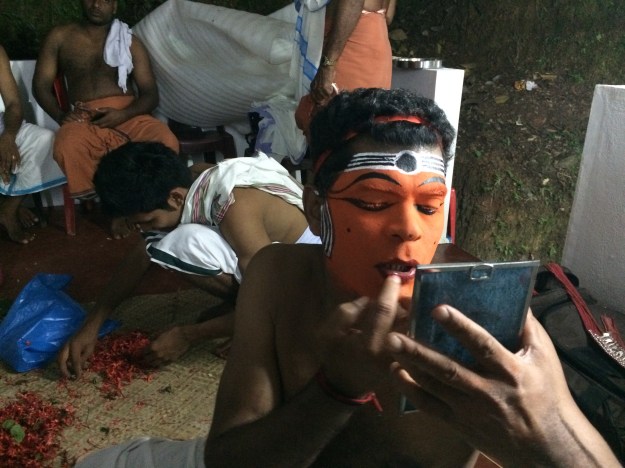
The ritual requires enormous physical and mental stamina. Elaborate headdresses can be over thirty feet tall, makeup can take from three to four hours to apply and metal anklets weighing two to three pounds each, are worn.

IMG_3724

Preparing the make up

We arrive at 4:30 am and everyone is fast asleep in the courtyard surrounding the temple, where the ceremony will take place. There is a tent structure set up- called “the green room”,considered a sacred space for the dancers to prepare themselves. I peek in and one of the performers, with face make-up,is snoring loudly.

P1060733

calm before the storm

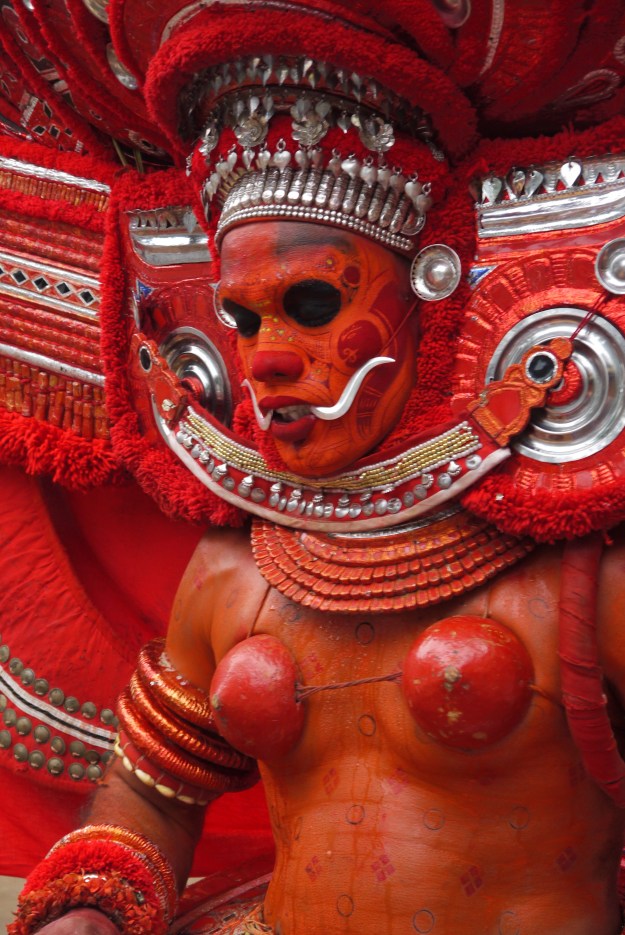
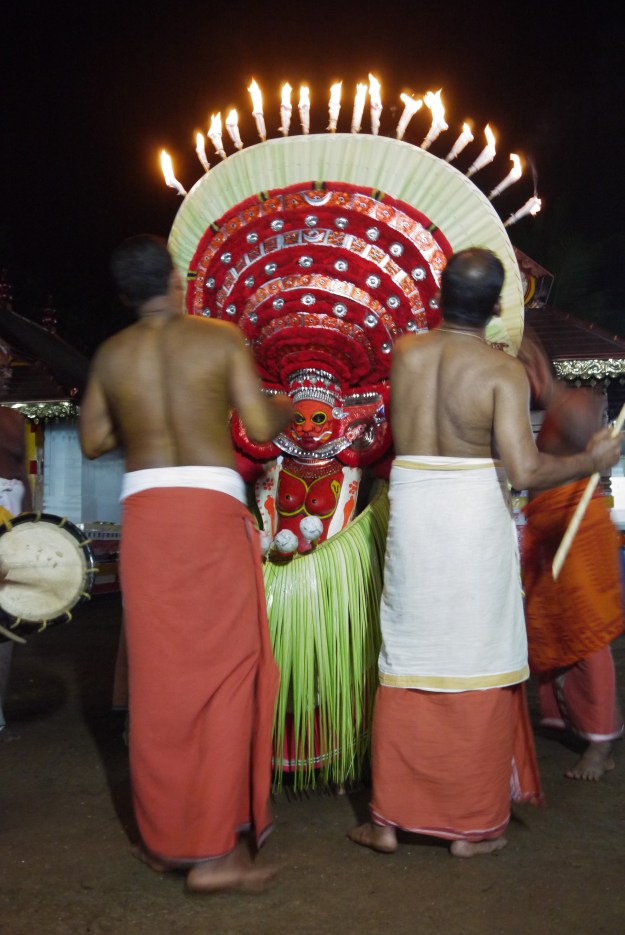
After thirty minutes the frenzy of preparation begins. There are to be three deities manifested today and two are goddesses. The drumming begins and out comes a fierce looking Pullurkali (Kali),with an enormous headdress sporting sixteen flaming torches and four more are hanging from the grass waistband of her skirt. Dancing starts off slowly with drummers and dancer encircling the two shrines. The face has metal fangs on each side, which look terrifying, and I find myself recoiling when “she” gets too close. The ritual goes on for about one hour and at the end, villagers line up to talk with the deities, ask questions and get blessed.

image

Goddess Pullurkali

image

Villagers lining up to speak to the deity

image

The. Goddess Pullurkaii with flaming headdress

Very few villagers have come at such an early hour, yet the air feels charged with energy.

We arrive at the next village at 5:00 pm (rituals start at sunrise and sunset), just in time for an unseasonal monsoon downpour.

When the rain ends twenty minutes later, the temple attendants clean out the water that has accumulated in the courtyard, with thick burlap bags. Many more villagers are here for this ritual then were this morning, and the mood is quite festive. An ice cream truck has arrived and parks on the temple grounds. Women and children are dressed in their finest clothes.

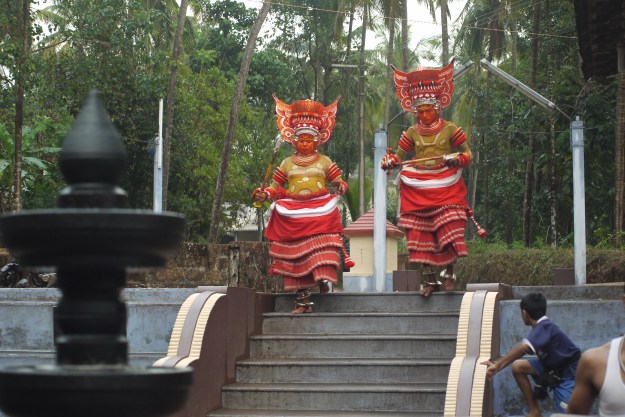
Tonight the deities are Ilamkaruvam (Vishnu), and Poothadi (Shiva).The dancing is more vigorous with both dancers battling each other with bow and arrows and sticks. Body make up is applied as well as on the face.

image

Deities Ilankaruvam and Poothudi

Turmeric, rice paste and lime are mixed to make the colors, and the paint is applied with a coconut palm reed as a brush.

The next morning we go to a simple roadside temple and it is the most personal. Watching the villagers line up to speak to the “gods” with such earnest expressions is an awe inspiring experience.

Illamkaryvam and Muttapan

Illamkaryvam and Muttapan

The God Thiruvappan

The Deity Thiruvappan

Tonight is our last ritual in yet another village. Lights are strung up around the temple grounds and garlands of marigolds hang from the buildings. It is obvious by the level of decoration that this is a wealthier community. We are offered food and snacks and told they are expecting five hundred people. Tomorrow is the climax of the three day ritual, but unfortunately we have to go back to Kochin.

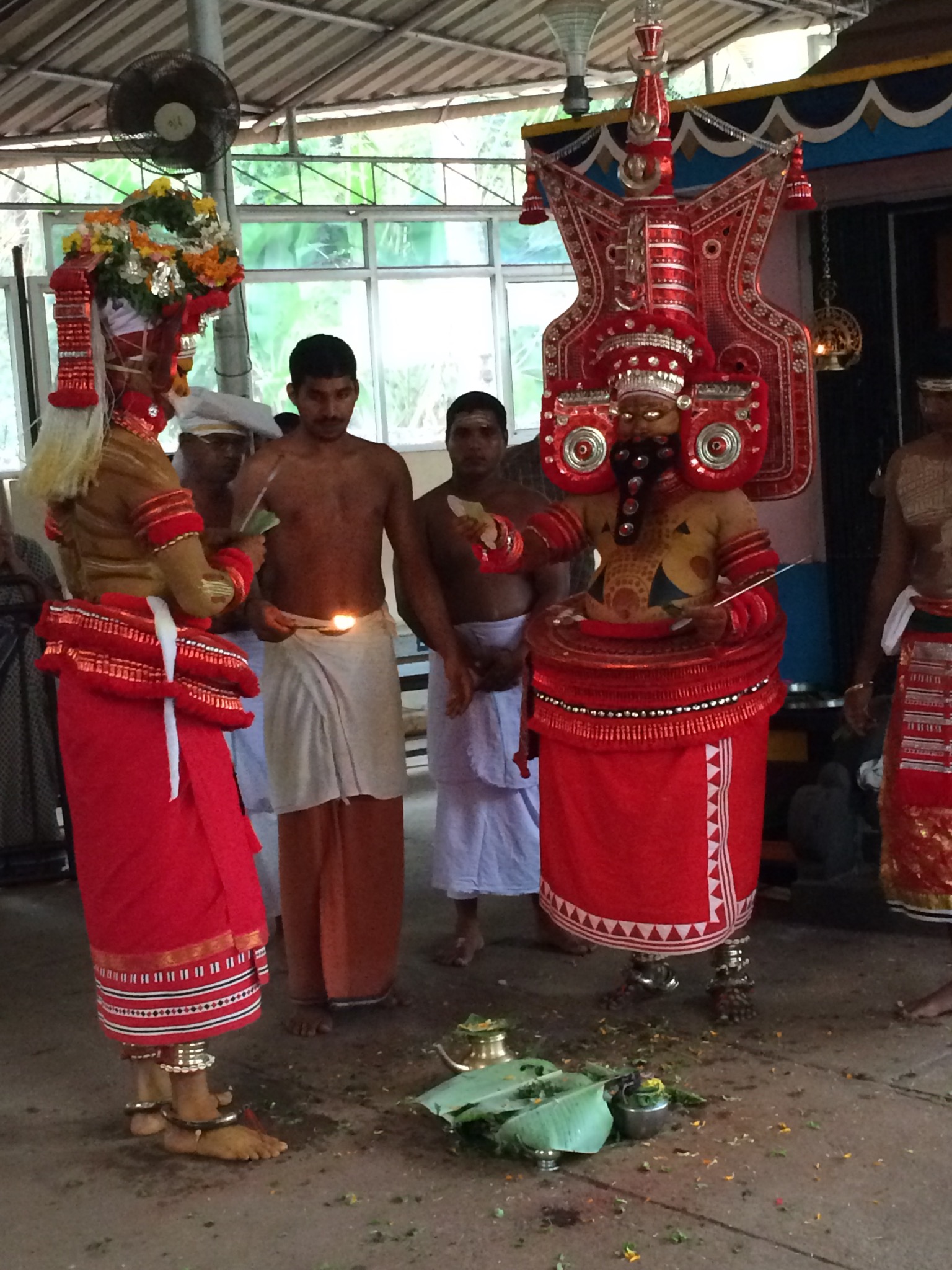
A line of villagers forms on both sides of the seated deity, asking for blessings and advice, men on one side women on the other. Meanwhile, Golikan,(another deity)with long,black hair flying around, appears, held upright by an attendant on each arm. Immediately he starts dancing in front of the fire of burning branches- spinning and yelling. He moves so quickly it is hard to keep him in sight. I am mesmerized.

IMG_3740

Golikan at night

Illanparuvam and Poothoodi

Illanparuvam and Poothoodi

We are warmly welcomed to participate,  people wanting us to come back for the big twenty four hour finale. Of all the things I have experienced in my life so far, this has to be one of the most spectacular and fascinating.

Incredible India!