Category Archives: India

A journey to the Pushkar Camel Fair- a lifelong dream fulfilled for my husband, Gerald, and scratched off his bucket list

Sadhus on Parade


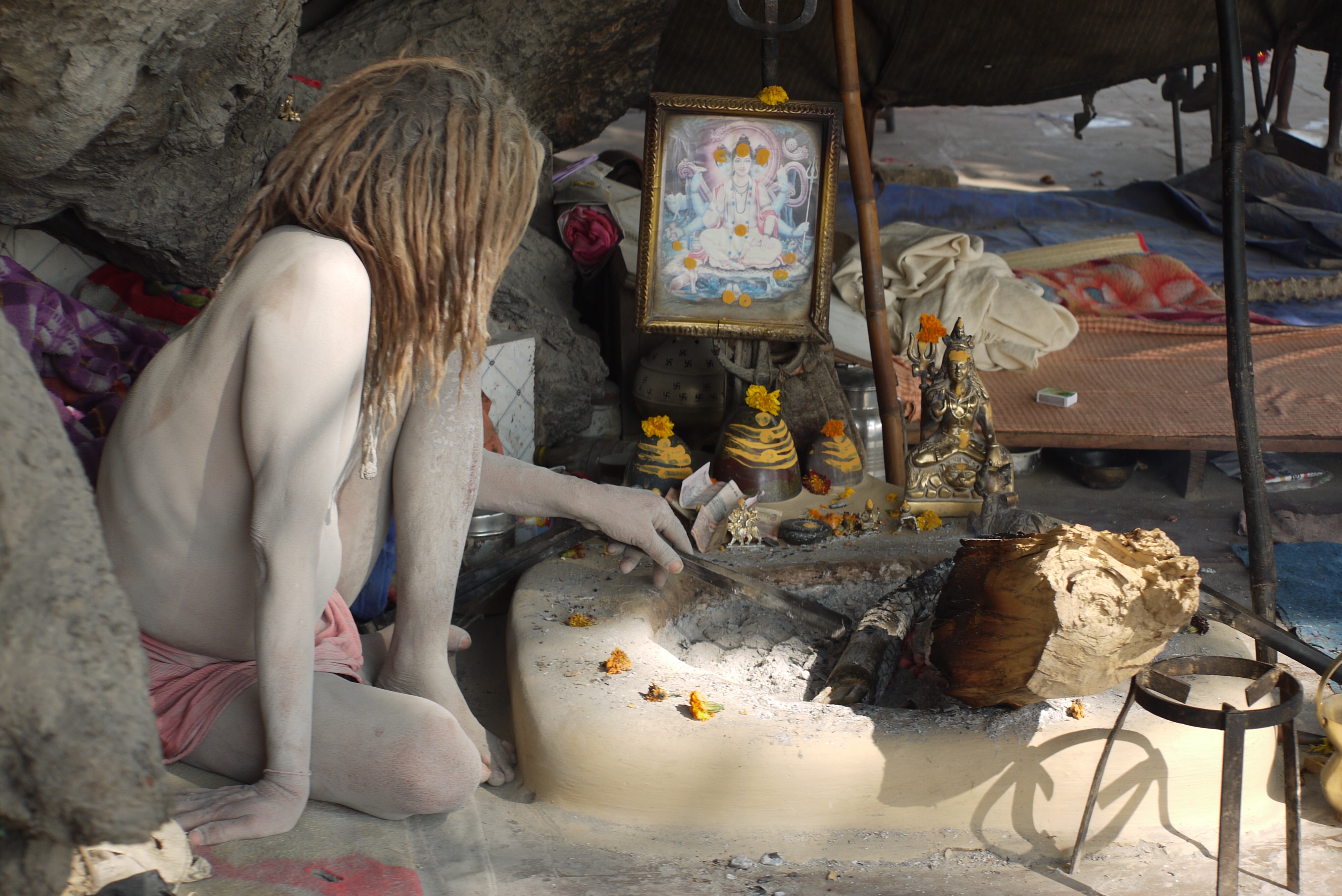
sadhu covered in ashes

Rishikesh exploded onto the Western scene when George Harrison and the Beatles came here to gain enlightenment at the Maharishi Mahesh Yogi’s ashram in 1968.  We know at the outset that it will be more tourist oriented than Haridwar,but our first impression is one of extreme disappointment. On the narrow, unpaved lanes on the way to our guest house we pass rubble, varying sized mounds of cow dung and dog poop.

After dropping our bags in the room,we head out to explore the town. Sandwiched between posters advertising ” emotional block treatment” and ” Bliss of Breath”, are the “German Bakery” shops. (Dating from the hippie days in Katmandhu, they specialiize in western favorites such as chocolate cake and apple pie) Advertisements for yoga classes, yoga teacher training courses, meditation,Ayurveda and esoteric treatments are papered on entrances,walls and poles. Too many Westerners here for my taste.  I want Sadhus! Sadhus are a uniquely Indian phenomenon. Men, often highly successful,renounce their worldy possessions and wander.They depend on the generosity of others to survive , and are considered holy men.

We beat a hasty retreat to the rooftop terrace of our guesthouse overlooking the Ganges, with a spectacular view of the mountains.


Today is another day and a completely different picture emerges. On our way to eat breakfast down the hill from our guesthouse ,we pass one of the many ashrams. Big cars are parked inside and a beehive of activity is going on. Turbaned sadhus clothed in saffron colored robes are mingling with devotees dressed in white. I look for someone who might speak English and ask what is going on. “Guru happy birthday.  Rich people bring donations. After Satsang everyone come eat.”

After eating  breakfast my mood changes. We wander through town, passing Kashmiri souvenir shops selling pashminas and jewelry,and  more German Bakery signs.  Further along, the scene becomes more Indian- stalls frying spicy aloo tiki (mashed potato patties), chai wallahs (tea sellers), and women selling a kind of fruit like a guava.

As we walk back, I notice that all the sadhus coming in our direction are carrying big bundles and packages. First I joke that it must be sadhu shopping day, and then it hits me. They must be giving out food at the “birthday guru’s ashram”.  I almost trip over myself trying to get there before I miss the action.

Crossing the footbridge over the Ganges, my eyes pop out of my head. I can’t believe what I am seeing. Hundreds of sadhus are lined up against the wall leading to the entrance of the ashram. Mixed in among them are spaced out beggars- smoking hashish through a pipe.


Hauling the goodies


I can hardly contain my excitement as I inch my way through the crowd.  The grizzled faces and tattered clothing tell the story of a hard life. These men(and the rare woman) are less fortunate than the ones I saw with the packages on the way here, and they are relegated to the back of the line.  I would love to photograph each medieval face- but it’s not possible. The suffering is too raw and personal. The ashram has a security guard with a stick to control the crowd should things get out of hand.  If I give just one person some money there would be a riot.

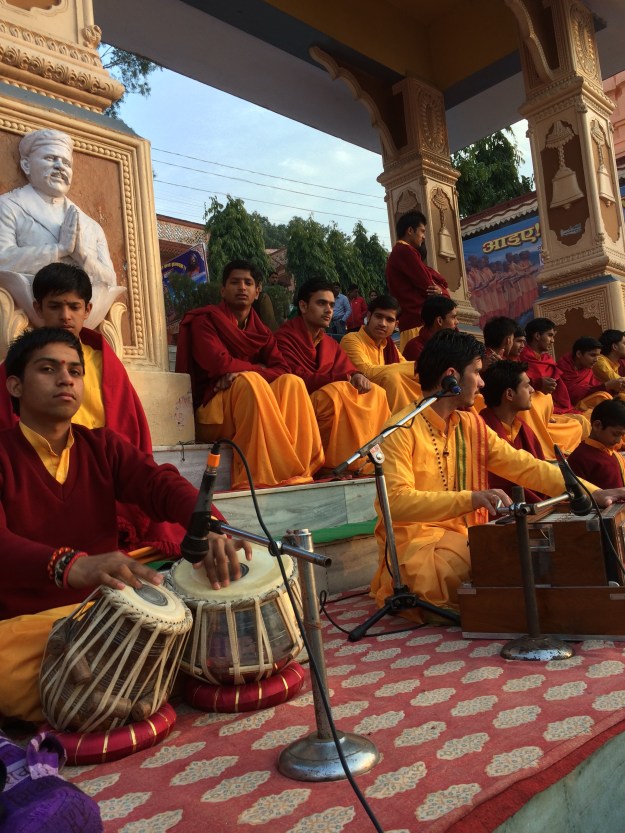
Every evening on the Ganges there is a ceremony called Ganga Aarti, to bless the sacred river.  We were warned that the one here in Rishikesh was small and geared to foreign tourists and western ashram people-but decide to go anyway. Organized by Pramath Niketan Ashram, the service is conducted by the novices, and like the one in Haridwar, is intimate and moving.  The faces of the young men and boys, some in deep meditation and prayer create a strong sense of community with the assembled group.

As we walk back to the guest house when it ends, we can see the flickering lights and hear the chanting of other Ganga Arti that are going on across the other side of the river.

Another day in Incredible India.
IMG_5841


Om Hari Om/”Can You Hear Me Now?”

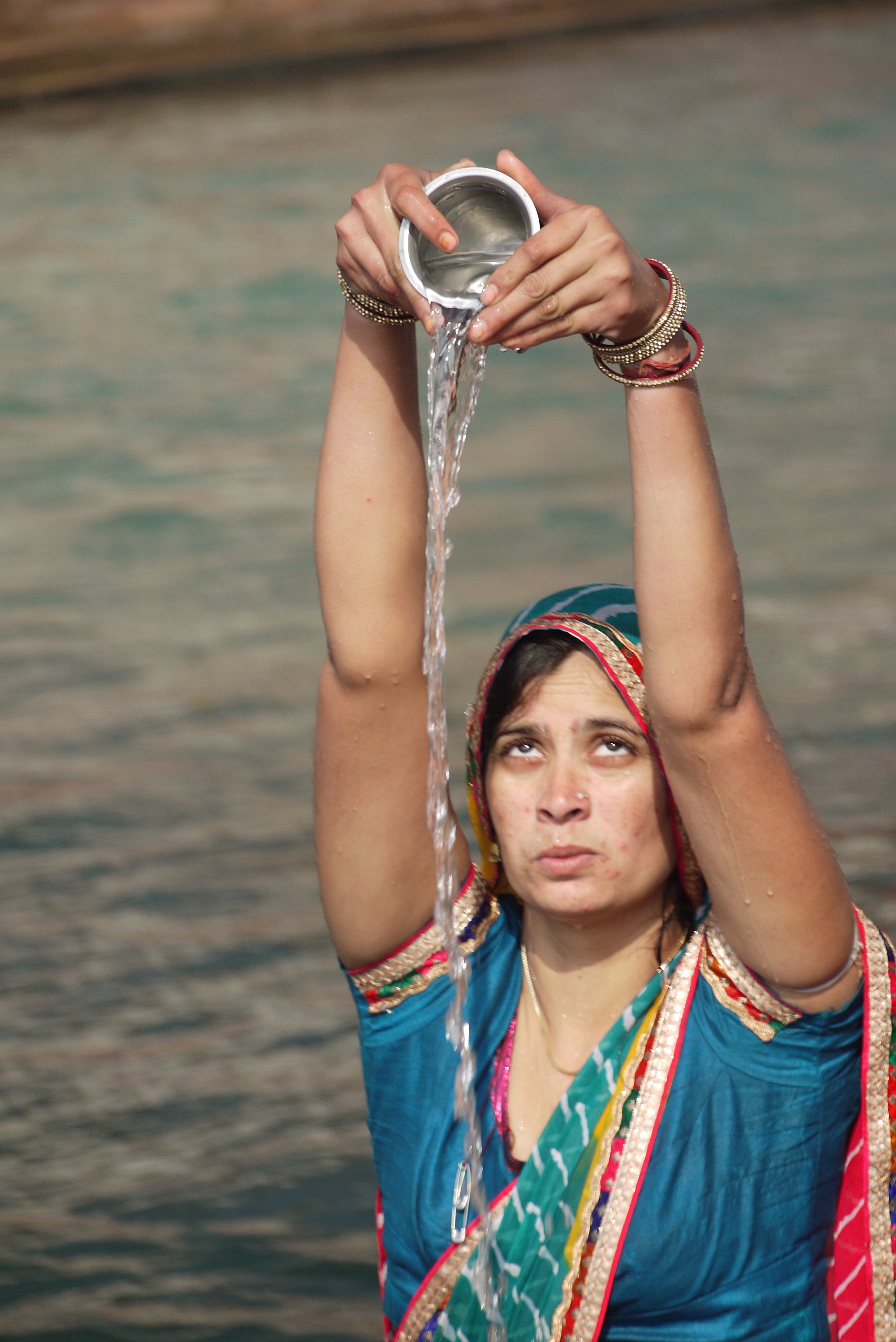
Pouring the holy Ganges water and doing puja

Ritual bathing in the Ganges

Haridwar is a  place that brings out the best that India has to offer. Peaceful and spiritual are the words that come to mind. It is a holy city situated in the foothills of the Garhwal  Himalaya and close to the source of the Ganges River. The rushing green waters tumble out of the mountains,carrying India’s life source through to Varanasi towards the Bay of Bengal .Pilgrims come to place the ashes of their loved ones in the river,or to bathe in the hallowed waters of Maa Ganga. Mother India is a loud country, from Bollywood music to loudspeakers chanting vedas and mantras in shrines.Other than ashrams, which  can also be quite noisy, there are few places where you can walk the streets and hear yourself think. I’ve been to Varanasi, and since it is a cremation site as well as the holiest city in India,the intensity of that place can be overwhelming. Here I can inhale slowly and breathe freely.

This is not a tourist town and is geared toward Hindus fulfilling their religious obligations.  When you see Indians traveling, they are always in groups, because they travel with their extended family- parents, children, and  both sets of grandparents . Privacy is an unheard of concept here, and certainly not one to be desired.To be alone translates to loneliness and one is pitied for not having friends and family. The first question asked of Westerners is “Are you married?” and if not, “Why not?”Men stroll the streets arm in arm, without the contraints of seeming unmanly. I feel that this strong connectedness is what gives people a feeling of optimism and joy. That combined with their belief in reincarnation-that the next life can be free of this life’s challenges if one has accumulated enough good Karma.

Our hotel was formerly a private home, or haveli, built in 1916 by a wealthy Hindu family.We are greeted with a necklace of tulsi wood and a list of the included activites at the hotel.

Havan at Haveli’s Ghat 8:00 am.     ( prayer service with a pandit, or priest)

Astrologer/Palmist for consultation  3:30 pm.

Evening Tea                           4:30 pm.   ( a chance to socialize with the other Hotel guests)

Evening Aarti at Haveli Ghat.    4:45 pm ( short prayer service with lighted candleabras)

Escorted Evening Aarti at Har ki Pauri. 5:00 pm

Bhajan Sandhya. 7:30-8:30 pm.         ( Devotional music and chanting with tabla and    harmonium)

There is a mix of guests staying at the hotel-Indians, non-resident Indians, and foreigners. Lisa comes from N. Carolina and is here to scatter the ashes of her deceased husband who died suddenly of a heart attack at the age of fifty,and to perform the traditional funeral rites he requested. We notice her sitting alone in a corner and invite her to join us at Tea Time.  A Gujarati couple from Ahmedabad , with their two grown sons are  sharing the table with us.  They are also here to scatter ashes and do the ritual bathing in the Ganges. The elder son, 26 years old, is chewing a big wad of paan (red beetle nut)  and his teeth and lips are stained a disgusting red.  I can’t bear looking at him so I concentrate my attention on the parents. At the morning ritual the mother guided us along and showed us when we should take the holy water, wash our hands,inhale the smoke, and in general try to follow the prescribed rituals.

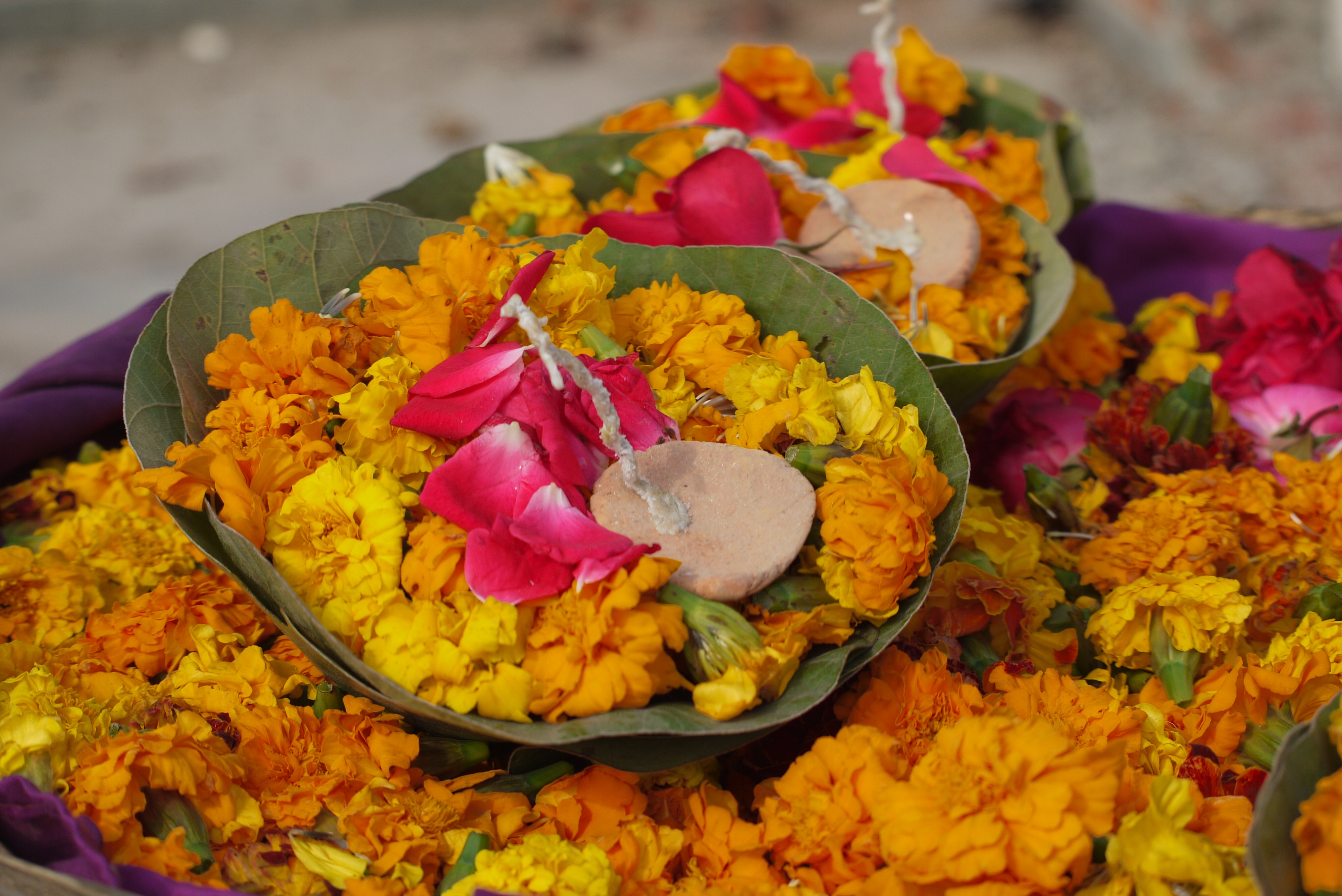
At 5:00 we gather in the lobby in front of the reception desk to wait for the Brahmin who will escort us to the evening Ganga Arti.  Chanting, fire, pouring of milk in the Ganges, bells clanging- all of this is part of this  daily evening ritual which takes place on innumerable rows of steps, known as ghats,  on the banks of the Ganges. All to sing praises of Maa Ganga. Lisa, Gerald and I, the Amdavadi family,  an Indian family living in Minnesota with their two grown sons from Chicago and New Jersey, and last but certainly not least, the Brazilian man,Claudio and his twelve year old daughter, Gabriele,  are patiently waiting in the lobby the hotel. Gabriele looks like an 18 year old super model and is spinning around on her new Hoverboard that she bought in Delhi. At first it seems an unwieldy group, as we are more used to doing things on our own. However, when we arrive ,we are escorted to a special section with prime viewing position, and we truly appreciate the extra attention.Mrs. Amdavadi helps me stay firmly on the slippery steps by the river. One false move and the fast moving current will pull me away in a New York minute.  Chains are fastened along the banks as an anchoring device to hold onto while going in the water. Lisa and I decide to purchase “diyas”, the small banana leaf boats filled with marigolds, roses and a ghee candle, as an offering of prayer for the departed and those loved ones in need of healing. Paan mouth’s younger brother offers to take photos with his Iphone as we place them in the water.
.

Diyas or prayer offings

India is a country of paradox and contrast.Ancient traditions are passed down through the generations-but along the way they adapt to the modern times, sometimes too much so.  During the evening services, temples and shrines  light up with garish neon lights,spinning in circles,shooting out like fireworks- a mini Las Vegas. And the cell phones! Nothing is too holy or sacred that it should disturb or disrupt a call. Priests are busily stoking ashes, or  cracking coconuts as part of a solemn ceremony with one hand,and with the other they are on the phone.  I saw this with marriage ceremonies, blessing rituals- even my hairdresser while washing my hair ,continued talking non stop to her boyfriend for over an hour. “Customer hair wash” she yelled into the phone as she massaged my head vigourously with her free hand. I went for my Astrology consultation at the hotel and the young man told me he is studying for an MBA, but he comes from a line of astrologers through the male line, and he wants to continue using his knowledge and gift.  He told me we could SKYPE if I had any questions for him when I got home.

Edit

Pandit

Puja on the ghats

I learned something this evening- how good it feels to be in a group. Some people I really
liked, others less so, but it didn’t really matter, the experience was the same. The sense of community and spirituality we feel here in Haridwar will remain etched in my heart as a memorable moment on this trip.

.

The Magical Mystery Tour


IMG_3939

Lake Palace Hotel

Bheru on his special name day in Udaipur


“Allah u Akbar, Allah u Akbar, Ashadu al la illaha ill Allah……”.

What a difference a day makes! Last week I was miserable in Ahmadebad and now it is 6:15 in the morning and the soulful strains of the Muslim call to prayer drifts in through the window of my room.  I love waking up to this.  Udaipur is in the heart of Rajasthan and is as wonderful as Ahmedabad was horrible.  It is the city of Octopussy fame, where the James Bond movie was filmed in 1981. Palaces,fanciful,flowery Mughal designs painted on walls, shrines with incense burning, bells ringing- the stuff of fairy tales.  This is the India I love.  The India of Rudyard Kipling’s Maharajahs and mysterious, bejewelled women hiding behind silky sarees, is easily summoned up in the imagination.

Wandering  narrow lanes in the early morning- before the sleepy city comes to life at 10 or 11 am- I watch the light reflected on the spectacular Lake Palace Hotel, as the sun slowly makes its way over the peaks of the Aravalli mountains which surround Lake Pichola. I check out my beloved Bheru shrine- a god favored by rural Rajasthani women.  Sometimes he is represented by an amorphous mound of tin foil, but today is his special day. An older man, the guardian of the shrine, is busy painting a smiling face with a mustache and a turban on the form.  A piece of flowery blue fabric has been draped around his “body” and garlands of marigolds and roses are hanging around his neck. I admire his work, and he smiles in recognition and pride.  I pass by several times a day to pay my respects.

The vegetable sellers are busily arranging their carts with cauliflower,carrots,eggplants.peas,tomatoes and other various fruits in season. Scooters and motorcycles are crowding around the popular food stalls selling warm breakfast snacks of samosa,and katchuri. (a type of  small,puffy bread stuffed with potatoes and drenched in an eye poppingly spicy  curry sauce. Shopkeepers are setting up their displays of copper pots and utensils, as they light incense in front of their small shrines to ensure a succesful and peaceful day.


 I have been to Udaipur four times and it remains for me the most beautiful and magicial city in India.

Between Heaven and Hell/It Depends On Which Day You Ask

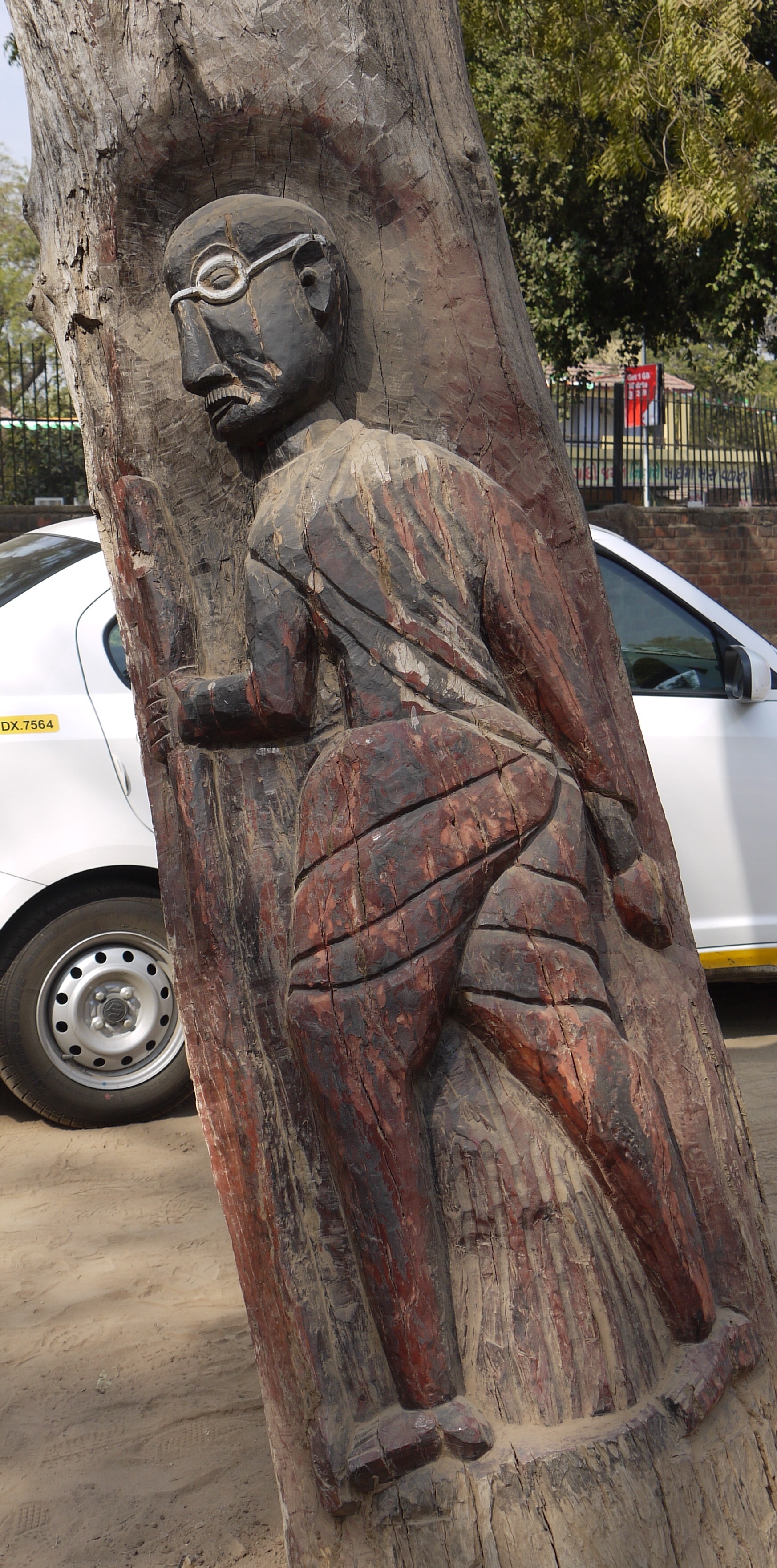
Gandhi sculpted in a tree at the ashram

“It depends on which day you ask”  was the response from Veena, (an Indian-American volunteer from Berkeley),when asked how she would rate her experience working as a doctor for Manav Sadhna this past year. It certainly could be said about so many things in India. I would be lying if I said that the three weeks spent in Ahmedabad working with the children at Manav Sadhna went by quickly. The last week I was counting the days until our departure.  We hated the city- the choking fumes of pollution, the rubble, the slums, and the complete chaos.  There doesn’t seem to be any redeeming factors to counter the negativity.

The flip side is the incredible experience of working with people so totally dedicated to compassionate service and non violence. This is no ashram with holy people; it is everyday people putting into practice their convictions in the most humble manner without ego, only service. Each day begins with communal prayer and sharing.Virren gave up a lucrative career in the US and decided not to marry and have a family, in order to follow his heart and be fully committed to serving others.  He earned enough money  in the USA which enabled him not to have to worry about working anymore.  Similar stories were repeated many times.

What is so startling to me is the number of young people, born in the UK or US who come  as repeat volunteers to Ahmedabad each year during school vacations to serve at Manav Sadhna.  Esham is an 18 year old ,born in England of Gujarati parents ,who first visited India as a fifteen year old with the program, Discover India.  He was so taken with what he experienced, that he started his own charitable foundation to build sports fields in the slum areas of Ahmedabad.  Britain awarded him honors for his work.  His father was born in Uganda, but grew up in the UK when his family and all people of Indian ancestry were kicked out by the dictator, Idi Amin in 1972.  Esham’s wish for his 18th birthday was to bring his father to experience Manav Sadhna, and see Gujarat for the first time. During the summer break, the ashram is filled with young Indians from abroad, who have never grown up or lived in India, but feel a strong pull.  I met three or four 18 year old girls,on winter break from University.  All of them expressed the same sentiment.  “When I leave, all I think about is when I’m coming back next”. Nimmo is a 37 year old hip hop singer who grew up in LA and moved to Ahmedabad permanently six years ago. He is in the process of helping set up an arts center and tours around the world sharing his message of love and cooperation, through his music.
I loved how I felt at the ashram and the relationships with the volunteers and the children I worked with, but I could never go back to Ahmedabad.  Its hard for me to understand the powerful magnet that attracts these young people come back to such a place. I know it will take some time to fully absorb what I learned and I am grateful for the time I spent there. So ,yes it depends what day you ask for my answer about my Indian adventure, but it is not yet over.  After Rajasthan we are headed for the Himalayas and the sacred cities of Haridwar and Rishikesh.

Go Fly a Kite

International Kite Festival

Our final day in Ahmedabad is Uttarayan- the  Kite Flying Festival.  Actually there are two festivals-an International one which goes on for four days along the Sabarmati Rivefront and displays impressive kites from countries around the world, and the local one which is celebrated on January 14  by every Amdavadi, young and old, rich and poor alike.

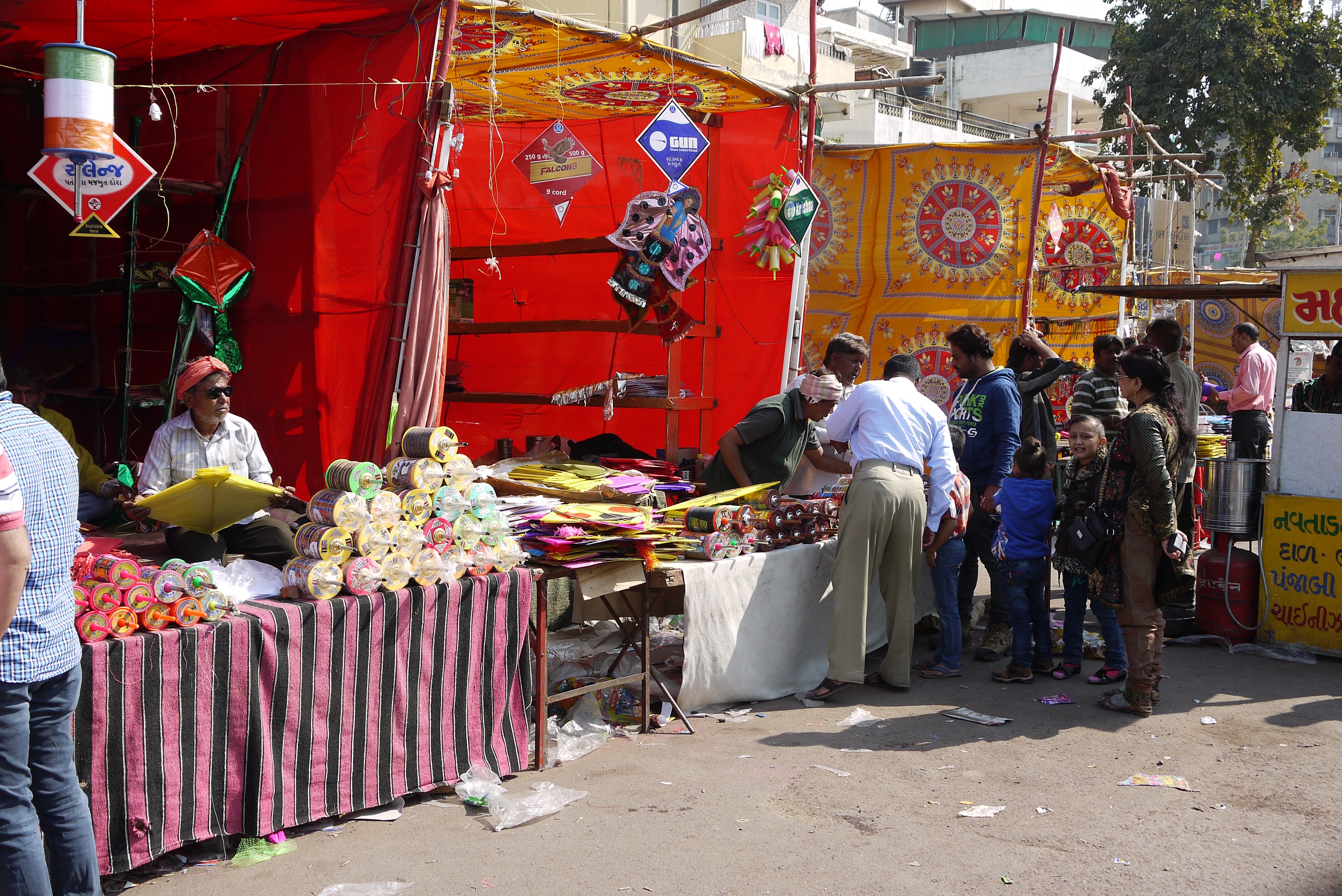
Schools are closed, shops and banks are shuttered, and the whole city comes to a standstill and flies kites during Uttarayan. Streets are empty  of rickshaws and traffic (thank god) and  the action is centered around the kite markets. Sellers of string are on the street with vats of dyes in vibrant colors.  These are not ordinary kites as we know them.  They are made out of small pieces of colored tissue paper and cost only a few cents each and are meant for one time use only. Families buy fifty or sixty of them, depending on their finances.  The strings are coated with crushed glass and the goal is to cut other peoples kites and see how long you can keep yours up in the air.  Of course this makes the whole event not only fun, but dangerous as well.  The number of people and birds injured each year by having their necks and throats cut by the strings is well documented in the local papers.  The govenment tried to ban the sale of these “Chinese strings”, with no luck. Days before the actual festival children are on the rooftops of buildings, and kites can be seen caught in the trees.

Kite string sellers

Dyeing the strings

Virren, the director of Manav Sadhna, has invited the staff and volunteers to the rooftop of his home for a kite flying party. “Come sometime after 10:30 in the morning”. When we arrive at 11:00 a.m. (the first guests) he is up on the roof, dressed in jeans and a plaid shirt.  “ I’ve been here flying kites since 7:00 a.m.”. He is 52 years old, lived in the USA for 26 years, and is now permanently settled in his hometown of Ahmedabad.  Dancing around like an excited little boy, he moves with precise steps to and fro, manoevering the flow of his kite. Throughout the afternoon  more and more guests arrive- Indians, Westerners, NRIs ( non resident Indians)-and each tries his/her hand at kite flying. In the corner is a stack of more than fifty kites of all colors and sizes. There is very little wind, so his valiant efforts at trying to teach me how to fly a kite is hopeless.

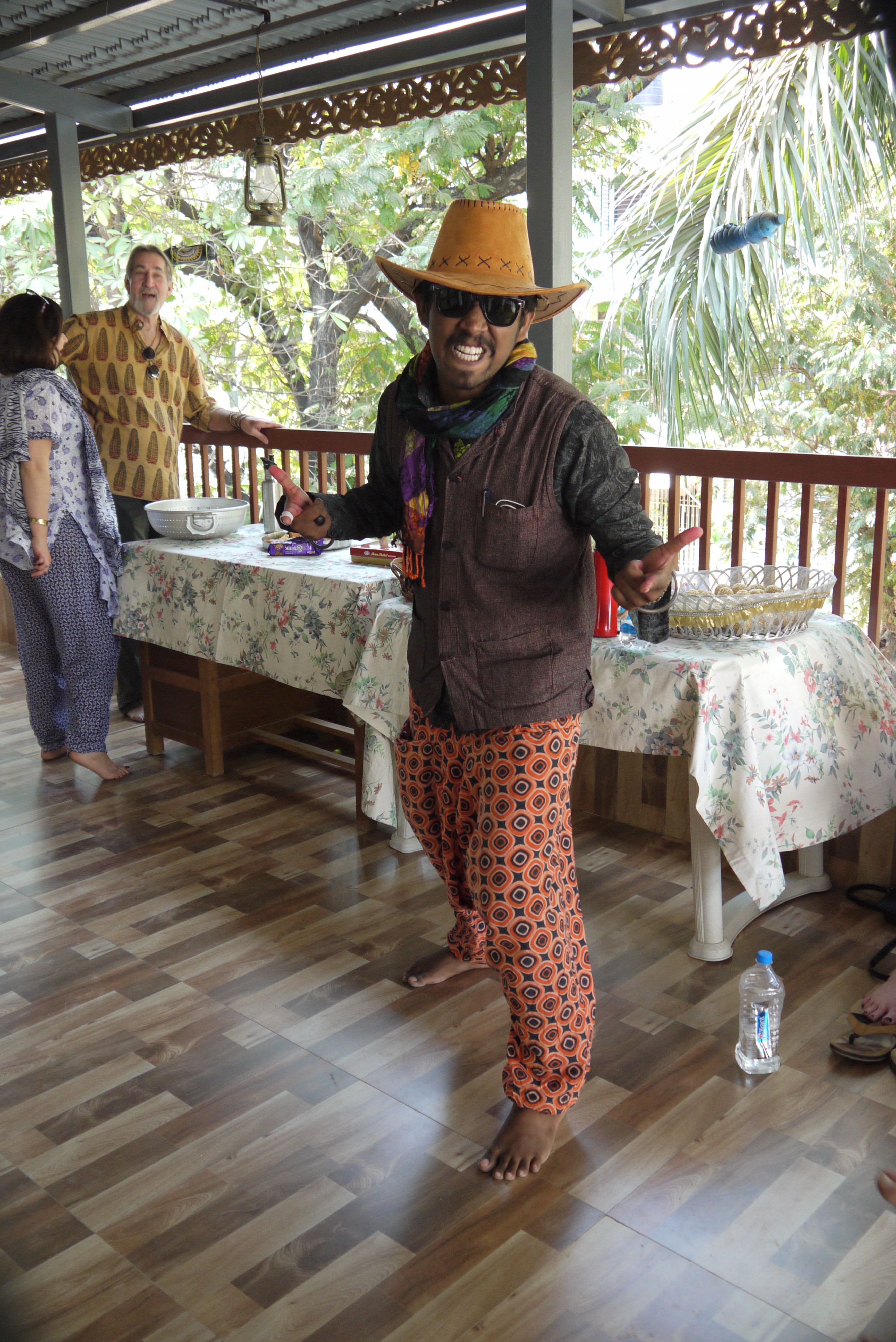
With a leather cowboy hat to protect his head from the blazing sun, Virren doesn’t give up on his own kites  Each time another kite is “cut” he whoops and hollers with his friends.  One person holds the spool of string, judging when to wind or unwind, while the kite flyer pulls the string up or down depending on the direction of the wind. Every rooftop is filled with people, flying kites, eating and drinking, having fun.  Many have loudspeakers with Gujarati Bollywood music blaring.  After all, what’s an Indian party without lots of noise! A food table has been set up, buffet style, with special treats like “jalebies”- a flour dough shaped like a pretzel and fried,with lots of sugar.

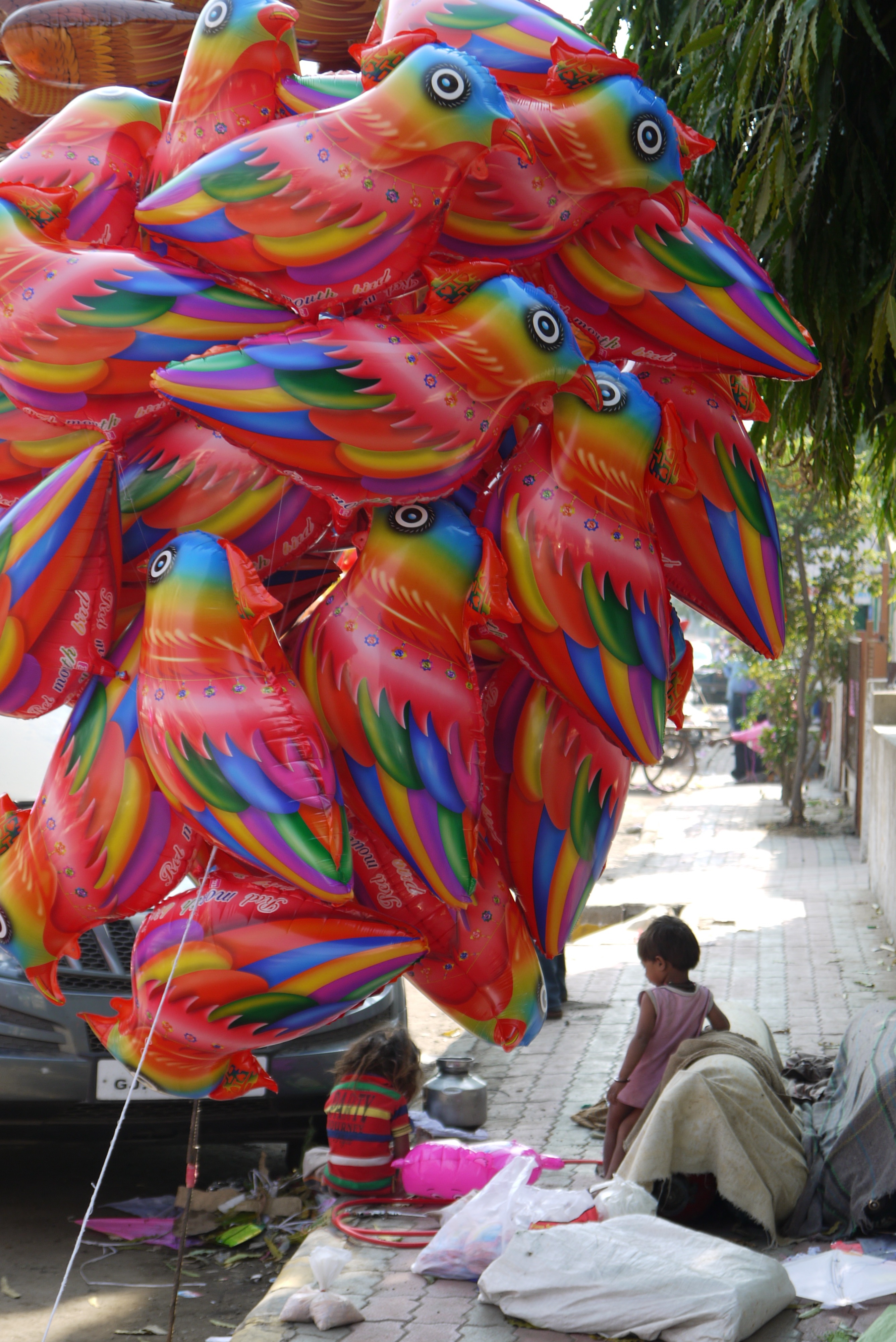
We decide to take a short break and check out the kite market around the corner. The scene is hectic with a carnival-like atmosphere.  Hawkers are walking around with balloons of varying shapes and sizes attached to a long pole-  Bollywood stars, parrots,hawks and crocodiles.  We choose a parrot and a hawk,  and watch the brisk sales as cars pull up to buy balloons and kites. And then we go back to the party.

Balloon extravaganza

Brisk balloon sales

As night settles in, the mood changes. Paper lanterns with flames inside(yet another illegal, dangerous activity) float through the sky.  It looks like stars and moon beams-hundreds of them- accompanied by bursts of fireworks. All this we  see from the large panoramic window of our hotel room. The day has been a wonderful ending to our time at Manav Sadhna.  For a short while, nothing else matters and all is well is the world.

Everybody loves to party at Virren-bai

Loban-“Performed by the Inmates of the Asylum under the Direction of the Marquis de Sade”*

Loban Incense stall

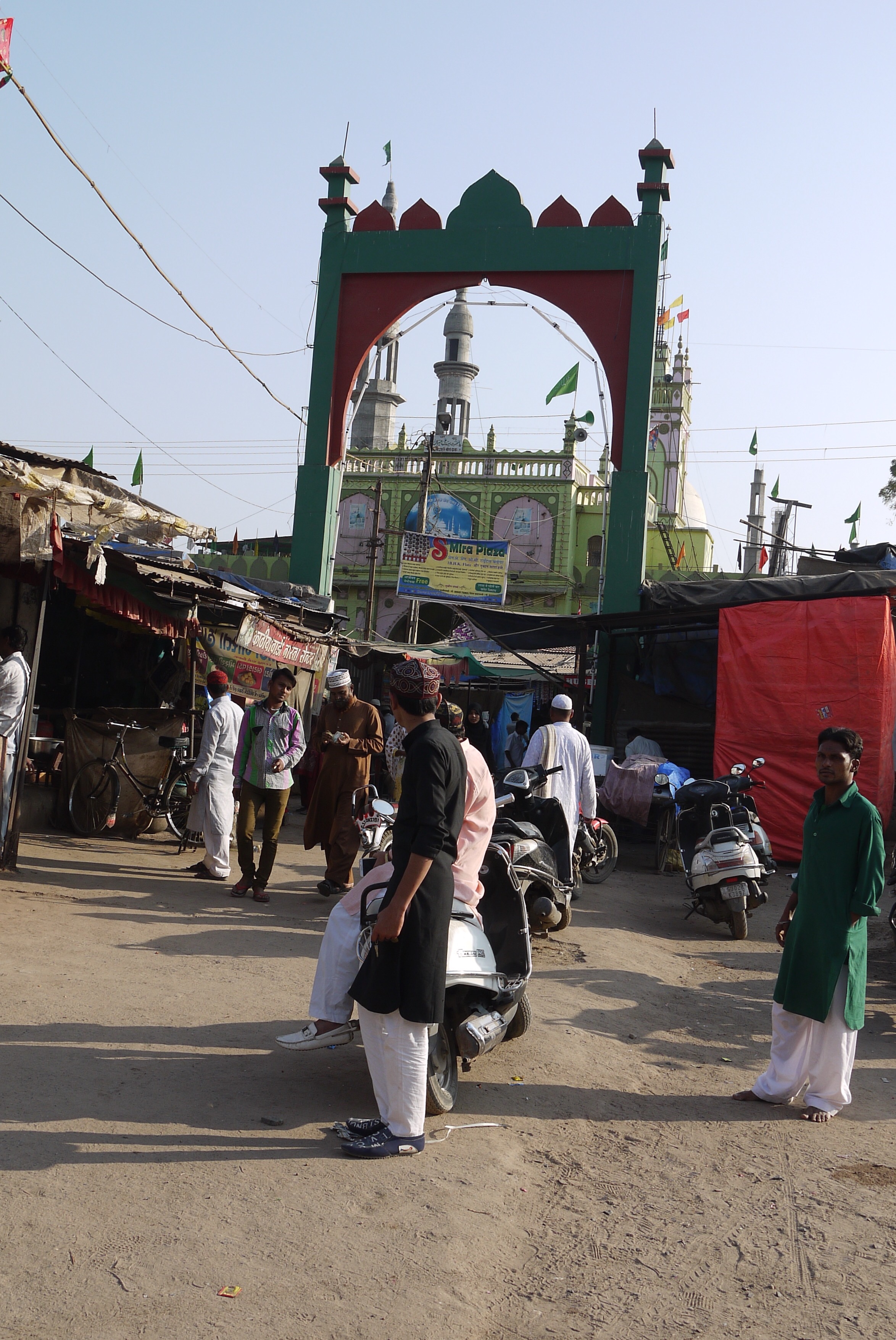
Don’t stare at anyone while they are in a trance, and no photography is allowed, it’s too intrusive”.  These are the directives given to me on the phone by Vanita, an Indian woman from Mumbai, doing a PH.D. on the psychology of trance in India.  Shaikh, our resourceful driver/guide from last year, escorted her and two visiting professors from the UK, to the Loban ritual the night before. She is staying in the village of Unawa, famous for the shrine of Hazrat Sayyad Ali, called “Mira Datar”(Mira=The Brave One, Datar=Giver or Bestower)  to study this surreal ceremony. I had been to one such “event” on our last trip- thanks to Shaikh,who understands my fascination with all things bizarre and mystical. Mira Datar is one of the most famous shrines where this ritual is practiced, and both Muslims and Hindus come from near and far for healing.

From their website:

This shrine is known for driving out evil forces and healing the ones,especially the women who are possessed by demons and evil Jinns. Over the centuries, the mentally affected or “possessed” Indian women have found a sanctuary here. The fame of this Dargah is spread far and wide and people of all religions,caste and creed visit the shroud year round with offerings and fulfillment of their vows.  Roses and incense are offered.

Mira Datar in Unawa,Gujarat


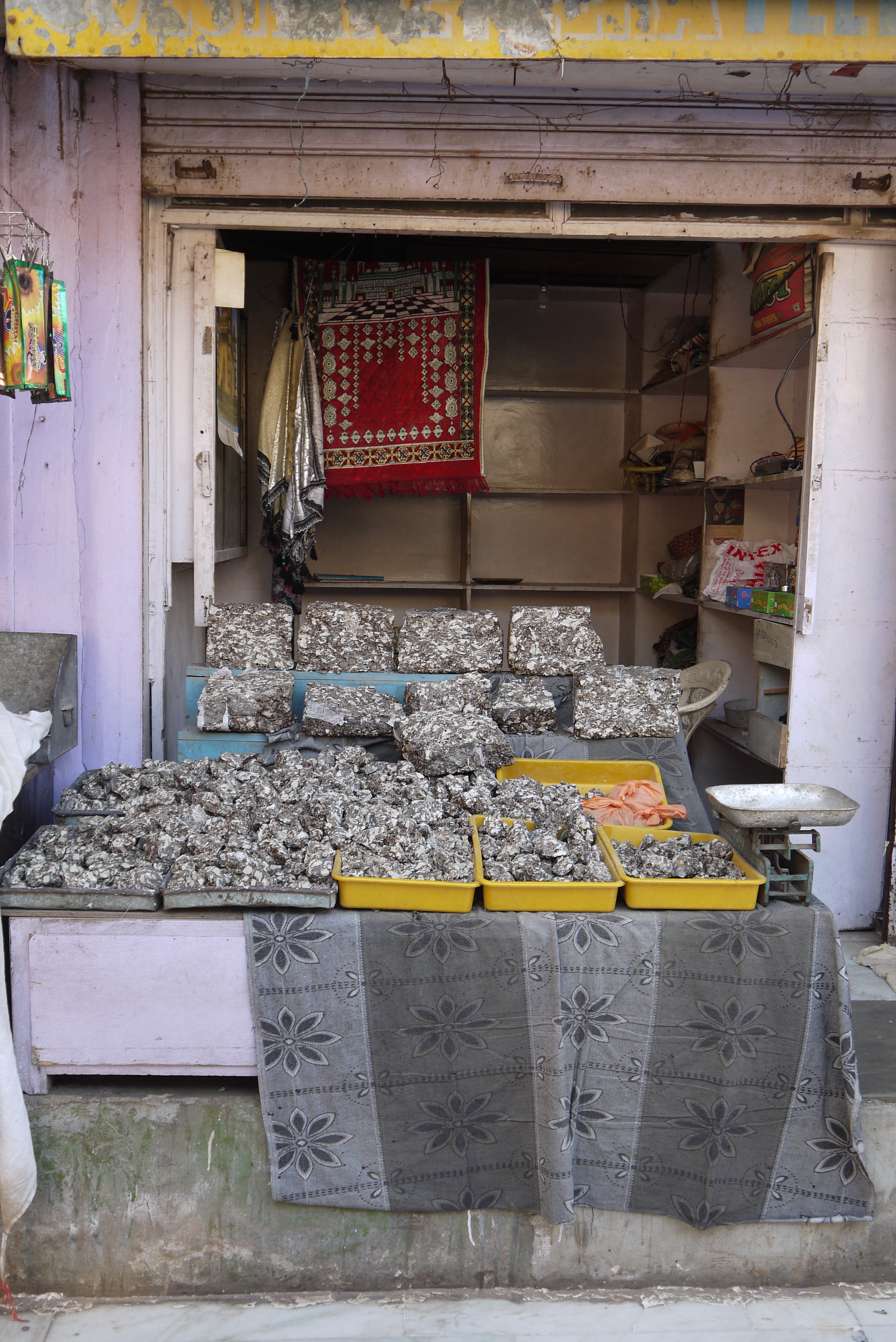
Loban is actually the name of the incense used to purge bad spirits from the body.  We know it under the name of Copal. Our arrival in the town takes us back one thousand years.  Streets are mounds of dirt and rubble.  Ragged beggar women and children roam the alleys with their hands out, murmuring unintelligible sounds. The air is heavy with the pungent aromas of smoke and grilled meats.  Booths are set up with huge woks filled with bubbling oil to fry the samosa. Although I  have been craving meat, since Gujarat is mostly a vegetarian state, I am not tempted to try any of the dishes being hawked. Everything feels dirty and unclean.

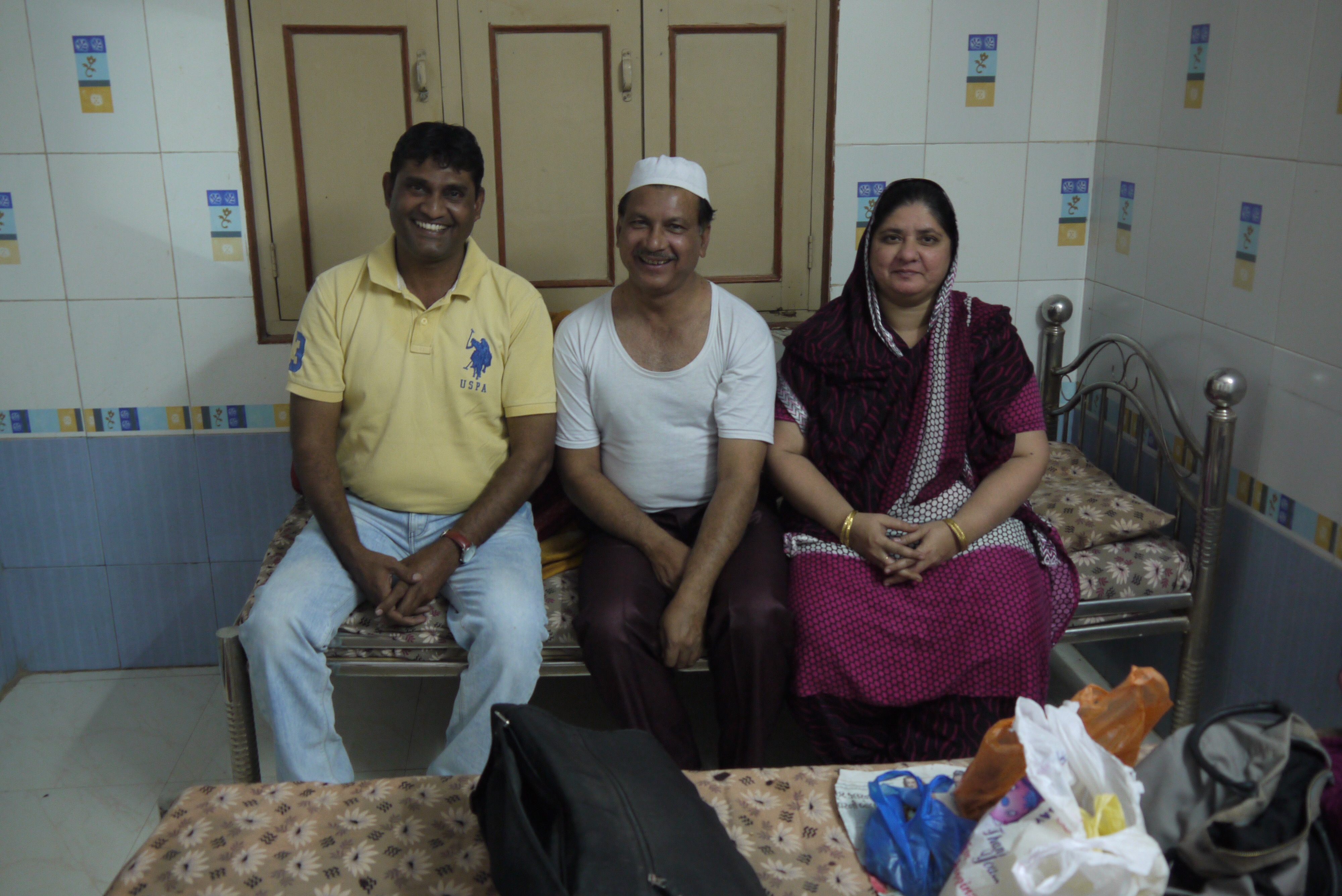
There is a ring of small guest houses encircling the main area. Pilgrims come from all over India, and those with more money stay in one of these hostels- designated by religion.  One for Muslims, another for Jains, Hindus,etc. Shaikh’s brother -in -law and wife have travelled overnight to visit the shrine and we go to their room for a visit and a rest.  The room and stairwell are immaculate.  Inside a tiny room are two simple beds and a small bathroom.  The floor and walls are tiled. A room costs 50 rupees ( 80 cents). He is a structural engineer and head of a large international firm.  When I ask why he has come so far to visit this shrine, he replies simply “I come from time to time to feel good”.

Shaikh with his family at the hostel


The entrance to the shrine and mosque

A tall gate marks the entrance to the sacred area leading to an impressive mosque. We remove our shoes. All along the passageway are sellers of incense, talisman, jewelry, trinkets and souvenirs. When we arrive inside the compound ,Shaikh takes us up a narrow,steep stairway. On the way up a group of young, well dressed girls comes hurtling down the steps, as if they have seen a ghost.  At the top of the stairwell I understand why.

Women of all ages dressed in tattered clothes,hair loose and disheveled,are walking briskly around a large dome in the center of the room with a crazed vacant stare. They are screaming, banging their heads on the stone, falling down, trying to attack other women, climbing up the wall, always circling,circling.  A family member stands near each woman ready to step in and protect their loved one from harm to themself or others.It is believed that circling the “chakki” (dome) seven times will remove evil spirits.

I am fascinated and mesmerized by the scene and at the same time a deep sadness comes over me. What must these families go through when they are at home and how do they manage to take care of these women? How many remedies have they tried, and do they really expect that a miracle will occur? I read on the website about the 10 foot snakes that came out of a man’s body in 1973, after he spent weeks praying and crying at the shrine to get relief from his terrible stomach pains.  Back downstairs we look for a spot to sit and wait for the ritual to begin. More and more people arrive and the crowd swells to well over a thousand.

One man has his hands and feet in chains- being led by two other men. A woman is doing somersaults on the cement floor and screaming- around and around they go, while the mosque fills up for evening prayer, women on one side, men on the other.  There are nine doors made of sterling silver in the inner sanctum where groups of people are being blessed under a small green holy coverlet.  I am seated next to a young woman from Mumbai.  She is obviously mentally disturbed and rambles on to me in English about her problems and how she was married and in engineering school, “but things are hard, people expect things” and she is unhappy.  Shaikh finds out from her mother that they have tried everything- expensive psychiatrists, medication, clinics, but nothing has worked.  They are hoping something will happen tonight.

Precisely at six thirty the imam starts chanting the prayers and the smell of the Loban permeates the enclosure.  We stand and watch the ritual unfold . There are no longer random ,wandering crazy people ;most of the women seem to have worn themselves out and are quiet.  Three or four khadim ( holy men who are descendants of the family of Hazrat Sayyad Ali) walk through the crowd while people push to get close enough to inhale the smoke. It is believed that inhaling the holy smoke can cure illnesses and bring good fortune.

It is now seven o’clock and the crowd disperses. I am mentally and physically exhausted and feel like I’ve been through a time machine. One of the amazing things about India is the juxtaposition of the modern world with primitive ritual.  Where else would you find sophisticated professionals mingling with simple villagers to talk with gods or exorcise spirits?

*nb- this is a reference to the play by Jean Anouilh “The Persecution and Assassination of Jean Marat as Performed by the Inmates of the Asylum of  Charenton under the direction of the Marquis de Sade”.  It was performed on Broadway in the 1970’s and was a masterpiece.

Thursday’s Children

Monday’s child is fair of face,

Tuesday’s child is full of grace,

Wednesday’s child is full of woe,

Thursday’s child has far to go

Friday’s child is loving and giving

Saturday’s child works hard for a living

And the child that is born on the Sabbath day is bonny and wise and fair and gay.

caption id=”” align=”alignnone” width=”538″] The community Center at Manav Gulvar[/caption]

The  classroom is bright and airy, a ceiling fan is turning slowly, and the children are seated on the floor in two rows, one against each side of the wall. Eighteen pairs of shining, black eyes follow us as we move through the space, getting the room ready for today’s project.  There is a hushed silence that feels like being in a church; each word we speak, each gesture we make, is observed with intense concentration by the children. We decide to make an accordian book of buildings with the children’s collages.  Five, ten minutes go by and I notice that no one has put anything on their board yet.  Nilam, the teacher, pulls me aside. “The children have never seen a real building, so they have no idea what to draw.  All they know are the small shops in their community.  I told them to just draw their favorite shop.”  I am stunned,speechless.  It never occurred to us that this was beyond their scope of experience. Gerald, whose heart is bigger than his size, is forever the optimist.  “Just wait.  Give them a chance, they’ll come around. All they have to do is look outside the window and copy the shrine or mosque, I’ll get them started.”

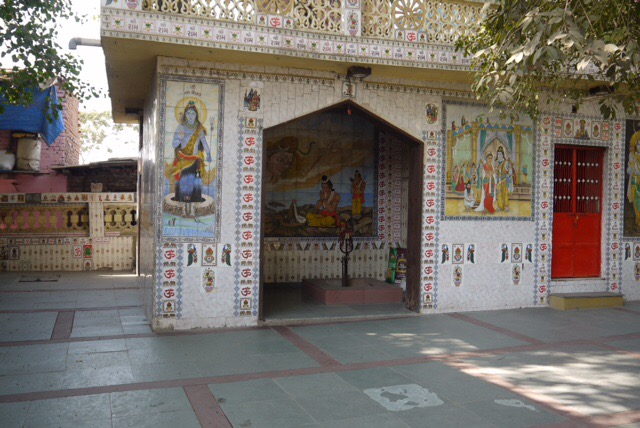
Hindu shrine in the community center

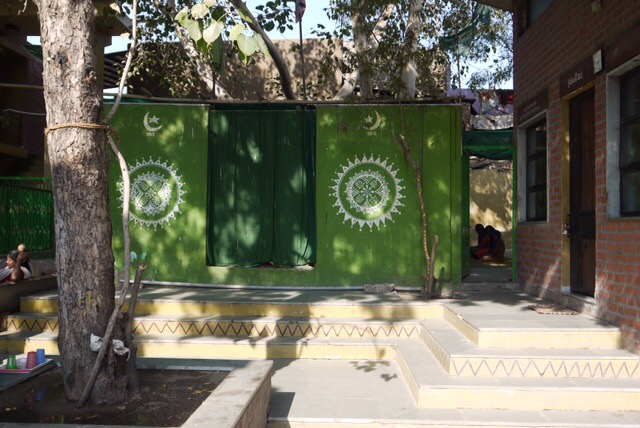
Mosque in the community center

Bea, one of the Spanish volunteers is in the room with us, as well as two Indian Americans who are there to translate from Gujarati.  None of the children speak either Hindi or English. We  go to each child and gently prod them to pick from the beautiful selection of colorful hand made papers we have brought with us, and paste something on the board. They are more comfortable with rulers and erasers and pencils, freedom is a luxury they have not experienced.

One of the older girls,Monisha,has already started to paste papers on a Hindu Shrine she drew.  Soon the others follow suit, some more slowly than others, but all becoming engrossed in the work.  Two small Muslim boys motion to me to come to them.  I don’t quite understand what they want from me,but the adoring look in their eyes has me almost in tears.  I think they want me to help, so I cut up some shapes and give it to them for their Mosque.  As Nilam passes by I ask her what they want.  She says they think I want them to put these shapes on the board, and they don’t want to do something wrong!


Two hours pass by quickly.  Children from other classes peek inside, smile, shake hands, give hugs, and even another teacher comes to join the project.  Bea and I decide to entertain them with Spanish songs.  I only know a few lines of “Malagueña” and “La Cucaracha”- but it does the trick.  They are all holding their bellies and laughing,shrieking and rolling on the ground in glee.

It is amazing for us, even after six visits to India, to be reminded how cut off some of the locals are, even in big cities. For a few hours a day, these children exist in a safe, protected, joyous and loving bubble. Maybe they do have “far to go” but it brings to mind Mother Theresa’s words

We can do no great things, just small things with great love

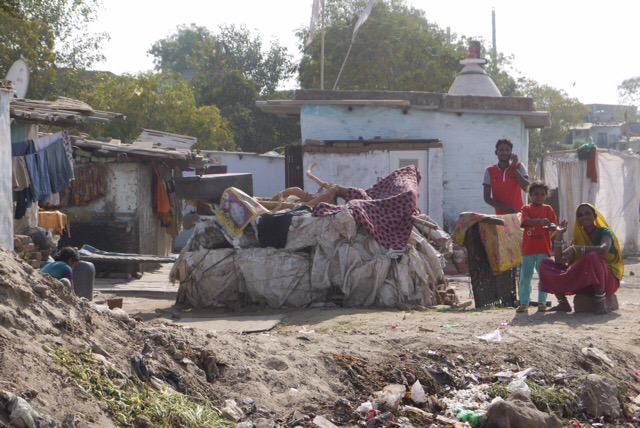
Gulvar slum

A very happy group with their finished project

Gandhi’s Dream is Alive and Well in Ahmedabad 

  It’s been almost two weeks since we started working at Manav Sadhna, a non governmental organization (NGO) located on the grounds of Gandhi’s former ashram. I’ve struggled to put my feelings into words. This has probably been the most difficult project we’ve worked on to date. A feeling of love and  compassion envelops you upon entering the ashram grounds, but the world outside is difficult to digest.  The negative things that people fear about visiting India are abundantly evident in Ahmedabad- the pollution, the poverty, the congestion, the beggars and the chaotic nature of a metropolis that is overpopulated and under developed.  We have never stayed long in big cities because of this, but were moved by the work we saw being done at Manav Sadhna last year.

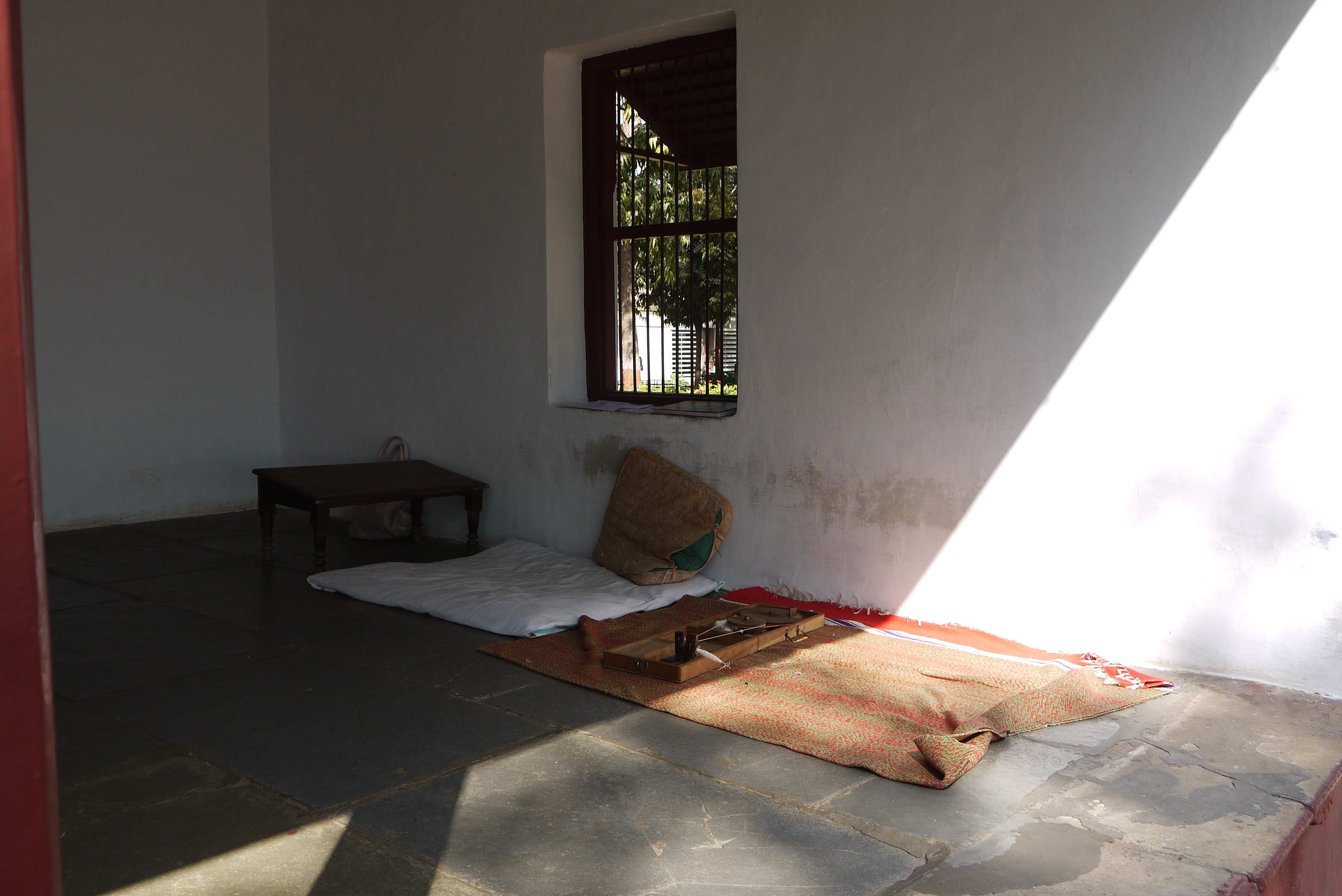
The scope of the organization is mind boggling, and every program is organized in keeping with Gandhi’s principles of loving kindness.   The original buildings on the banks of the Sabarmati river, where Gandhi lived for twelve years from 1918-1930, have been converted into a living museum.  It attracts flocks of visitors, mostly Indian,to relive a period in history that changed India and the world forever.

Gandhi’s living quarters

The banks of the Sabarmati River

Manav Sadhna- worshiping each individual as a service to God– was founded in 1990 based on Gandhi’s philosophy of “Love all, Serve all”. Walking through the grounds , the peaceful nature of the place  creates a meditative environment . Shoes are removed and left at the entrance of the main building , as a sign of respect.

Three women who work in the kitchen, sweep and clean the dirt and dust from the day before, as the entrance room fills up with  volunteers from around the world,many  of whom are  non resident Indians who have grown up in the USA . We  sit cross legged on a mat , and by now the workers have also joined the group. A tape plays excerpts from Hindu,Muslim,Buddhist,Christian and Jewish prayers, while the group bows their head in silent meditation. Each new volunteer is acknowledged with an introduction,drums, and a tikka (traditional red dot made out of vermilion paste)placed on the forehead.  A hand made paper garland is put around their neck.  In the center of a flower it says “Be the Change”, and each petal has one word written- “Beauty”, “Truth”, “Hope”, “Compassion” and “Love”. The volunteers talk about what they will be doing – teaching, arts projects,medical work,marketing,environmental, social welfare, women’s issues, etc. Many are repeat volunteers and have been coming for years-bringing supplies,skills and most of all,their complete dedication to the values of Gandhi.  And then everyone scatters to their respective projects.

Main entrance hall of Manav Sadhna

I am in awe of the work being done and the manner in which it is carried out.  There is a camraderie among the volunteers who work here in the various programs. Laura and Catherine are Pacific Islanders who live in California.Laura left a lucrative multi million dollar financial enterprise to start a charitable foundation. She is here to build homes in Nepal,Afghanistan and Pakistan. The lively contingent of five Spaniards have come for four months to do whatever is necessary, and organize yoga classes and silent spiritual meditation retreats. This weekend they are cooking  a Spanish meal for  Seva, a “pay it forward” cafe. It promises to be filled with music, laughter and lots of garlic. Ashish, a software engineer from Delhi, has come to set up a recycling operation as a profit sharing enterprise for some of the 40,000 women who spend their days scavenging the garbage dumps in the hope of salvaging enough junk to make a few pennies to buy food. We visited the program and felt his passion, as he described how each of the “sisters” is treated with respect,given health care, a fair price for their work, and a day (Saturday) which is reserved for some well deserved pampering.

Our work with the children has been mixed. The first group was very talented, and are employed doing part time work for the ashram, making paper goods to be sold at their retail store. Creativity and enthusiasm were both in full measure.  We were sorry to have to end our time with them and move to another group. The next class was at a brand new beautiful community center, built by a famous Indian architect deep inside one of the nearby slums. As we passed through the narrow lanes, with tiny, cramped cement block homes, feelings of sadness, despair and  wonder filled me. Living in these conditions is a daily struggle to survive, yet the smiles were bright and forthcoming.We visited homes where five or six people lived that were no larger than my bedroom and the walls were covered with mold and mildew.  Always we are offered chai, some snack, and as people wander in and out, it is obvious that family and neighbors are important and account for their incredible resiliency. What would be intolerable living conditions for us, is for them a daily reality.

It’s strange to feel “stuck” in our lovely hotel , rather than being out and about exploring the city,but all attempts  have been abysmal,frustrating and terrifying. Rickshaw drivers don’t seem to know where anything is, traffic is  at a standstill, and the belching fumes of exhaust are sickening.

Today was a great day. We worked at a new community center in a slum that is 60% Muslim and 40% Hindu.  To get there we had to drive on an unpaved road and then clamber up a dirt hill.  It was much poorer than the other two locations where we worked.  Again, the center was an oasis in the midst of extreme poverty. A Hindu temple and a small mosque were built  on the grounds., and this was an experiment in harmonious living between the two religions. The children obviously  had little previous outside contact and treated us as a curiosity.  It took a while for them to open up to trying something new, but then it was all smiles and creative energy. It’s really such a small thing we do with the children, a few hours of having fun and exploring new ideas- but they are so happy for the attention and respect.

Manav Gulzar slum

We finished the day by going to the Sabarmati Riverfront Festival, where Gerald had created and organized an interactive collage mural and an exhibition of the work done by the children at his workshops. Next week is the kite festival.

Manav Sadhna- An Oasis in the Desert

Early morning view from my window

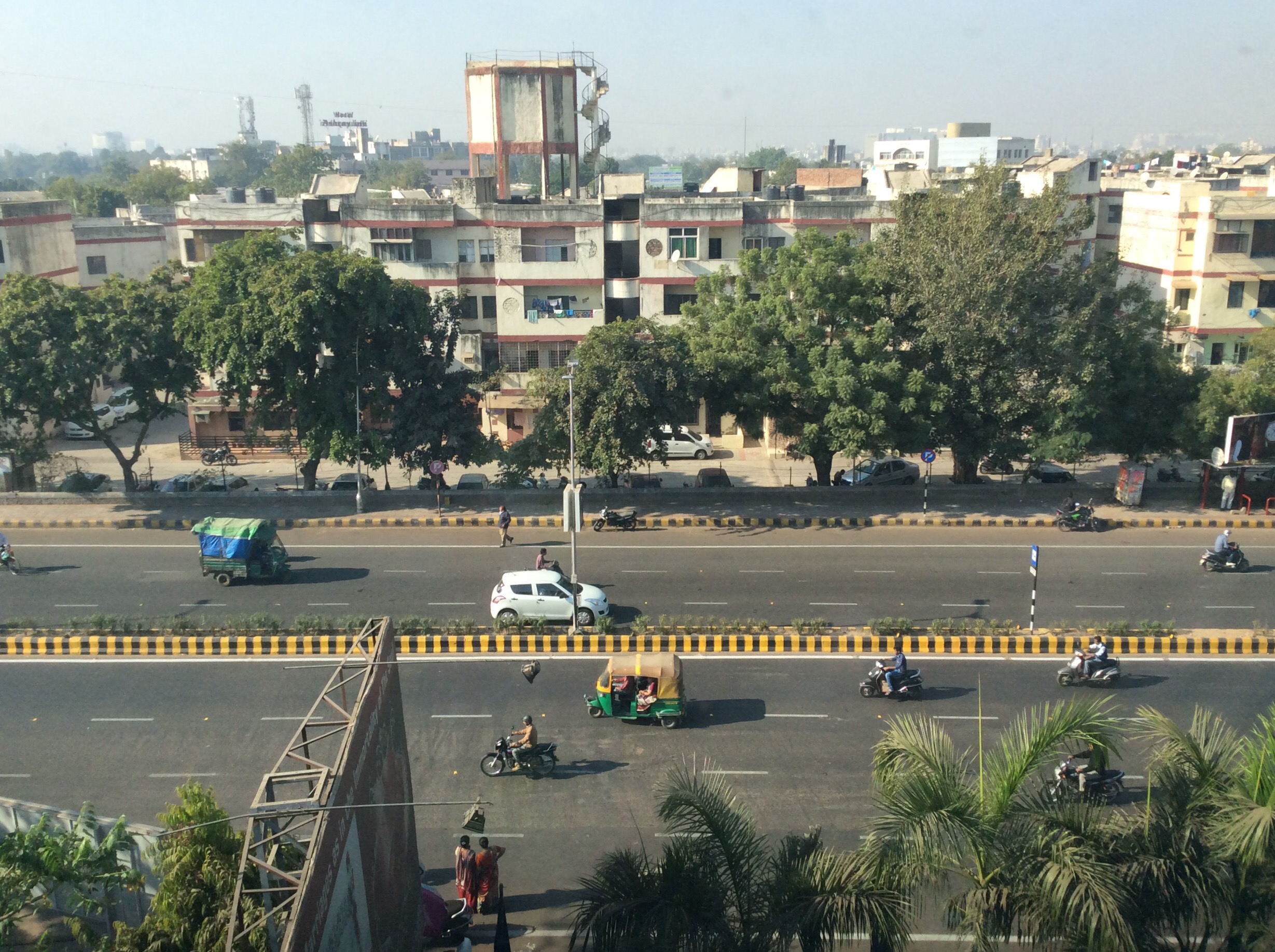
Today is a day like any other in a big South Asian city. Early in the morning, just after the sun rises at 7 am, people slowly start to appear- on roof tops flying kites, hanging out the wash, sweeping dust off the streets-all without any sense of urgency. Streets are eerily quiet at this hour, since shops open  informally at 10 or 11- even the banks don’t open until 10:30. As the day progresses,Ahmedabad, the capital city of Gujarat,becomes increasingly congested, with auto rickshaws belching their thick smoke, ancient buses rattling along, emitting intermittent blasts of exhaust. And there there are the people- three million of them. Crossing to the other side of the road from our hotel is a life-threatening proposition.  Each day 382 people are killed in traffic accidents in India. There are occasional traffic lights, but they are a suggestion, rather than an imperative, and few drivers pay any attention.  “Challenge the motos not the cars” is Gerald’s mantra.

We’ve come here, not for the sights, but to volunteer at Manav Sadhna, an organization on the grounds of Gandhi’s ashram.  Their mission is to serve the thousands of slum dweller families who live in and around the city. Our first day, Christmas,is a typical Indian experience.  Sharish, the volunteer coordinator at the ashram, has sent us an email. “The children are doing a Christmas celebration from 3-6.. Do come and you can see what the children are like that you’ll be working with”.  However,when we arrive at the ashram it is surprisingly deserted.  A young woman tells us “Oh, Sharish isn’t here, he’s at the riverfront for the Christmas celebration.”  No one has thought to tell us that the event is not at the ashram. By a twist of fate we meet the director who is heading that way in a van.

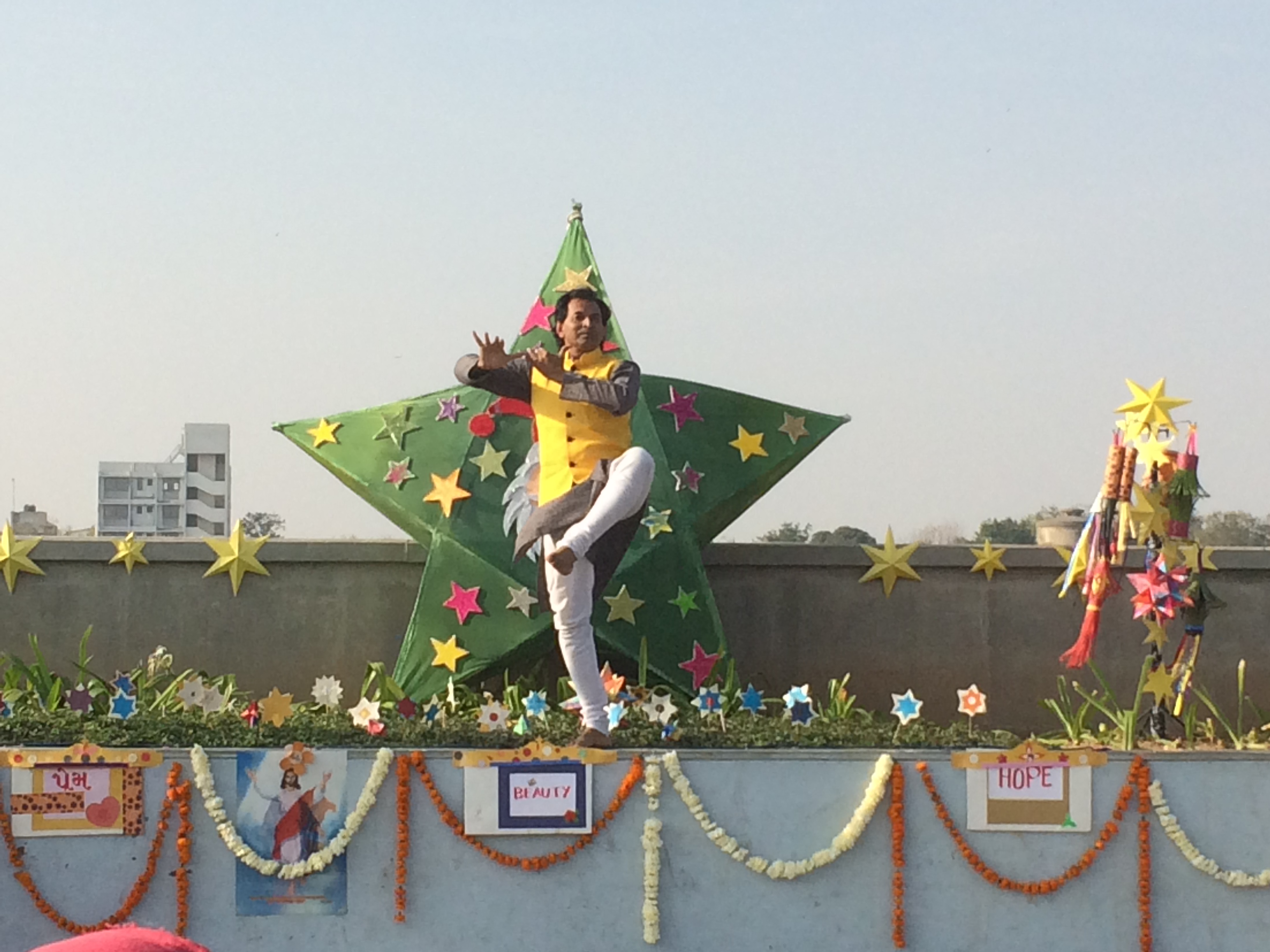
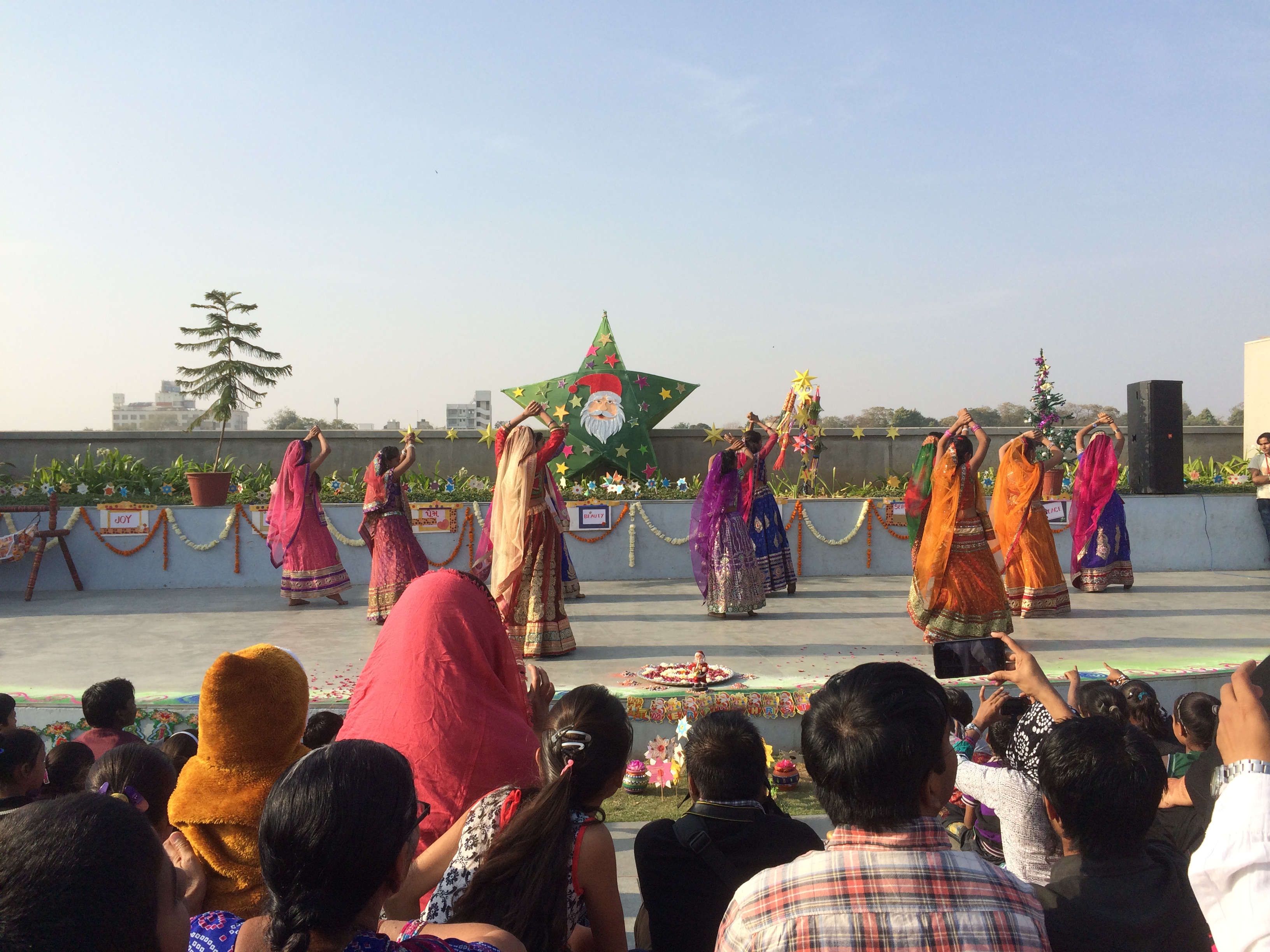
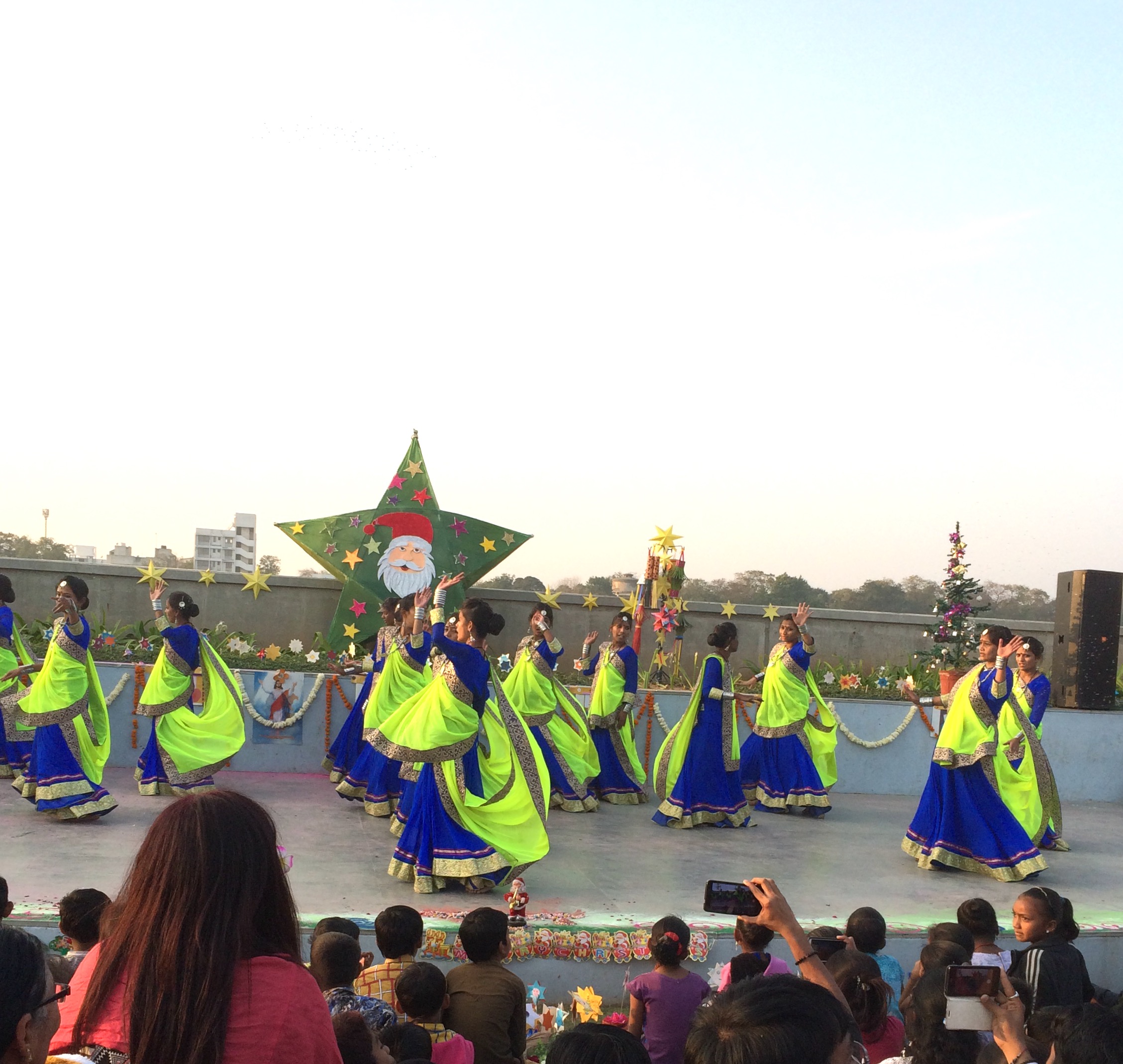
When we arrive at the venue there are easily a thousand people, mostly women and children, seated on the terraced concrete steps by the riverfront promenade. We are then introduced to Sharish onstage, and are shown to prime seats. These are children who spend their days scavenging garbage heaps looking for something they can sell for recycling. Manav Sadhna has organized recycling centers, cutting out the middle man and giving the women the money directly. By looking at the collected group you would never suspect their impoverished condition. Smiling, clean faces, groomed hair, and for the most part, nicely dressed. The show is amazing! Costumes have been rented and the dances are choreographed by an alumnus of the program- easily rivaling a Bollywood production. All this has been underwritten by a software company. An addendum to the program is a group of blind children singing and drumming.  Unfortunately there is only one microphone which gets passed back and forth between the drummers and the dancers, rendering each group mute alternately.

  1. imageimageimageAn auspicious beginning.

Bonfire of the Deities/Burning Man Kerala

A bonfire is blazing as we arrive at the village at 4:30 am. The stage is being set for what will be the most spectacular Theyyam we have seen yet.  The Kavu, or sacred shrine,in the courtyard of a wealthy Keralan landowner, is the setting for a seldom seen fire dance.  The three day Pottan Theyyam he has ordered as a blessing for his family and their new home is an expensive undertaking, and I am thrilled that we will witness this event. Theyyam looks similar to the more famous Kathakali dance theater of Kerala, but it is a religious event rather than a performance for entertainment. These rituals take place once a year during the months of December through March.

As dawn begins to break on this second day of the ritual,the temple attendants, dressed in lunghis(wraps), throw in another log each time the fire seems to be dying down. Sparks are flying and I move some distance away so as not to have my carry bag catch fire.  We are with two other westerners, who have been staying at our guest house, Angela and Annette from the UK.

It is still dark and the sun will not start to peek through until 7:00 am. The four young drummers, who played so vigorously last night for two solid hours, are snuggled together sweetly in the spoon position, on a blue plastic tarp in the “green room” ( the sacred space for Theyyam preparation).


Enormous pots are boiling in the back area of the house where a festive meal is being prepared for the throngs of villagers  who will attend the ceremony.We are offered tea with a typical Keralan sweet, and an invitation to enter the house.

Theyyam performers traditionally receive money from each person who lines up to ask for a favor or prayer, or  to thank the gods for wishes fulfilled. Last night two men personifed different aspects of the deity,Golikan.  Today there will be four deities,including the famous Vishnumoorthi  who will perform the fire dance.

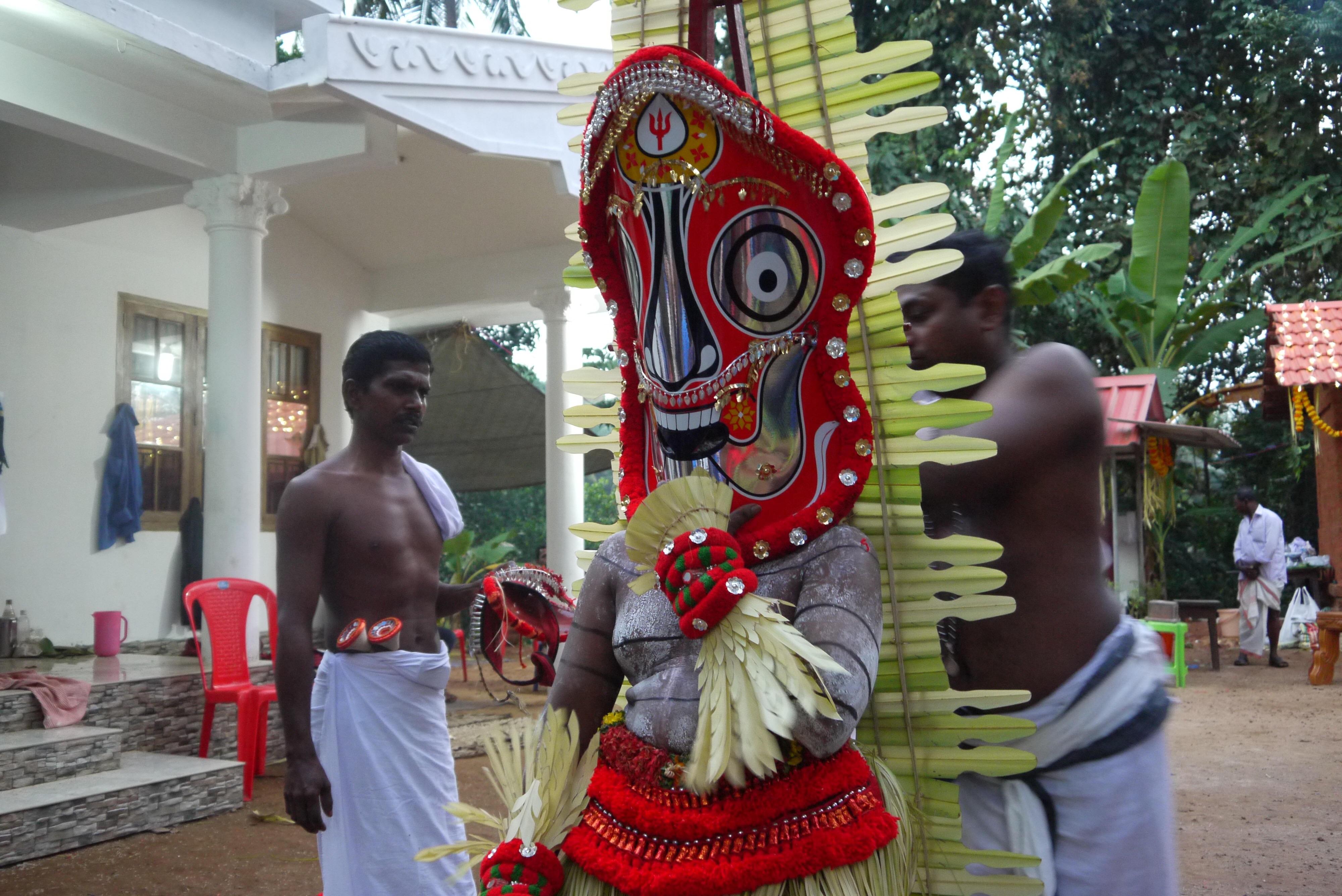
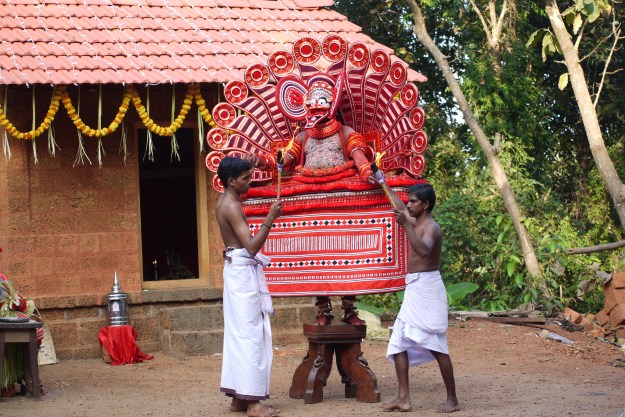
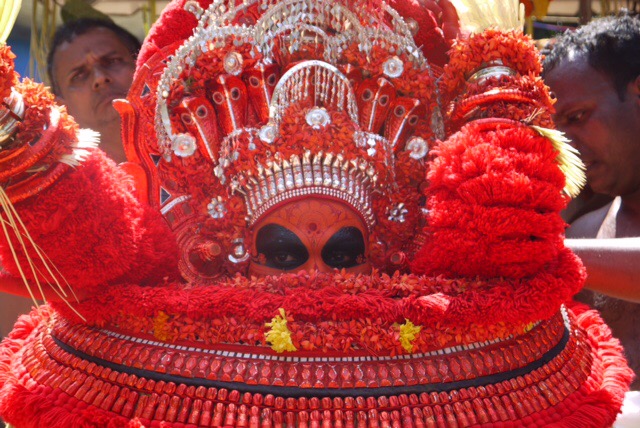
The first dancer comes out with a  20 foot headdress made out of banana leaves in the shape of a ladder.  He is wearing a large clown like mask painted a brilliant silver,red and black. First he blesses the shrine, then he encircles the Kavu,with the drummers leading the way. After an hour of dancing which includes highly skillful stilt-walking and recounting his story, he is seated on a type of throne, with his headdress resting against the wall.  Next comes a Theyyam with an elaborate red hemispheric shaped headdress bordered with peacock feather designs,a mask with large ear flaps and mouth,and  a skirt created over a rectangular frame.   I remind  both Annette and Gerald to make sure not to forget to stand when the deity passes by (a sign of respect).  The night before, Gerald was so engrossed in his drawing that he didn’t notice that Golikan was right in front of him, remained seated, and an angry deity glared and threw rice in his face.  The same with Annette who was so in awe of seeing Theyyam for the first time, that she,too,didn’t get up. She got the stink eye.


p1080119

Meanwhile the fire has been smoldering and the attendants make a neat pile of the burning hot coals, getting ready for the arrival of Krishnamurthi who will lay down on the ashes.  His mask has been resting in the house after having been blessed, surrounded by ghee lamps burning all night. Both the first and second deity are now seated, receiving villagers and talking with each one individually. The tension mounts as the drummers continue their fierce drumming, jumping in unison high into the air from time to time.  I can’t imagine how they can keep this up- it is now 10:30 in the morning and they have been going at it since 4.


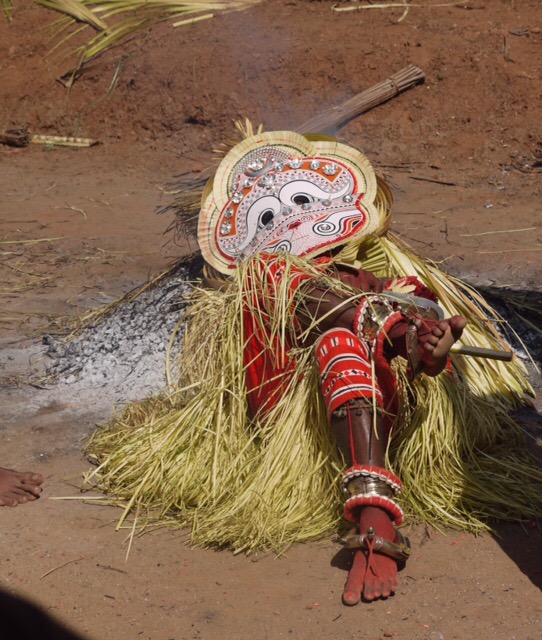
Krishnamurthi arrives in a grass skirt made out of young banana leaves, heavy metal ankle and arm bracelets, and a mask. When the moment arrives, he is led to the burning coals by the temple attendants, one on each arm.  I think it will be quick, but no, I am wrong.  After a bit of positioning, he lies down, crosses his legs, and makes himself comfortable.  Each of the other two deities approach, bend down and have a few words with him.  Then, suddenly he jumps up, changes direction, and lies back down.  This is repeated in all four directions.  The intensity of this Theyyam requires the performer to prepare for forty one days. Complete abstinence from sex,alcohol,tobacco and meat. His mind and body must be sharp and focused.


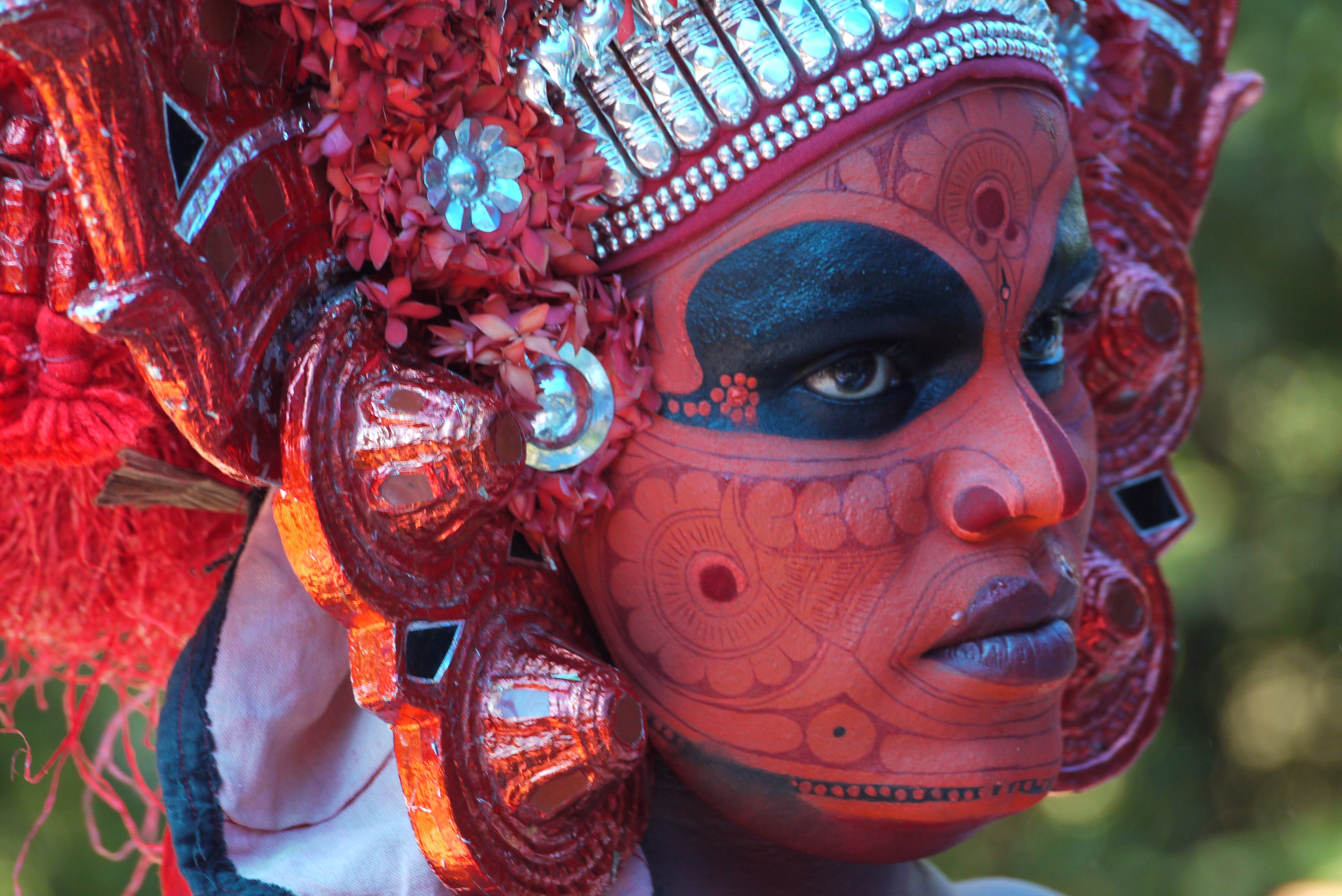
Preparation for the final dancer reveals a completely different facial design- with orange colored turmeric paste and black charcoal around the eyes. An intricate pattern, called “face writing” is drawn with a brush made from banana leaf. Only his head and arms stick out of a huge grass skirt. Red cloth bands are on his forearms and silver bracelets on his wrists.


The climax arrives with all four Theyyam interacting and dancing around the courtyard.  By this time it is noon and the sun is beating down on us until we feel like we will collapse.  It reminds us that although our minds and spirits have been transported  to an alternate reality, our bodies are still very much in the tropics of the Malabar coast. Hundreds of villagers are mulling about, eating, drinking tea, talking on their cell phones or standing and taking close up photos. We are treated as honored guests due to my blond hair, and Gerald’s size.  Chairs are set up for us directly in front of the action to ensure the best photos, and we are made to feel included at all times.  The women beckon to me to come on the steps of the home in order to get a better view, and push me almost directly into the path of Vishnumurthi as he enters to bless their home.

I am sad to leave tomorrow, but we are heading north to Ahmedabad where we will start our teaching at Gandhi’s ashram. The Theyyam has left an indelible mark on my psyche which I can never forget. And I will carry the vivid red of their costumes and the pulsating rhythms of the drums with me throughout the rest of the journey through India.