
Plaza de la Revolucion
Delta Airlines flight 488 from New York touched down in Havana at noon on January 7, 2017, carrying myself,my daughter,Naomi, and a few dozen other tourists who were taking advantage of the recent opening of flights between the USA and Cuba. The airport was small and dingy and the heaviness of the humid air permeated my skin. Off came our down jackets and scarves. We looked around for a sign with our name, hoping that the pre-arranged taxi driver was there to pick us up. Nothing. Meanwhile, I searched anxiously for something resembling a toilet. The tired-looking woman attendant at the entrance had a small dish with coins, and motioned for me to drop some in, but I had no Cuban money yet, so I timidly slinked inside. The toilet had no seat,there was no toilet paper,the flusher didn’t work, and it was obvious I wasn’t the first person to use it that day. It didn’t take long for me to realize that this was going to be an eye-opening experience.


A solidly built man in his forties, with dark skin and a big grin, dressed casually in long tan pants and a loose shirt, waved a piece of paper with “Deborah” written on it. As he ushered us to his 1950’s era taxi, painted red, and upholstered with the Cuban flag, he whisked out a bottle of Havana Club rum, took a few swigs, and offered us a drink. When we politely refused, he looked at us incredulously and said “Are you sure you don’t want some? Bienvenidos”. Welcome to Havana!
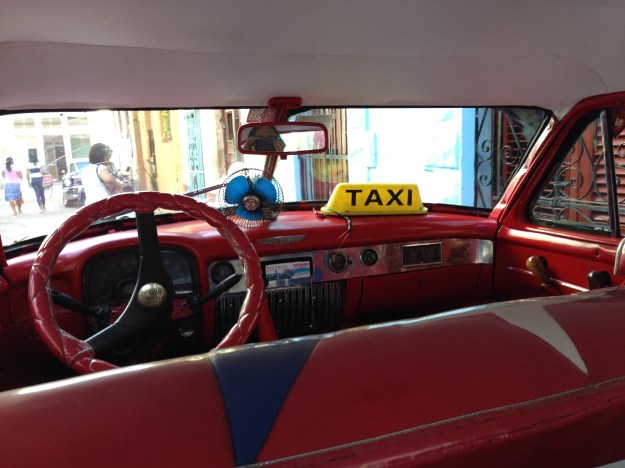
Our Taxi
On the way in from the airport we passed signs and Billboards with political slogans and pictures of Fidel or Che Guevara.The city itself looked like a mix of magnificent deteriorating colonial buildings and a war zone. In each doorway people were either chatting with passersby, or sat at a small table selling bits and pieces of fruits, vegetables or other essential items.The streets were alive with animated conversation, whistles, loud music, and the mood was definitely upbeat.


But what were those lines everywhere? Cubans earn between $15-$20 a month, with top salaries of $40 for doctors, engineers or other professionals. Health care and education is free and each person receives a ration book for food supplies. There are two types of stores, ration stores and CUC stores (where you can try to buy whatever you cannot get with rations). and two currencies – Cuban pesos for locals, and CUC (Convertibles pesos) for use by tourists, and in non-ration locales. When the bakery had bread, for example,- a big line would form. Nobody goes hungry, but the choices of food available are meager, and both ration and CUC bodegas, or supermarkets, have mostly bare shelves. It became obvious to me that there are two realities of life here- one for locals and another for tourists.


I hired a private tour guide for three days to help me navigate my way through Havana and get as much out of the short visit as possible. Mila was 34 years old, recently married,had a Masters Degree and had been teaching Spanish to Chinese exchange students at Havana University. Although university education is free, the government decides what you may study.
“When I got married,the government gave us a free night in a hotel, a case of beer and a photographer to record the marraige. That’s the closest a Cuban will get to going on a vacation. But’s it’s not like that anymore, they cut it out.
When the contract ended with the Chinese government I lost my job at the university. I’m happy to be working as a tour guide now because I want to save money to have a child. It’s hard convincing my brother that he should go to university because he feels it’s pointless.”
The US embargo, called “El Bloqueo”, the blockade, in Cuba, has definitely had an enormous impact on the country but that can’t account for all the problems and poverty I saw. Many people loved Fidel, but resented their limited opportunities for advancement. I came with an open mind and few expectations, only wanting to experience the vibrant culture of arts, music and dance, but left with a feeling of disappointment. I see a two tier system evolving, not unlike the situation before Fidel took power fifty years ago. The cruise ships have returned,and students on Spring Break can find a cheap vacation.


It’s been difficult for me to digest and understand my feelings about Cuba. As a western traveler I am obviously wealthier than the locals. But the feeling of optimism I have encountered over my many journeys these last twelve years in Asia, is conspicuously lacking in Cuba. In those countries (particularly India) the knowledge that education and family planning can enable one to rise out of poverty, gives people a greater sense of hope. That’s why my focus has been with nurturing and supporting educational opportunities for girls. I realize my observations are colored by the disappointments I experienced due to the short period time I spent there, the difficulty in establishing meaningful contacts with people in the arts as I had hoped, and the lack of decent infrastructure.


I know many Americans will be flocking down to Cuba to see a country that has been forbidden to visit legally for fifty years. Sadly, I feel that this influx is too much, too soon and will destroy the beauty of Cuba’s identity and culture. My advice is to be sensitive to the culture, enjoy the music and the outgoing, warm, friendly people and try to understand the history.
 THE DREAM OF DISTANT LANDS