Tag Archives: Goa

Trouble in Paradise/The Turtles are Coming

It’s chaos now in Agonda. What with the new Turtle Nesting Legislation and the 28% tax! Nobody knows what is going to happen. – Terry Fernandes, owner of our resort

Agonda beach in Goa has been our secret retreat since we first came here ten years ago. Most savvy travelers eschew Goa because of its reputation for overcrowded beaches,noisy bars and general mayhem. But Agonda is different. It is a small fishing village made up mostly of descendants of the masala mix of Portuguese and Indians. Its quiet calm and absence of discos and nightclubs is the major draw for Indian and European visitors looking for a peaceful escape. There is an easygoing balance between the locals and the tourists.

Last year it was discovered that some Olive Ridley turtles had nested on the beach. Each of them lays hundreds of eggs between November and April and the incubation period is forty to fifty days before the babies can swim out to sea. The government decided to set up “Turtle Nesting” zones for eventual development as tourist attractions and enacted legislation prohibiting any and all structures within two hundred twenty meters (about 700 ft.) of the shoreline. Marine turtles are considered “vulnerable species and have the highest protection status.”

Agonda’s economy is primarily based on tourism. Local merchants protested to the government and managed to get a temporary stay order. If the stay is overturned Agonda will effectively cease to exist, as almost all of the lodgings, stores and restaurants are within this arbitrary boundary, and will have to be razed.

I saw no signs of turtle nesting anywhere on the beach and the constant zipping around of the beach patrol truck certainly doesn’t do much to show that the government is serious. It is astonishing that they would imperil a flourishing community.

Living in California I have the utmost respect for environmental protection, but the priorities seem a bit lopsided in a developing country like India where human needs are overwhelming.

After our exhausting thirty six hour journey we experienced some initial disappointment at the changes in our beloved beach experience. We were saddened to hear that our favorite chef and friend,Frances,was in a motorcycle accident and was was forced to close his restaurant where we dined nightly. (Notice that I say “dined” not ate- he was a master chef and a true artist in the kitchen and I looked forward to his nightly creations.) The political demonstrations due to the new citizenship laws enacted by Prime Minister Modi, as well as the bankruptcy of the travel agency Thomas Cook have also had a major impact on tourism.

Our disappointment was short lived as the wonder that is India kicked in.

Last night was a “live music” performance featuring a father and his eight year old daughter, Meghan,visiting from Bangalore. While he calmly played the guitar, this diminutive energizer bunny belted out “Purple Rain” and “This Girl’s on Fire”. She was enthusiastically enjoying the attention of being in front of a crowd of appreciative listeners. She was cute and she knew it.

When her set was over she came over to the table where I was sitting with a young Belgian couple because she saw me mouthing the words to a song her Dad was singing. “How do you know the words?” she gushed. Satisfied that I knew a bit about music she then started jumping up and down, flicking back her long black hair like an MTV diva, and proclaimed “I want to be a singer!” Dressed in a pink flowered jumpsuit her attitude belied her eight young years, and she didn’t stop jumping for an instant. I asked her how long she thought she could keep on jumping up and down and her response came quickly with a mischievous smile- “Forever”.

The audience was made up of first time visitors to India, long time expats as well as young and old Indian families.Everyone was having such a good time that we didn’t care if sometimes her voice didn’t quite hit the right notes. This sense of family and community is the Agonda that I love.

Thankfully the old adage “The more things change, the more things stay the same” proved true.

The Wedding


image

Decorations for the engagement party

Dressed in jeans, with a baseball cap covering his shaved head, Dixon introduces himself to us at the engagement party.  “I hear you’re from California.  I studied oenology  at Napa college for four months a few years back.” That’s India. Just when you think you’ve heard or seen everything, you haven’t. Wine and India are not two words you expect to hear in the same sentence.

Dixon worked many years on Carnival Cruise ships and was paid by the company to take the course. “Wine Professor “is his new title and he teaches classes for hotel personnel in wine appreciation. “I’ll be the MC at the wedding” he tells us.

image

When we arrive at the church, the pews are already full to capacity- women elegantly dressed in their best saris and satin dresses and men wearing black suits and ties. Gerald is in his safari shirt and cargo pants and I am wearing my wedding attire and  the silver, sparkly heels Francis’ wife lent me for the occasion. We discretely seat ourselves in the back, and listen while the ceremony is conducted in Concani ( the local language).The church is beautiful.  It is a large white building with stained glass windows and chandeliers.  The congregation is alternately deep in prayer or singing hymns along with the choir.

img_0015

After the ceremony people line up outside the church to greet the newlyweds. At the far end of the courtyard it appears that after the guests congratulate the couple, they are receiving something. We are motioned to join the line.  I’m feeling a bit excited about the prospect of getting a “wedding treat”. It turns out to be a box of mango juice and a hot dog bun filled with shredded lettuce and mayo. So much for local delicacies.

Greeting the bride and groom

The bride and grrom arrive

The invitation states “reception commences at  seven thirty  in the evening at Dr. Neville’s Wedding Hall” but we are told that IST ( Indian standard time) dictates that guests  start arriving closer to nine. Nonetheless, we arrive promptly at 7:30 pm and enter an enormous outdoor wedding venue, lit up like Disneyland. Tables and chairs are set up around a lake with fountains and lush landscaping.

image

True to form,  with the band playing “Rhinestone Cowboy”,people start trickling in  at about 9:00. “Ladies and Gentlemen, please come onto the dance floor and welcome Mr. and Mrs. Cordozo appearing for the first time as a married couple.” It is Dixon with a microphone, standing in the center of the open space. I don’t recognize him at first,dressed in his snazzy suit and dapper hat. From there it all proceeds as on a cruise ship, with Dixon exhorting us  to clap, cheer and dance, first the Mexican Hat dance, then the Bunny Hop and eventually some Goan dances. The place is rockin’. Once the music starts ,I get up and step out onto the dance floor, forgetting about my growling stomach. The music is mostly pop and some Goan contemporary, and alternates with the MC announcing what exactly we should be doing. ” Happy to see California doing our Goan dancing”, I hear from the microphone while I dance with Francis, his wife and daughter.


When the announcement comes that the buffet room is open, it is almost 10:30pm.  The food looks impressive and abundant, but unfortunately isn’t  much better than the pre dinner appetizers of little white bread peanut butter and jelly triangles and minced meat rolls which looked like miniature dog turds.

Round midnight I need to rest my weary bones ,  so I drag myself off the dance floor,and look for Gerald, who is sitting at a table and chatting with some local guests.

Its been a great evening and we decide it’s probably time to go.  Another glimpse into incredible India.


Whose life is it anyway?

image

While buying train tickets to our next destination in Kerala, I bump into Catherine, a long time British ex-pat we met last year. “If you want a good story, go down to the end of the beach to the “maharajah’s place”, she grins mischievously.

The face of Goa has changed dramatically since independence from Portugal in 1961. Goans were offered the possibility of a Portuguese passport, and many jumped at the chance.  Catholics now account for only 25% of the population, down from 60%, due to the diaspora of Catholics, and the increase of Hindus and Muslims with their large families.  Cruise ships,the Merchant Marine and the Emirates offer high paying jobs, which is reflected in the unusually small size of Goan families. (Men are away  for long periods of time.)

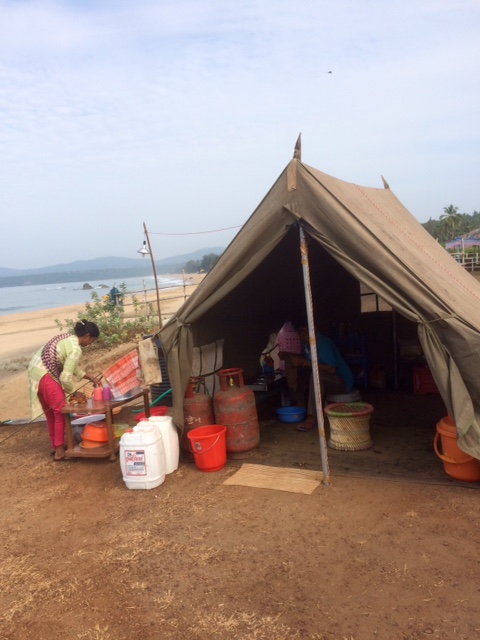
For our morning walk we decide to check out the “maharajah”. At the end of the long sandy stretch of beach  there is a small cove, and we see a cluster of tent structures and a trailer. A man and a woman are busily washing and cooking inside a “work tent”.  They are obviously the servants. In front of the elaborate trailer with solar panels on the roof, sits a neatly bearded man with a gold earring in his left ear. He looks relaxed and carefree in his lounge chair.

image

The servants working

As we hesitantly approach, he beckons us to come closer. ” I’m Nenni”, he says with a broad grin as he extends his arm for a handshake. Rather than being the “maharajah” himself , he is the driver. “It took us nine days to drive down here from the north. My boss arrives tonight. He is from a royal family, you know. He owns many agricultural farms and businesses. Every year he comes down with his wife and stays for three months”.  We get a tour of the complex.  The blue oblong tent is the outside shower for the servants.  Inside the trailer there is a bedroom with flat screen tv, fully equipped bathroom and shower, and room for lounging.  The outside is fitted with fold down shelving, and storage bins. The dining gazebo is covered in white canvas material, and an electric fan is is blowing the air around the neatly set table. There are two other tents which are for the servants.

Shower tent

Shower tent

image

dining gazebo with ocean view

NENNI’S STORY

Nenni is a man in his early forties and was born as the only son into a Sikh family. At the age of 17 he decided he wanted to go abroad to work, so he cut off his hair, and removed his turban.  Sikhs have a religious obligation to be unshaven and let their hair grow, covered by a turban.  His fear was that he would be mistaken for a Muslim, and  he wanted to avoid being conspicuous.  Because of this act of rebellion he was disowned by his family. After some years living in Europe, he returned home and was accepted back, and  soon a marriage was arranged. ” We just didn’t get along, so I got a divorce.  Now I will get married next week to a Hindu lady.  I am happy and will open my own chicken restaurant in my village”.  When I asked if he had children, he replied that he has two but doesn’t see them often as they live with their mother far away.  We left with handshakes and hugs all around and our promise to visit him and eat at his restaurant when we pass through that area at the end of our journey.

Marriage Goan Style

” Whose wedding are you going to?”asked the young shop girl with a twinkle in her eye. I had already been asked the same question twice before as I scoured the shops of Agonda for a “wedding envelope”(used to place money as a gift for bride and groom). Agonda is a village in  southern Goa, which has managed to maintain its small town character and warm,family atmosphere, despite the influx of tourists to this wonderfully idyllic seaside. It is predominantly Catholic, which is evidence of the Portuguese occupation from the early 1600’s until as late as 1961. The church and its activities play a central role in the daily life.

At first glance one would think that the women are all pregnant – -a small “bump” protruding from their flowered, waisted house dresses. Upon further inspection it appears to be a body type rather than a condition. Their wavy, black hair is tied back into a bushy ponytail , and their smiles are broad and welcoming. Almost everyone has Fernandes as a surname and is somehow related to one another. The few Hindus that remain wear traditional saris  or salwar kameze(a long tunic top with pants), but for others this has been long ago  been replaced by western wear, due to prolonged contact with missionaries.

“My cousin’s daughter is getting married next week and the brides family is having a luncheon here on Sunday, do you want to come” asked Francis, our chef friend. (I wrote about him last year-The Sailor and the Saint). I’m always up for a wedding, but that also presents the challenge of finding clothes and shoes for the occasion. When you travel with only a carry on bag, there’s not much room for such luxuries. I did bring my “acceptable” wedding outfit, hoping  that I would get the opportunity to wear it, but I forgot my bling flip flops. I figure no one will look at my feet anyway.

Sunday arrives and Gerald asks if he has to wear long pants. It is hot and humid and he’d much rather wear shorts. I say that out of respect he should. I put on some make up, my best Indian costume jewelry, a blue paisley skirt and my clunky black Tevas.

Decorations for the engagement party

Decorations for the engagement party

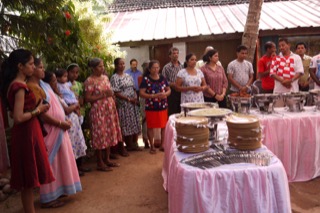
We arrive early, hoping to get a good seat, Francis says they are expecting almost 200 guests. The night before, the restaurant was a flurry of activity as the “aunties” decorated the courtyard with sparkly,gauzy fabric and greenery and the men started setting up the chairs. Of course we are the first ones to arrive,in time to watch the last minute preparations.

image

the “aunties” overseeing the food preparation

As people start to trickle in, Gerald turns to me and says sadly “All the men are wearing shorts!” And yep, it’s true. There is a sprinkling of men in long pants, and women in satin dresses, but for the most part it’s casual. I’m told that the wedding party on Tuesday night will be a formal affair and despite the heat, the men will be wearing suits and ties.

image.jpg

women and children section

A table has been set up where the westerners congregate, and the rest of the chairs have women and children in one section and men in another. There is a dj playing pop music and drinks are served. I decide to have a Feni, a local brew made from cashews, and quite potent. I meet the bride, who is an atypically thin young woman of thirty. The marrying age here is between twenty five and thirty-much later than the rest of India. Appetizers of marinated beef, roasted pork and chicken are passed around while we wait for the buffet.

image.jpg

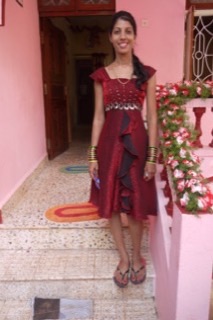
Jama or “Emy” the bride-to-be

At the right moment all the aunties and family members line up around the buffet table and we stand as prayers are recited.  When the time comes to start eating,I am amazed at the restraint and calm that follows.  After eating, people get up and leave immediately, until all that is left are a few western stragglers.

image.jpeg

It’s been quite an un-Indian experience without the wildness and ritual of a Hindu engagement party .  Tomorrow night is the wedding in a village 35km from here and we will see what happens.