Tag Archives: Gujarat

Amy’s Story

I was born in Calcutta and adopted at three years old by a single woman from Utah. I have no memories of India at all and when I applied for a visa to come here was surprised to learn that I had to first renounce my Indian citizenship. I never knew I was still an Indian citizen.

img_0052

Amy has a big,beautiful infectious smile, with eyes that invite you to engage. When I asked if I could interview her she readily agreed. I’ve been curious about the motivation for so many young Europeans and Americans of Gujarati origin to come to Ahmedabad to live or work at Manav Sadhna for extended periods of time. But Amy’s story is a bit different because she grew up in the non-Indian, very white Mormon culture of Salt Lake City.

My mother was a non practicing Mormon, as were her parents. They enjoyed a lifestyle of cocktail parties and country clubs. My mom felt that she shouldn’t have to be married to have a child and was liberal minded. She picked me out from an orphanage photo.


Amy’s upbringing was filled with the love of her mother and grandparents, and when asked if she experienced any racism growing up, she replied simply “No”. I was surprised and pushed further. ” Maybe my mom sheltered me from that. When I was a junior in High School someone called me a “Nigger”. I told them I was Indian.” Amy’s mother exposed her to Indian culture as a young child and had a mural painted in her bedroom of Amy riding an elephant amidst landscape scenes of India. Four years later her mother asked if she would like to have a brother or sister, and soon after a boy from Bulgaria was added to the family.

Unfortunately this idyllic childhood ended with the untimely death of her beloved mother when Amy was twelve. Her mother’s niece and husband, who were childless, came to live and care for the two motherless children. Trying to cope with the loss of her support system Amy turned to the Mormon church. The idea of being “sealed”with her mother for life ( a Mormon ritual)was very comforting .

Sealing is the everlasting covenant from God to families that we will always be together eternally. All married couples are sealed to each other with their children being born into the covenant, but when a couple adopt a child, they take the child with them to the Temple for a sealing ceremony..

She had been spending almost all her free time with the local Bishops family as well as other practicing Mormons, a way of escaping her less than happy home-life. Becoming active in the church was a natural consequence. Although her family were “inactive” Mormons, Amy was baptized at eight according to Mormon practice.

For the next twenty years Amy was the ideal Mormon. She didn’t drink, smoke, practiced purity in thought and action and attended Church regularly. She never questioned any of the tenets of the religion. All that changed in 2008.

Amy’s brother had a much more difficult time adjusting to his new home, having lived with his mother only a few years before she died. He turned to drugs and alcohol and had a tumultuous youth. They lost touch for many years. When one day he called and said he was clean and sober, and had found a homosexual lover, she was delighted for him. The church up until this point had been vague on their position on homosexuality, and left the handling of the issue to local leaders. Meanwhile, Amy had been experiencing doubts about her own sexuality and began seeing a therapist. The legalization of same sex marriage in California in 2008 made her curious to learn more about homosexuality.

In 2015 when the Church came out with their official position on same-sex marriage, Amy was at this point identifying as a lesbian.The handbook stated that children of same-sex marriage could not be blessed or baptized until age 18 and at that point had to renounce their parents in order to join the church. The policy also states that those in same sex marriages would be considered apostates, a category that includes murderers and rapists.This was the final straw. It was time to leave.

I strongly believe in God because of my adoption story and other spiritual experiences I’ve had throughout my life. I also believe I will be forever with my mom and grandparents with or without the Church’s teachings. If the LDS Church reversed their policies on homosexuality I’d be an openly gay member. I still believe in the tenets of the church but I am also learning to have more faith in the universe, that I don’t need to worship in a church or temple. I can be close to God anywhere.

I’ve always known that my life was a miracle and lived it as such.
 

THE TOILET GARDEN/GANDHI’S DREAM

“It is health that is wealth not pieces of gold and silver.”-Gandhi

I wrote this four years ago but noticed that it was not published and had “disappeared”. For those that haven’t seen it before, it was this visit that inspired us to come back and work at Manav Sadhna.

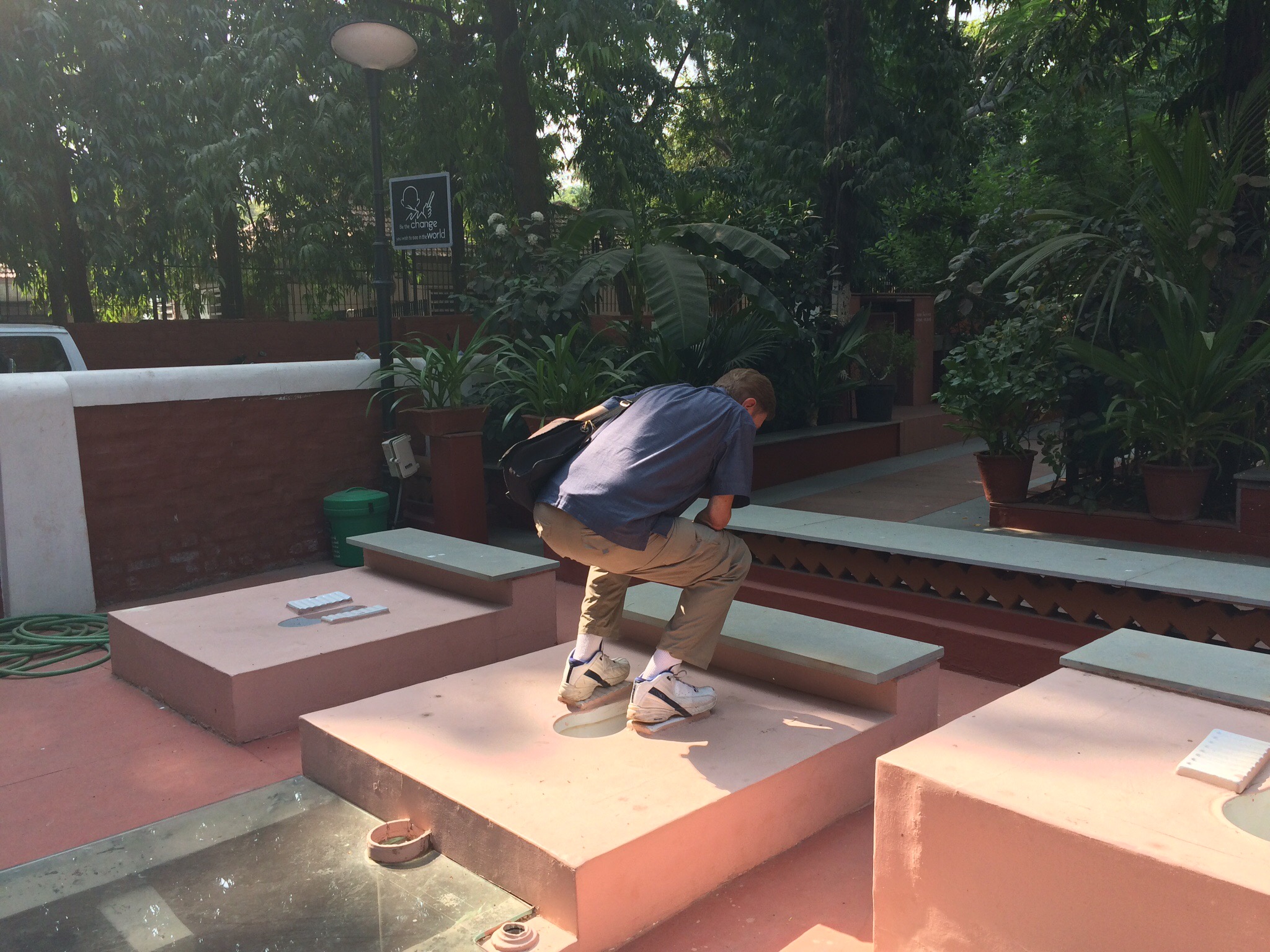
More people in India have cell phones than toilets. The Toilet Garden was listed as #61 in the guidebook “101 Things to Do in Ahmedabad “, under the heading “Flushing Diversions“. Yes, there is one, I am not joking.  During our family visit to Delhi we didn’t have time to visit the Toilet Museum so we thought we would make up for this lapse.

It is located inside the Environmental Sanitation Institute compound on the grounds of Gandhi’s former ashram. Founded in 1955 by Ishwarbai Patel, better known as “Mr. Toilet”, there are thirteen varieties of toilets displayed in a lovely garden.

Gandhi was horrified that one caste of people, the Harijans, formerly known as the “Untouchables”, were responsible for going around to the villages and collecting the waste. “Mr Toilet” distributed more than 30,000 toilets, and now 55% of the population have sanitary facilities , up from the previous low number of 8%. The garden was built in honor of this great accomplishment.

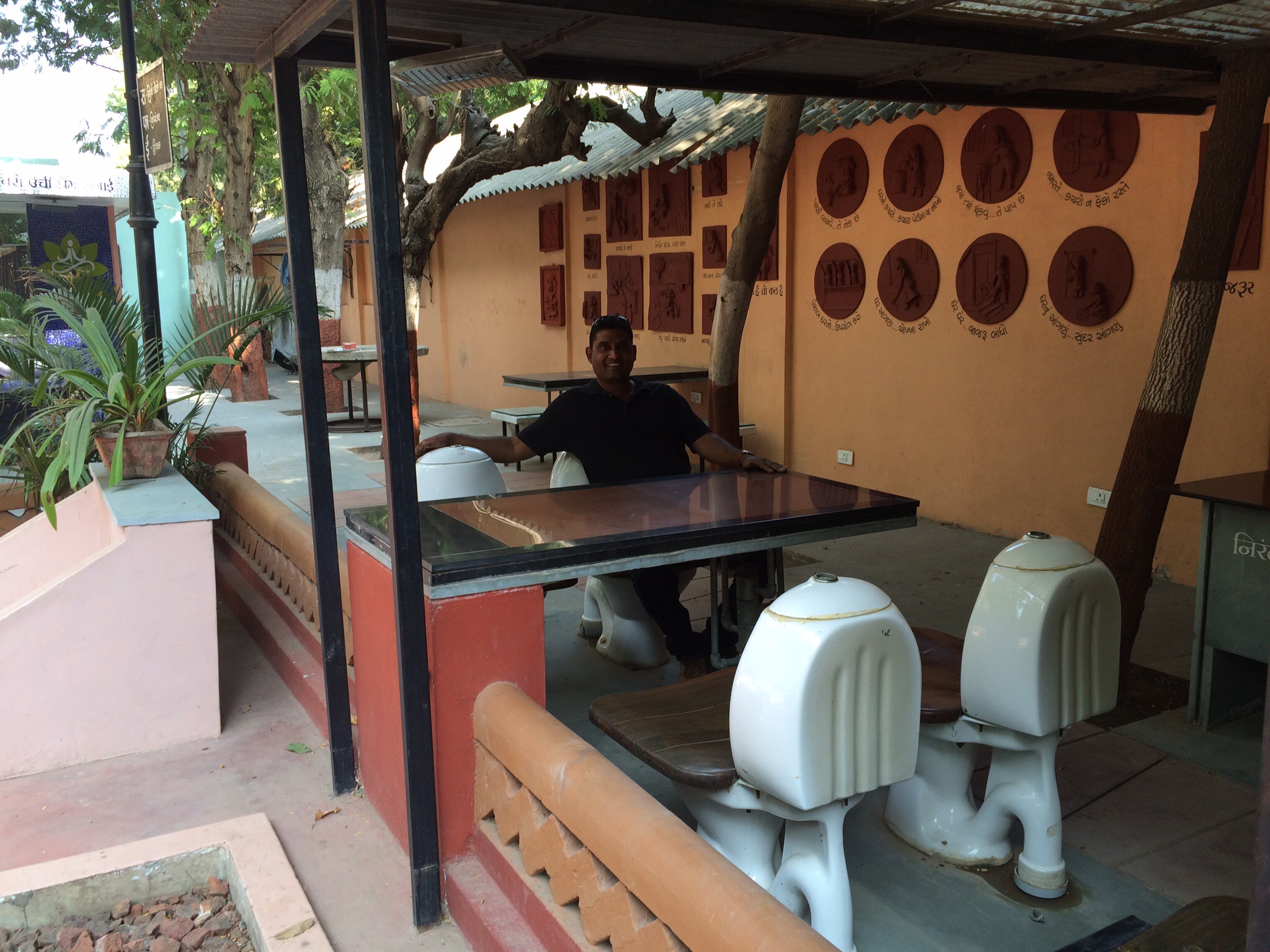
Gerald, of course posed in front of the “VIP TOILET” as well as one of the squatters.  I joked that it would be nice to have a  cafe with toilets as seats, and sure enough there was one. We sat down, had a chai, and used our toilet paper as napkins.

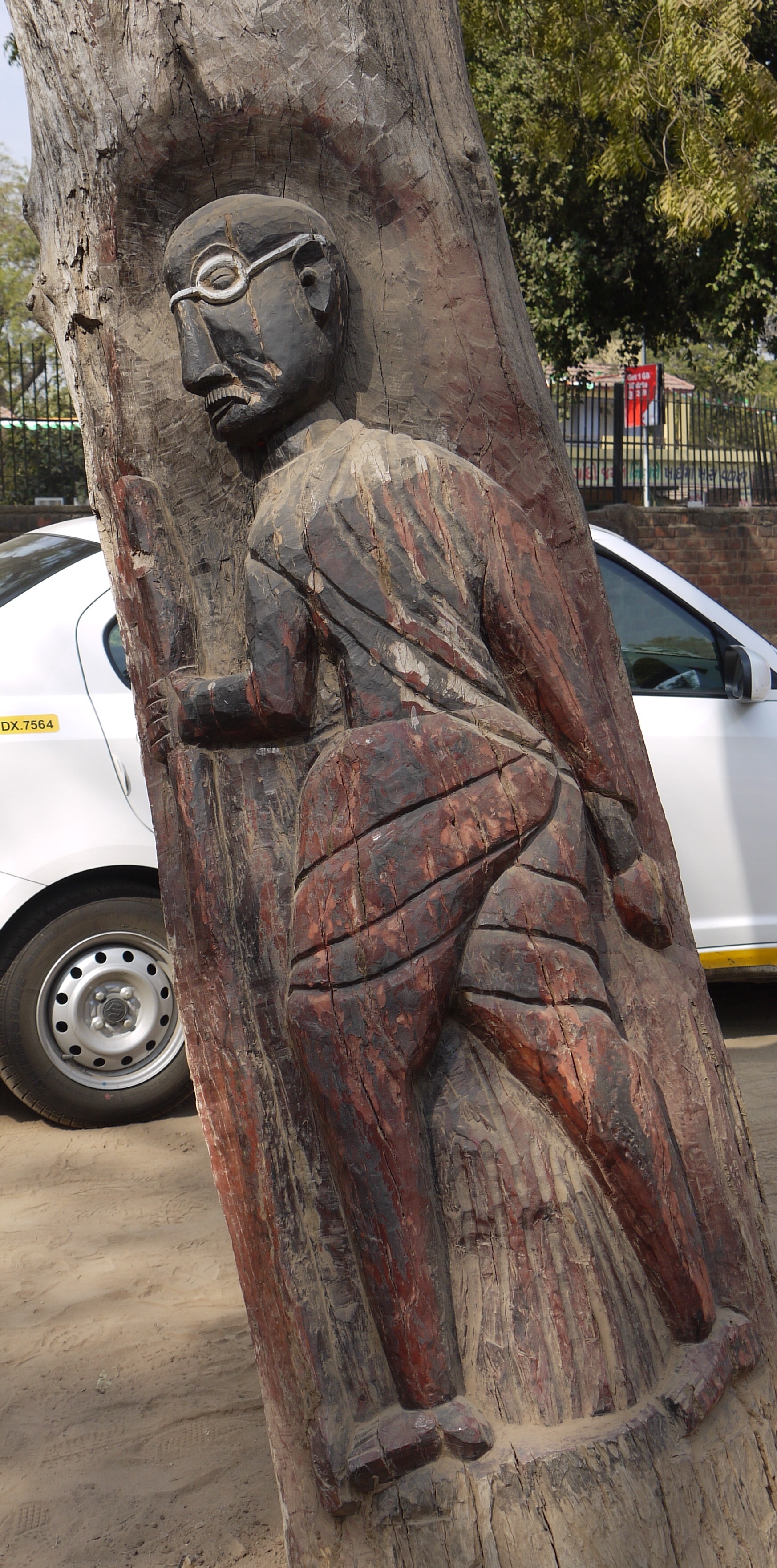
A figure of Gandhi was carved into a tree stump nearby and we went next door to visit his Ashram.

Manav Sadhna, an NGO that works with improving the lives of women and children in the neighboring slums has its headquarters here. Forty thousand women scrounge for garbage to sell to recyclers and these women play a vital role in the sanitation of Ahmedabad. This center is a safe haven for children to learn a skill, get basic health care and experience love and compassion. There are also various programs for the elderly,computer training , recycling and finance.  More than 9,000 people in the community are served.

What started as a lark, ended up as a fascinating and informative look at another side of India..

IMG_1631.JPGIMG_1628.JPGIMG_1626.JPG

Between Heaven and Hell/It Depends On Which Day You Ask

Gandhi sculpted in a tree at the ashram

“It depends on which day you ask”  was the response from Veena, (an Indian-American volunteer from Berkeley),when asked how she would rate her experience working as a doctor for Manav Sadhna this past year. It certainly could be said about so many things in India. I would be lying if I said that the three weeks spent in Ahmedabad working with the children at Manav Sadhna went by quickly. The last week I was counting the days until our departure.  We hated the city- the choking fumes of pollution, the rubble, the slums, and the complete chaos.  There doesn’t seem to be any redeeming factors to counter the negativity.

The flip side is the incredible experience of working with people so totally dedicated to compassionate service and non violence. This is no ashram with holy people; it is everyday people putting into practice their convictions in the most humble manner without ego, only service. Each day begins with communal prayer and sharing.Virren gave up a lucrative career in the US and decided not to marry and have a family, in order to follow his heart and be fully committed to serving others.  He earned enough money  in the USA which enabled him not to have to worry about working anymore.  Similar stories were repeated many times.

What is so startling to me is the number of young people, born in the UK or US who come  as repeat volunteers to Ahmedabad each year during school vacations to serve at Manav Sadhna.  Esham is an 18 year old ,born in England of Gujarati parents ,who first visited India as a fifteen year old with the program, Discover India.  He was so taken with what he experienced, that he started his own charitable foundation to build sports fields in the slum areas of Ahmedabad.  Britain awarded him honors for his work.  His father was born in Uganda, but grew up in the UK when his family and all people of Indian ancestry were kicked out by the dictator, Idi Amin in 1972.  Esham’s wish for his 18th birthday was to bring his father to experience Manav Sadhna, and see Gujarat for the first time. During the summer break, the ashram is filled with young Indians from abroad, who have never grown up or lived in India, but feel a strong pull.  I met three or four 18 year old girls,on winter break from University.  All of them expressed the same sentiment.  “When I leave, all I think about is when I’m coming back next”. Nimmo is a 37 year old hip hop singer who grew up in LA and moved to Ahmedabad permanently six years ago. He is in the process of helping set up an arts center and tours around the world sharing his message of love and cooperation, through his music.

I loved how I felt at the ashram and the relationships with the volunteers and the children I worked with, but I could never go back to Ahmedabad.  Its hard for me to understand the powerful magnet that attracts these young people come back to such a place. I know it will take some time to fully absorb what I learned and I am grateful for the time I spent there. So ,yes it depends what day you ask for my answer about my Indian adventure, but it is not yet over.  After Rajasthan we are headed for the Himalayas and the sacred cities of Haridwar and Rishikesh.

Go Fly a Kite

International Kite Festival

Our final day in Ahmedabad is Uttarayan- the  Kite Flying Festival.  Actually there are two festivals-an International one which goes on for four days along the Sabarmati Rivefront and displays impressive kites from countries around the world, and the local one which is celebrated on January 14  by every Amdavadi, young and old, rich and poor alike.

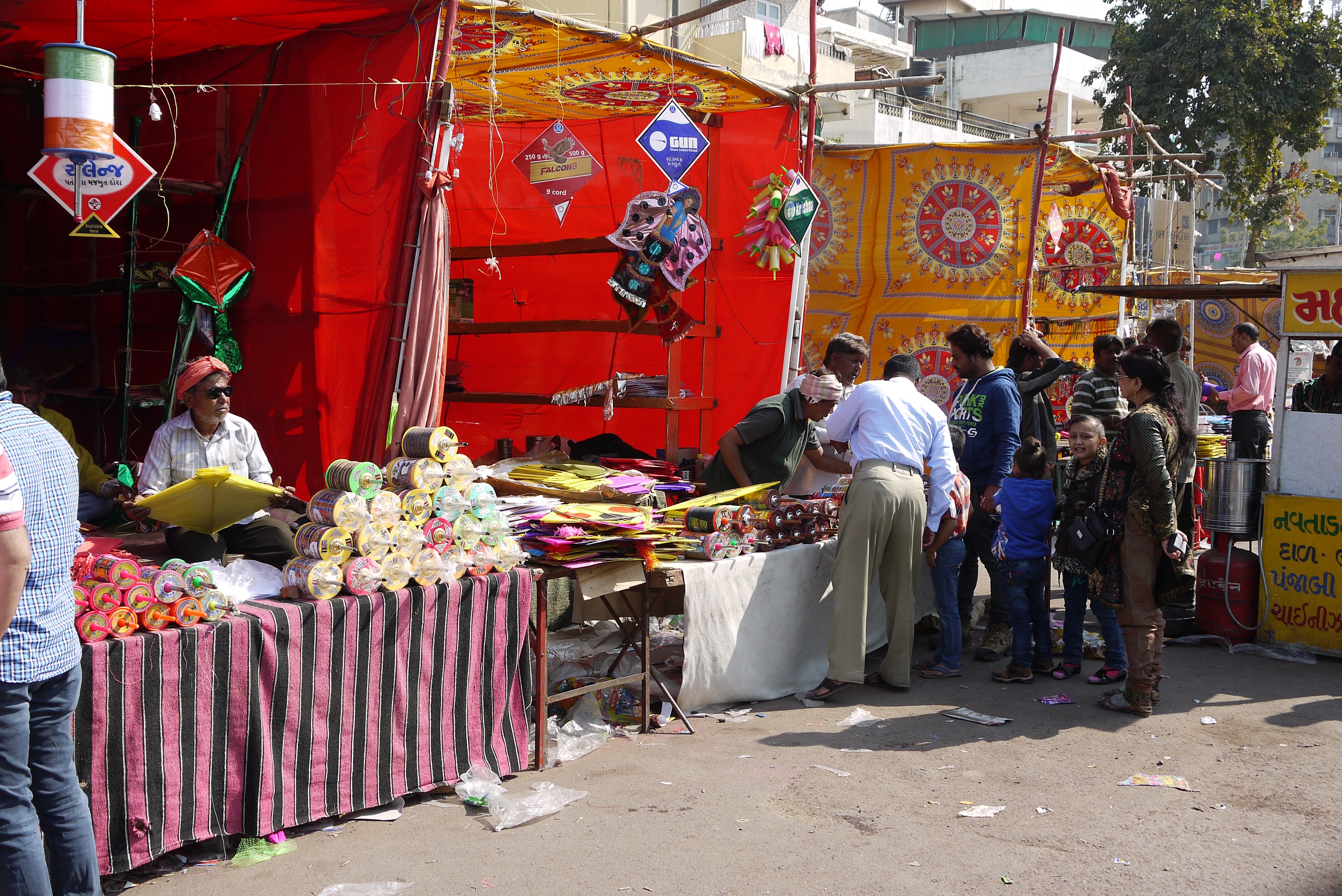
Schools are closed, shops and banks are shuttered, and the whole city comes to a standstill and flies kites during Uttarayan. Streets are empty  of rickshaws and traffic (thank god) and  the action is centered around the kite markets. Sellers of string are on the street with vats of dyes in vibrant colors.  These are not ordinary kites as we know them.  They are made out of small pieces of colored tissue paper and cost only a few cents each and are meant for one time use only. Families buy fifty or sixty of them, depending on their finances.  The strings are coated with crushed glass and the goal is to cut other peoples kites and see how long you can keep yours up in the air.  Of course this makes the whole event not only fun, but dangerous as well.  The number of people and birds injured each year by having their necks and throats cut by the strings is well documented in the local papers.  The govenment tried to ban the sale of these “Chinese strings”, with no luck. Days before the actual festival children are on the rooftops of buildings, and kites can be seen caught in the trees.

Kite string sellers

Dyeing the strings

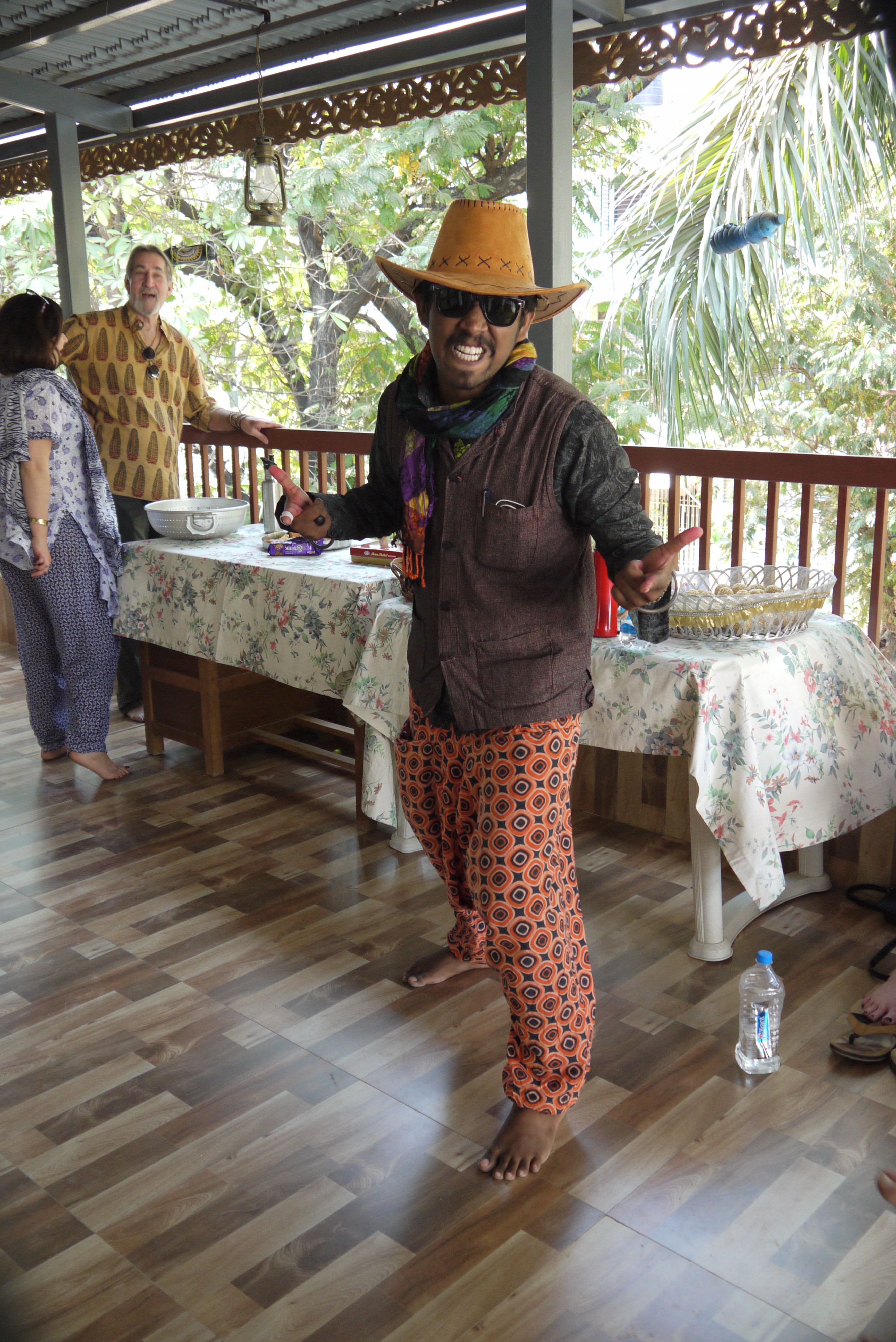
Virren, the director of Manav Sadhna, has invited the staff and volunteers to the rooftop of his home for a kite flying party. “Come sometime after 10:30 in the morning”. When we arrive at 11:00 a.m. (the first guests) he is up on the roof, dressed in jeans and a plaid shirt.  “ I’ve been here flying kites since 7:00 a.m.”. He is 52 years old, lived in the USA for 26 years, and is now permanently settled in his hometown of Ahmedabad.  Dancing around like an excited little boy, he moves with precise steps to and fro, manoevering the flow of his kite. Throughout the afternoon  more and more guests arrive- Indians, Westerners, NRIs ( non resident Indians)-and each tries his/her hand at kite flying. In the corner is a stack of more than fifty kites of all colors and sizes. There is very little wind, so his valiant efforts at trying to teach me how to fly a kite is hopeless.

With a leather cowboy hat to protect his head from the blazing sun, Virren doesn’t give up on his own kites  Each time another kite is “cut” he whoops and hollers with his friends.  One person holds the spool of string, judging when to wind or unwind, while the kite flyer pulls the string up or down depending on the direction of the wind. Every rooftop is filled with people, flying kites, eating and drinking, having fun.  Many have loudspeakers with Gujarati Bollywood music blaring.  After all, what’s an Indian party without lots of noise! A food table has been set up, buffet style, with special treats like “jalebies”- a flour dough shaped like a pretzel and fried,with lots of sugar.

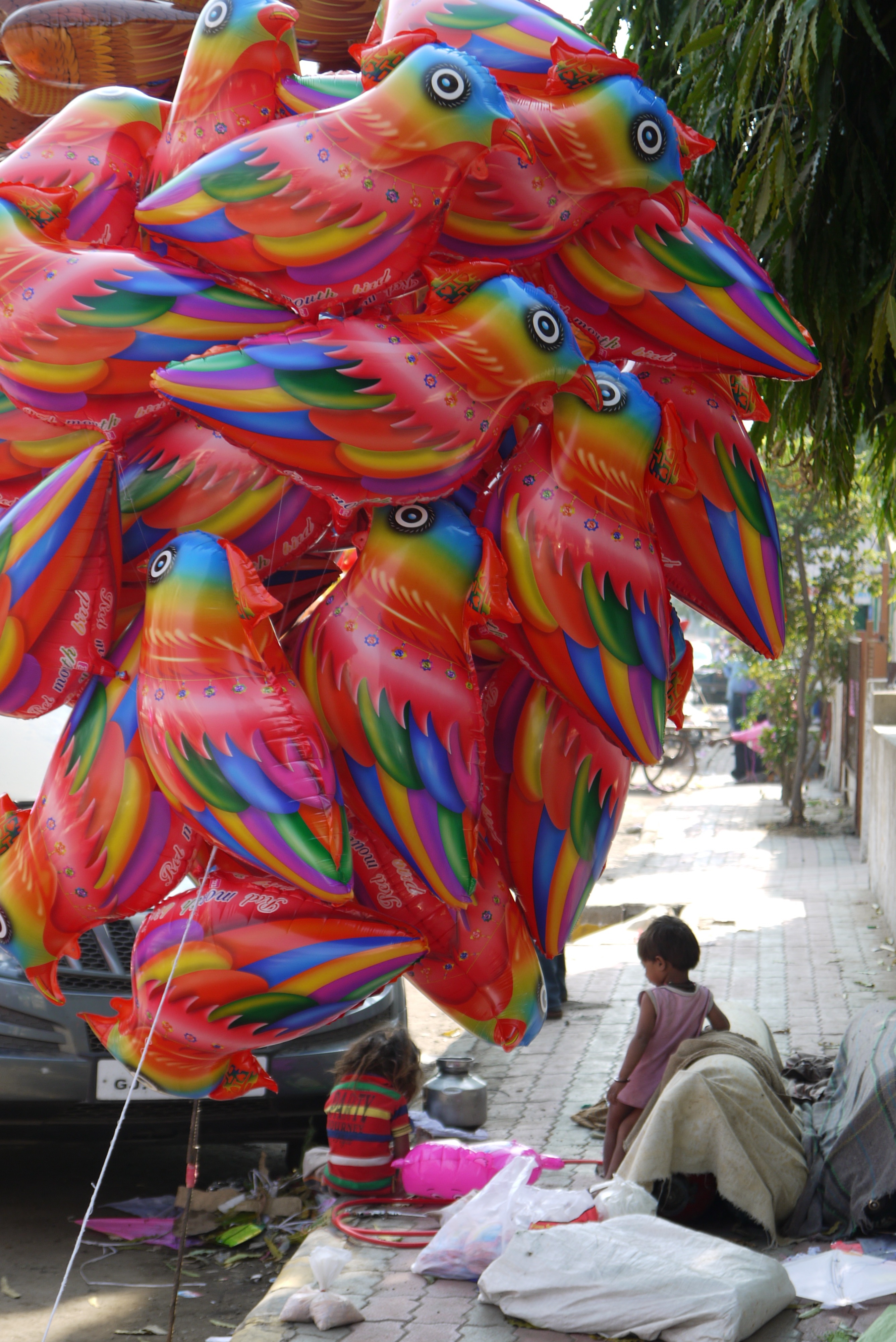
We decide to take a short break and check out the kite market around the corner. The scene is hectic with a carnival-like atmosphere.  Hawkers are walking around with balloons of varying shapes and sizes attached to a long pole-  Bollywood stars, parrots,hawks and crocodiles.  We choose a parrot and a hawk,  and watch the brisk sales as cars pull up to buy balloons and kites. And then we go back to the party.

Balloon extravaganza

Brisk balloon sales

As night settles in, the mood changes. Paper lanterns with flames inside(yet another illegal, dangerous activity) float through the sky.  It looks like stars and moon beams-hundreds of them- accompanied by bursts of fireworks. All this we  see from the large panoramic window of our hotel room. The day has been a wonderful ending to our time at Manav Sadhna.  For a short while, nothing else matters and all is well is the world.

Everybody loves to party at Virren-bai

Loban-“Performed by the Inmates of the Asylum under the Direction of the Marquis de Sade”*

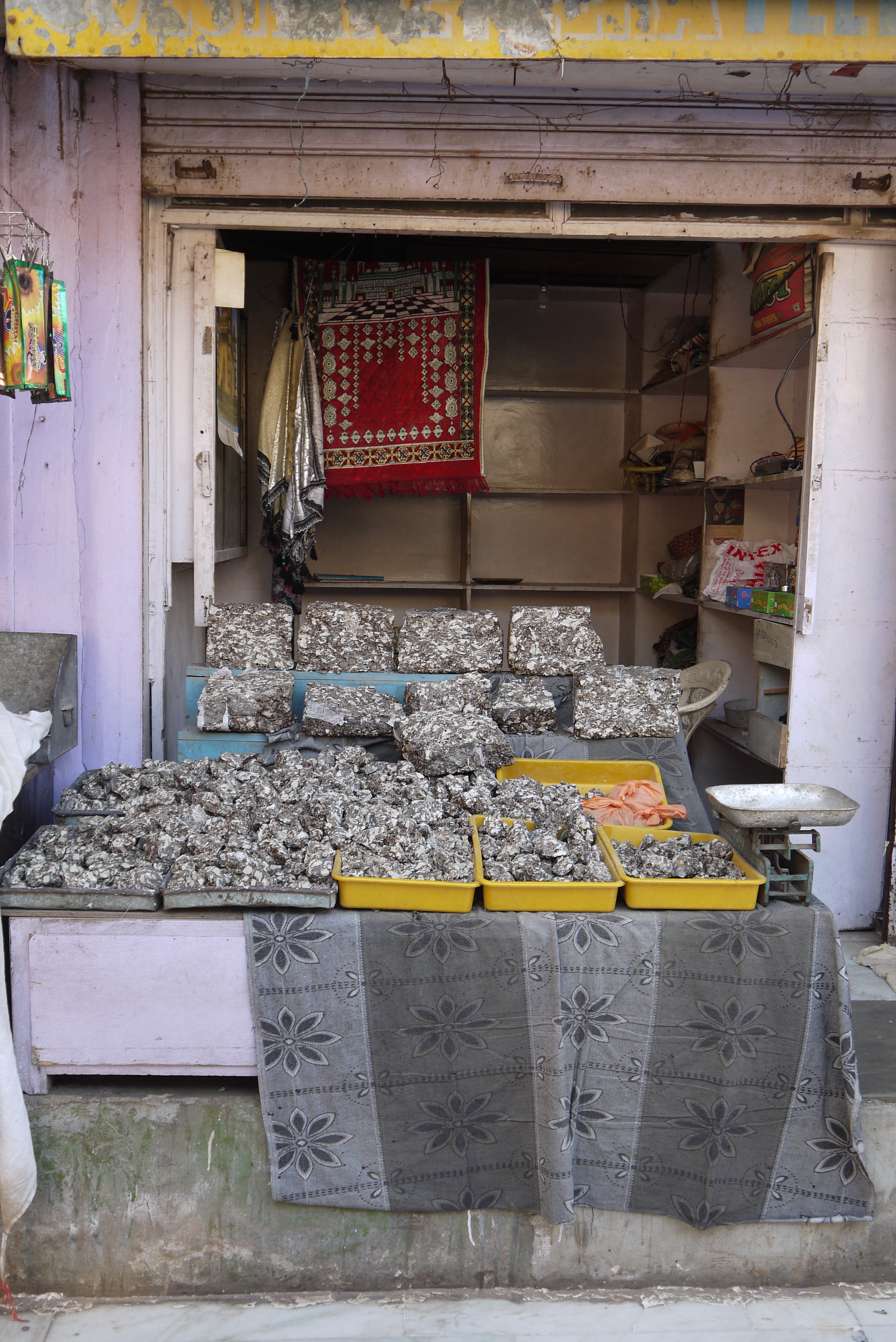
Loban Incense stall

Don’t stare at anyone while they are in a trance, and no photography is allowed, it’s too intrusive”.  These are the directives given to me on the phone by Vanita, an Indian woman from Mumbai, doing a PH.D. on the psychology of trance in India.  Shaikh, our resourceful driver/guide from last year, escorted her and two visiting professors from the UK, to the Loban ritual the night before. She is staying in the village of Unawa, famous for the shrine of Hazrat Sayyad Ali, called “Mira Datar”(Mira=The Brave One, Datar=Giver or Bestower)  to study this surreal ceremony. I had been to one such “event” on our last trip- thanks to Shaikh,who understands my fascination with all things bizarre and mystical. Mira Datar is one of the most famous shrines where this ritual is practiced, and both Muslims and Hindus come from near and far for healing.

From their website:

This shrine is known for driving out evil forces and healing the ones,especially the women who are possessed by demons and evil Jinns. Over the centuries, the mentally affected or “possessed” Indian women have found a sanctuary here. The fame of this Dargah is spread far and wide and people of all religions,caste and creed visit the shroud year round with offerings and fulfillment of their vows.  Roses and incense are offered.

Mira Datar in Unawa,Gujarat


Loban is actually the name of the incense used to purge bad spirits from the body.  We know it under the name of Copal. Our arrival in the town takes us back one thousand years.  Streets are mounds of dirt and rubble.  Ragged beggar women and children roam the alleys with their hands out, murmuring unintelligible sounds. The air is heavy with the pungent aromas of smoke and grilled meats.  Booths are set up with huge woks filled with bubbling oil to fry the samosa. Although I  have been craving meat, since Gujarat is mostly a vegetarian state, I am not tempted to try any of the dishes being hawked. Everything feels dirty and unclean.

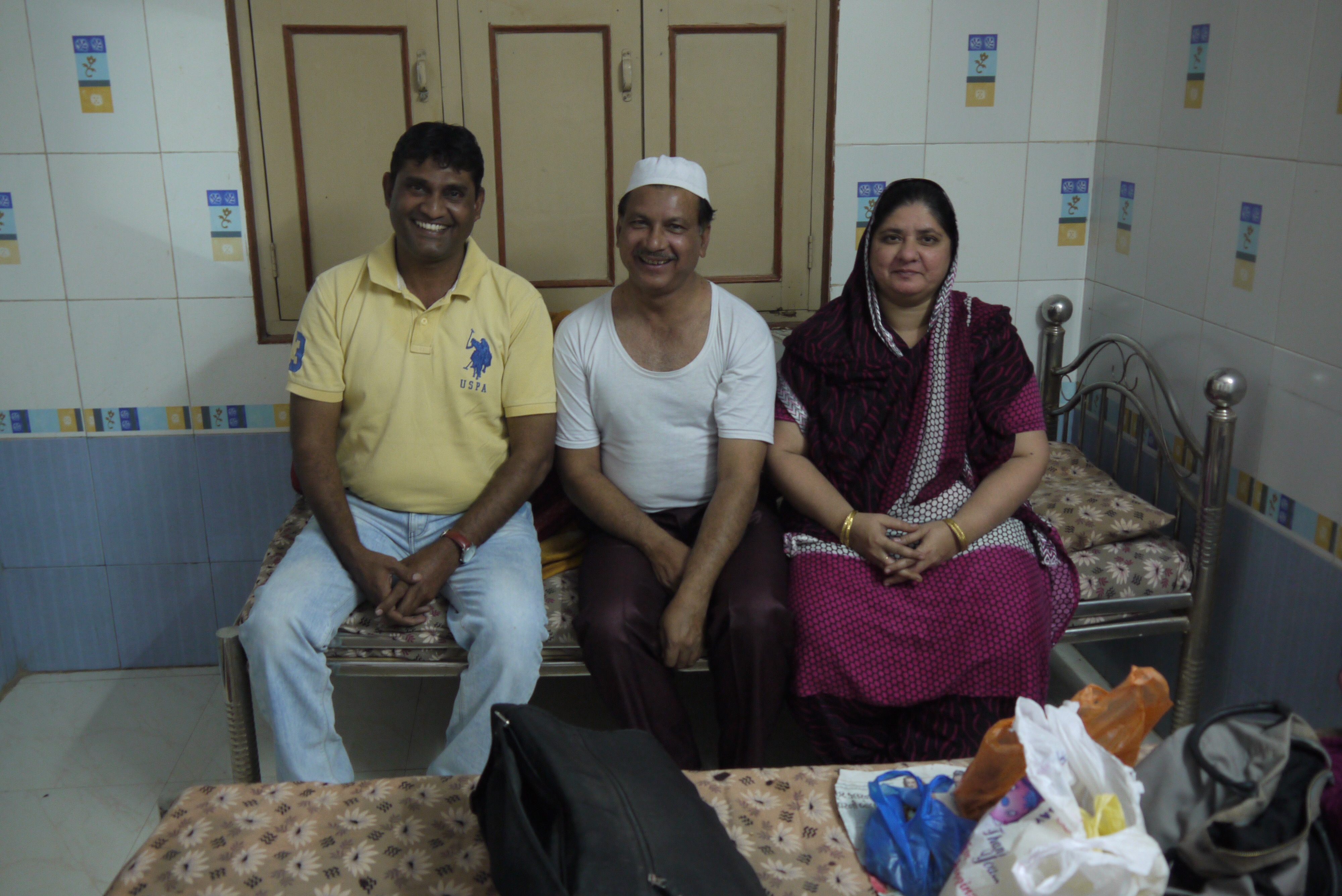
There is a ring of small guest houses encircling the main area. Pilgrims come from all over India, and those with more money stay in one of these hostels- designated by religion.  One for Muslims, another for Jains, Hindus,etc. Shaikh’s brother -in -law and wife have travelled overnight to visit the shrine and we go to their room for a visit and a rest.  The room and stairwell are immaculate.  Inside a tiny room are two simple beds and a small bathroom.  The floor and walls are tiled. A room costs 50 rupees ( 80 cents). He is a structural engineer and head of a large international firm.  When I ask why he has come so far to visit this shrine, he replies simply “I come from time to time to feel good”.

Shaikh with his family at the hostel


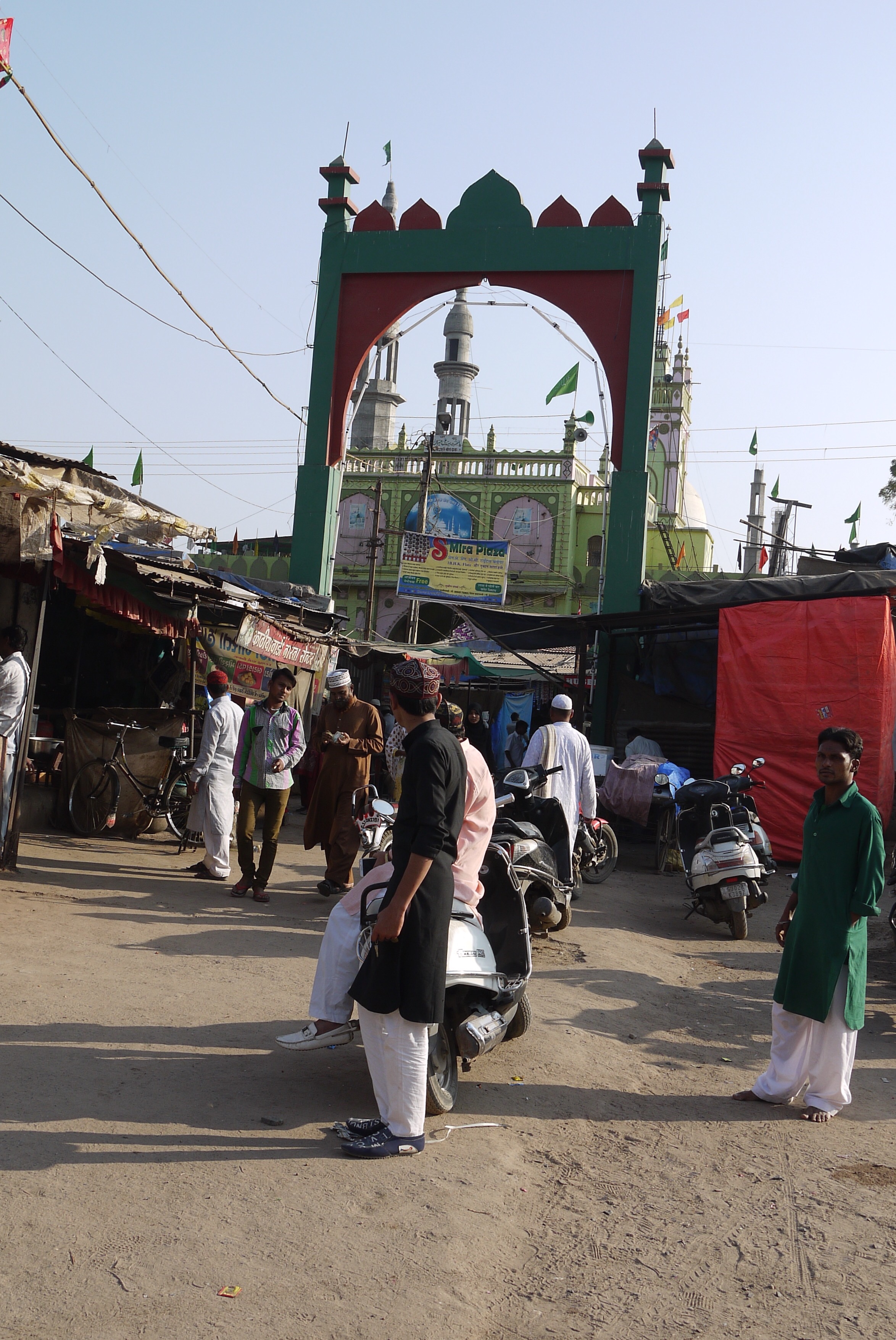
The entrance to the shrine and mosque

A tall gate marks the entrance to the sacred area leading to an impressive mosque. We remove our shoes. All along the passageway are sellers of incense, talisman, jewelry, trinkets and souvenirs. When we arrive inside the compound ,Shaikh takes us up a narrow,steep stairway. On the way up a group of young, well dressed girls comes hurtling down the steps, as if they have seen a ghost.  At the top of the stairwell I understand why.

Women of all ages dressed in tattered clothes,hair loose and disheveled,are walking briskly around a large dome in the center of the room with a crazed vacant stare. They are screaming, banging their heads on the stone, falling down, trying to attack other women, climbing up the wall, always circling,circling.  A family member stands near each woman ready to step in and protect their loved one from harm to themself or others.It is believed that circling the “chakki” (dome) seven times will remove evil spirits.

I am fascinated and mesmerized by the scene and at the same time a deep sadness comes over me. What must these families go through when they are at home and how do they manage to take care of these women? How many remedies have they tried, and do they really expect that a miracle will occur? I read on the website about the 10 foot snakes that came out of a man’s body in 1973, after he spent weeks praying and crying at the shrine to get relief from his terrible stomach pains.  Back downstairs we look for a spot to sit and wait for the ritual to begin. More and more people arrive and the crowd swells to well over a thousand.

One man has his hands and feet in chains- being led by two other men. A woman is doing somersaults on the cement floor and screaming- around and around they go, while the mosque fills up for evening prayer, women on one side, men on the other.  There are nine doors made of sterling silver in the inner sanctum where groups of people are being blessed under a small green holy coverlet.  I am seated next to a young woman from Mumbai.  She is obviously mentally disturbed and rambles on to me in English about her problems and how she was married and in engineering school, “but things are hard, people expect things” and she is unhappy.  Shaikh finds out from her mother that they have tried everything- expensive psychiatrists, medication, clinics, but nothing has worked.  They are hoping something will happen tonight.

Precisely at six thirty the imam starts chanting the prayers and the smell of the Loban permeates the enclosure.  We stand and watch the ritual unfold . There are no longer random ,wandering crazy people ;most of the women seem to have worn themselves out and are quiet.  Three or four khadim ( holy men who are descendants of the family of Hazrat Sayyad Ali) walk through the crowd while people push to get close enough to inhale the smoke. It is believed that inhaling the holy smoke can cure illnesses and bring good fortune.

It is now seven o’clock and the crowd disperses. I am mentally and physically exhausted and feel like I’ve been through a time machine. One of the amazing things about India is the juxtaposition of the modern world with primitive ritual.  Where else would you find sophisticated professionals mingling with simple villagers to talk with gods or exorcise spirits?

*nb- this is a reference to the play by Jean Anouilh “The Persecution and Assassination of Jean Marat as Performed by the Inmates of the Asylum of  Charenton under the direction of the Marquis de Sade”.  It was performed on Broadway in the 1970’s and was a masterpiece.