Tag Archives: shrines

The Last Theyyam in Kannur

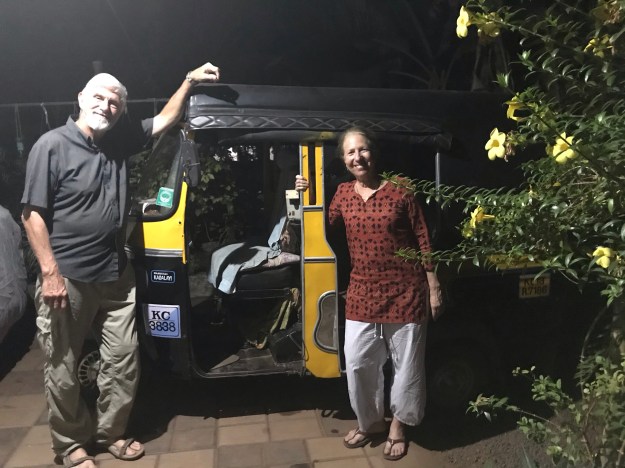
The alarm goes off at three in the morning and I jump up quickly and quietly so I don’t wake up Gerald. He insists it is not early morning but the middle of the night, and has decided to forgo this last Theyyam ceremony before we leave Kannur.

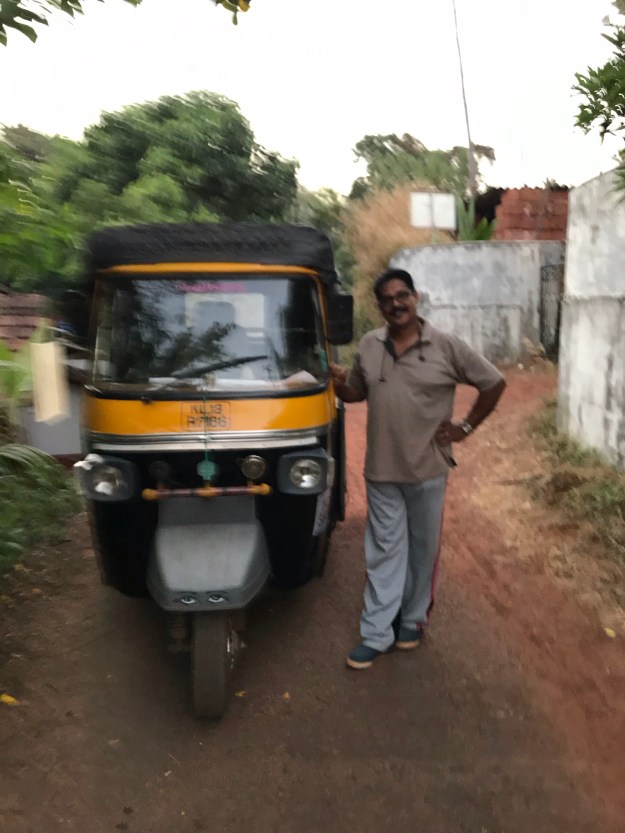
Vineeth, my trusted rickshaw driver and guide is already waiting for me outside. I put my pink cloth carry bag on the seat and off we go.
What’s in my bag? A banana and some biscuits, my camera and telephoto lens, iPhone, and last but certainly not least, a handy water spray bottle which brings down my body temperature quickly when the steamy tropical heat threatens to break my resolve to remain any longer.

The temple I am going to today is only 17km away but it not a paved road so I have no idea how long the journey will take. I ask myself if I should try to sleep on the way and I lie down in a fetal position on the plastic padded bench seat in the rickshaw.That idea is quickly abandoned after the first few bumps.

Forty minutes later we arrive and Golikan, the first deity, is making his appearance. The priest motions for me to wait until the blessings for putting on the mask are finished before I take any photos.I have seen this deity at other temples but this performer is more engaged and active than the others, walking on stilts and leaping around the courtyard wildly.

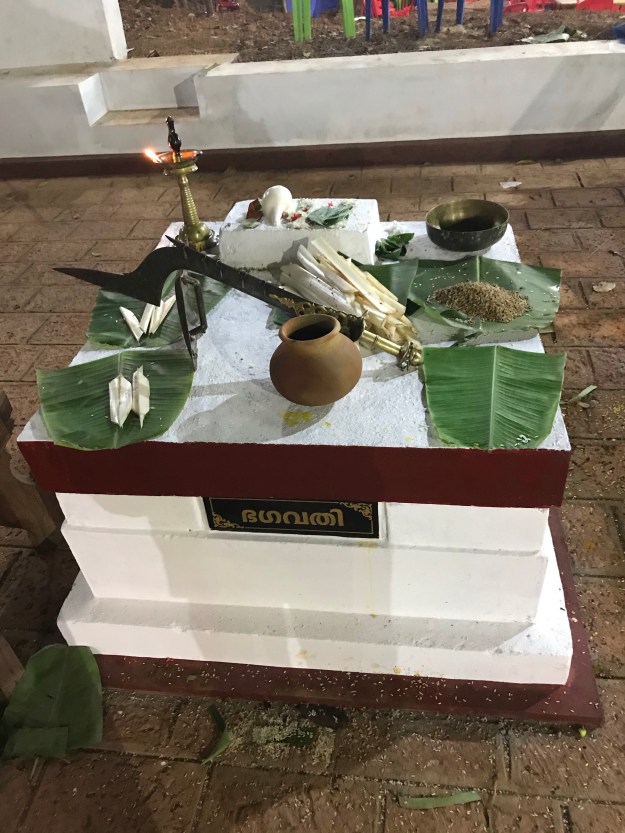
This temple is an older one dedicated to Shiva, and there are small shrines with offerings of rice and coconut.
Quite a crowd has gathered by now and there is an informal men’s and women’s section for seating.
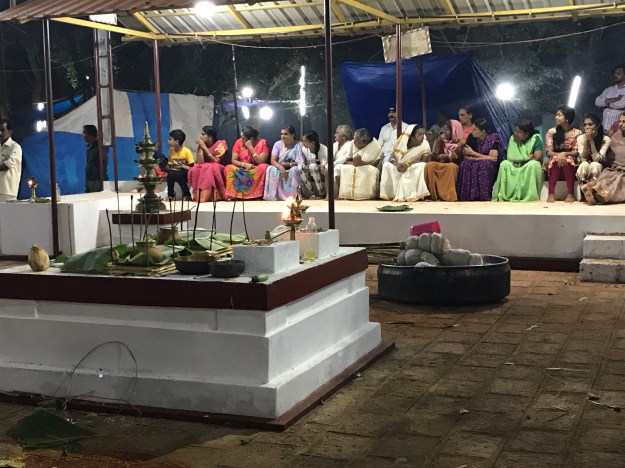
Beautiful traditional Keralan white silk saris banded with gold are worn by the older women, who have brass oil lamps which will be lit and blessed by the spectacular fire dancer deity who will be performing later.

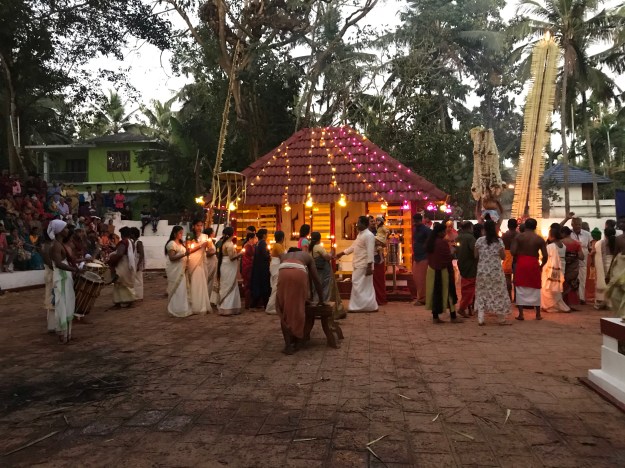
After the first three Theyyam have finished their performance there is a break. Seated on small thrones in the courtyard the Theyyam bless the villagers as they line up. Meanwhile, a loud speaker is advertising services by companies who have sponsored this ceremony. and like all things in India, is at high volume.

An aura of anticipation and excitement is in the air as we await the entrance of Agni Kandakarnan, the son of Shiva.

I am seated directly in front of the temple so that I have a prime view of the entrance of each deity. Agni Kandakarnan arrives and the temple attendants place the eight poles, each with a torch at either end, around his young coconut leaf skirt. When they are lit there is an audible hush and then a gasp.
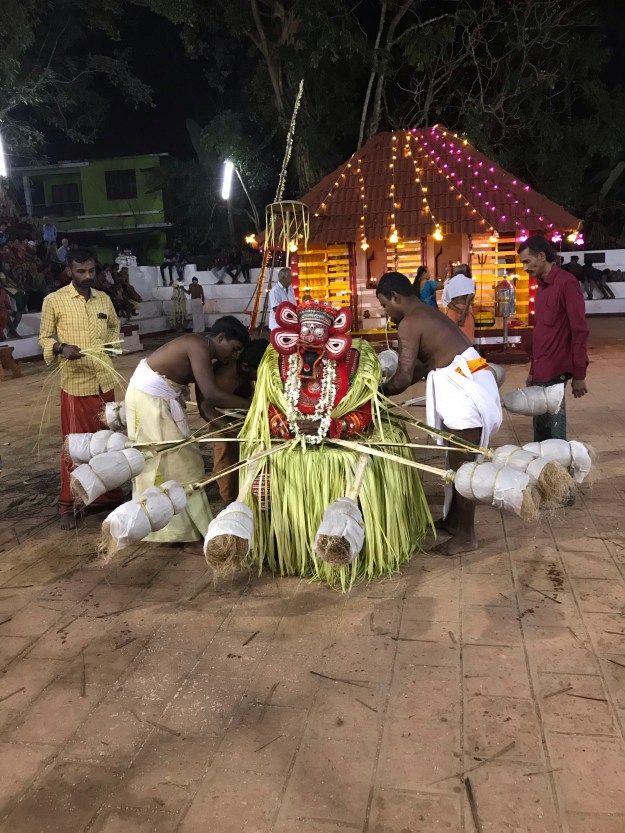
Each time Theyyam is performed, even if it is the same character, there is a sense of unpredictability. On this particular occasion it is both terrifying and playful. As the fiery Theyyam spins around, spreading balls of flames on the ground he is yelling angrily, running through the stands, stopping now and then to bless a man, woman or child. Then just as suddenly he leaps up to where a gaggle of young men are seated and grabs someone’s cell phone.

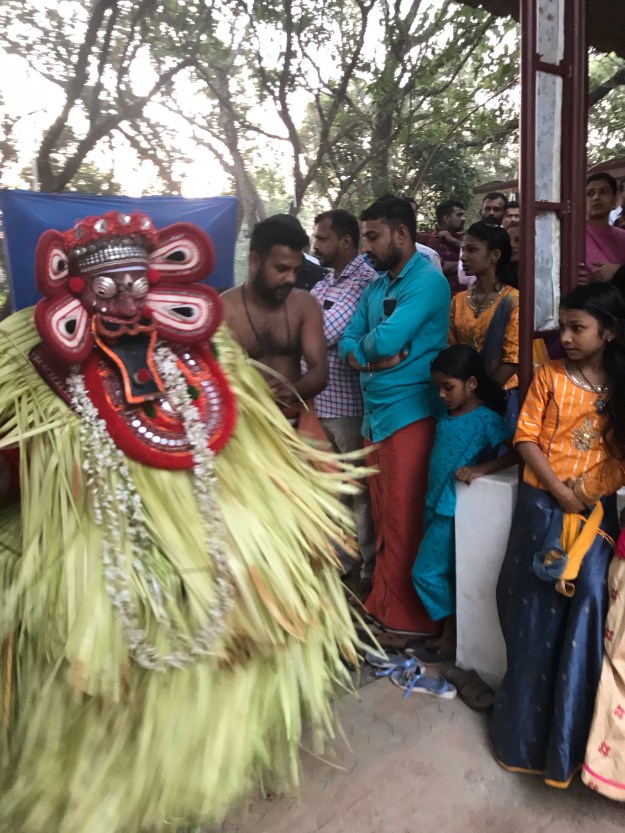
He runs around gleefully and mischievously displaying his prize, until he finally gives it to one of the drummers. The owner of the phone runs hurriedly to retrieve it.

By now the sun is rising and Vineeth has to bring his daughter to school and signals to me that it’s time to leave.

I arrive back at the guesthouse exhausted, exhilarated and unable to speak.

I will be forever grateful to my dear husband Gerald, who introduced me to India sixteen years ago. I could have never imagined what a profound impact it would make in my life.

Behind the Curtain/India Exposed

You won’t be able to take photos or watch the make up preparation, but to see the Theyyam Bagavathi Muttilotu is an experience not to be missed. She is one of the most powerful goddesses and the performer cannot eat meat, drink alcohol or have sex for forty one days beforehand. She stays behind a curtain and doesn’t come out until ready to receive the headdress. For some people it is scary because she can be unpredictable and start yelling and gesturing aggressively.

Kurian, my Theyyam authority, and owner of Costa Malabari Guest House in Kannur, explained this to me in an earnest tone. I have been coming here ever since I was first exposed to Theyyam in 2014.

Theyyam is an ancient ritual practiced in the Malabar region of southern India and is performed exclusively by men who manifest the deities and goddesses while in a trance-like state. The ritual started out as a practice of the lower castes and later became absorbed into Hindu culture as a way of communicating directly with deities.

Malabar village shrines are dedicated to a particular deity and an annual ritual or festival is sponsored either by a family or the priests, and is open to the greater community at large.Theyyam season is between November and May. The more powerful Theyyam deities can attract thousands of worshippers to the ceremonies.

At nine in the morning we started out for the first village. It was later than usual because the ceremonies, which usually start at sunrise, had been going on all night. Plastic tarps were set up as booths , carnival style, to sell the various trinkets- plastic toys, balloons,bangles and other assorted useful objects which the attendees would inevitably buy. Bollywood music, interspersed with adverts for travel agencies, hair growth clinics and “fancy dress” shops, bellowed out of two loudspeakers positioned just outside the kavu ( sacred area around the shrine). It was early and we were among the first to arrive. I always like to have time for the villagers to become comfortable with our presence.

My flip flops, already muddied with the moist red dirt, and traces of the many people who had trampled over them, were placed outside the entrance to the shrine, and I hoped I would be able to find them again after the crowds stormed through. I attempted (vainly) to sparkle as much as the Rajasthani women and wore my best gold dangly earrings, bangles and mangal sutra ( Rajasthani marriage necklace).

Gerald and Richard had set their backpacks on the red plastic chairs in the front row to save the best seats. It wasn’t until later, when an old lady snarled at him did he realize they were in the women’s section, and had to move.

I immediately rushed over to the costume/make up preparation area. Each one of the eight deities that would be represented has a unique costume and intricate face painting design which can take hours to complete. After four hours in the tropical heat,watching the six drummers feverishly lead the deities into trance, and the mesmerizing dancing of the Theyyam, I was exhausted. We had seen four deities and there were four more getting ready. As the sun baked into my skin, even with the sensory overload of these rituals I knew that I absolutely had to go to the next village where Bhagavati would be the grand finale.

As we arrived at the next shrine- a much bigger venue with hundreds of people already milling about in the temple grounds, the anticipation was palpable. As in the other village we were the only non-Indians and were given a place of honor so that we could to see better.

An old man with bloodshot eyes- probably from too much toddy-approached me.

Bagavathi is a powerful goddess, coming soon. She will make you cry, I do.

I was anxious for the finale after waiting almost two hours .We had rushed to get there by 2 pm and my eyes were glued to the curtain covering the place where Bagavathi was preparing, waiting to see some movement that would indicate an appearance. The only food I had eaten was a packaged ice cream bought from a vendor. Although we were invited to share the feast that was prepared for the masses at each shrine, I had politely refrained from eating and drinking, knowing that the toilet facilities would be suspect. But there was no way that I would even think of leaving before seeing what I had come for.

A bonfire had been smoldering for hours. Suddenly the temple priests and attendants started running over the hot coals and encircling the shrine. A swell of women and men charged across the temple grounds to the corner where Bagavathi was ready to receive her headdress. I didn’t know whether I should join them or stay put in my prime viewing position. The women next to me kept on squeezing me in in order to make room for a badly misshapen young man, lying on a mat behind me. They pointed to a woman standing nearby who I assumed was his mother, and she motioned that she wanted him to be blessed when Bagavahti passed by. I knew if I left there would be no returning.

Fearful that if I stayed I might miss the action, I ran over, just in time to see Bagavathi, in brilliant red headdress and huge skirt,flaming torches in both hands. Worshippers were pushing and shoving to get close enough to pass their arms through the flames, a sign of receiving her blessings.

And then just like that it was all over.

The car was quiet on the way back to our guesthouse. A small window had been opened , exposing one of the many sides of Incredible India.

The Magical Mystery Tour


IMG_3939

Lake Palace Hotel

Bheru on his special name day in Udaipur


“Allah u Akbar, Allah u Akbar, Ashadu al la illaha ill Allah……”.

What a difference a day makes! Last week I was miserable in Ahmadebad and now it is 6:15 in the morning and the soulful strains of the Muslim call to prayer drifts in through the window of my room.  I love waking up to this.  Udaipur is in the heart of Rajasthan and is as wonderful as Ahmedabad was horrible.  It is the city of Octopussy fame, where the James Bond movie was filmed in 1981. Palaces,fanciful,flowery Mughal designs painted on walls, shrines with incense burning, bells ringing- the stuff of fairy tales.  This is the India I love.  The India of Rudyard Kipling’s Maharajahs and mysterious, bejewelled women hiding behind silky sarees, is easily summoned up in the imagination.

Wandering  narrow lanes in the early morning- before the sleepy city comes to life at 10 or 11 am- I watch the light reflected on the spectacular Lake Palace Hotel, as the sun slowly makes its way over the peaks of the Aravalli mountains which surround Lake Pichola. I check out my beloved Bheru shrine- a god favored by rural Rajasthani women.  Sometimes he is represented by an amorphous mound of tin foil, but today is his special day. An older man, the guardian of the shrine, is busy painting a smiling face with a mustache and a turban on the form.  A piece of flowery blue fabric has been draped around his “body” and garlands of marigolds and roses are hanging around his neck. I admire his work, and he smiles in recognition and pride.  I pass by several times a day to pay my respects.

The vegetable sellers are busily arranging their carts with cauliflower,carrots,eggplants.peas,tomatoes and other various fruits in season. Scooters and motorcycles are crowding around the popular food stalls selling warm breakfast snacks of samosa,and katchuri. (a type of  small,puffy bread stuffed with potatoes and drenched in an eye poppingly spicy  curry sauce. Shopkeepers are setting up their displays of copper pots and utensils, as they light incense in front of their small shrines to ensure a succesful and peaceful day.


 I have been to Udaipur four times and it remains for me the most beautiful and magicial city in India.

A Very Auspicious Day/OY VEY!

The plaintive sounds of the muezzin calling the faithful to prayer at the local mosque drift into our room.  It is 6 am and time to get up.  Indians have dinner at 10pm and don’t go to sleep until after midnight, so the streets don’t come to life until about 11 am, when they start to rouse themselves out of bed.  That’s the  best time to wander, before the choking fumes of traffic and the mass of people make walking unpleasant.

Gerald is looking for great cow pictures and I monitor the changes in my favorite shrines.  Morning time is when incense is lit and flowers are offered to the gods.  It also presents a small window of opportunity to see/photograph the shrines while their little metal gate is open; otherwise it looks like the gods are imprisoned.  This morning I realize that in my haste I forgot my camera.

At the end of the road,after cursing myself numerous times for not having my camera, we hear drums.  Women are  pouring into a courtyard where a drummer is playing and a puja (blessing ceremony) is being done in front of a shrine. It is Sri Mata- a mother goddess, and this is a pre-wedding ritual. Durga, another female goddess is in the same compound  and the women pay homage to each goddess in turn.  The attendant at the shrine is a priestess. This group is from a simple village , but soon afterwards a wealthier group arrives and this time two drummers appear. First it is the bride’s family who take turns pouring offerings of milk and flowers, and there are now two drummers.  The groom’s family appears some minutes later, which presents a problem. They shouldn’t be there at the same time, but with IST (Indian Standard Time), the bride’s family was supposed to have been there much earlier.  Four generations of women dance with abandon to the drums, and I of course am invited to join them, which I willingly do.

“Gerald, I want to go to that wedding tonight, please go talk to the groom”. There will be more than two thousand guests, and it will be a gala affair. Indians are notoriously hospitable.  I am prepared with my best silk outfit and silver sandals for just such an occasion. Unfortunately this time we are not invited..  As we leave, people are arriving in cars, on foot, and rickshaw.  The wedding season has begun!

Dates for marriages are chosen with an astrologer, and this weekend is apparently an auspicious one.  Our friends and our guesthouse owner are all going to weddings with between 2000 and 4000 guests.  When I ask Mr. Singh (owner of our favorite restaurant ) if they are going to a wedding this weekend, he replies “We will be going to a big royal wedding in January.  All the Maharajas of each state will  be present and we have two chartered planes to take our group.” Now that’s a wedding I’d like to be invited to.

As we climb the six flights of stairs to our room the sounds of fire bombs exploding break the quiet. From our panoramic window we see the luxury hotel, on Jag Mandir, a private island,lit up like Las Vegas. Famous Lake Palace Hotel ( from the Bond movie “Octopussy’) is also ablaze with lights.

Our room is a bargain at $17 a night, with a painted stenciled ceiling and views of Lake Pichola on two sides,but the mattress is hard as a rock.  I am hoping for a good night’s sleep because I am pooped.  BOOM.BOOM.BOOM. There seems to be a wedding all over town tonight. Fireworks, drums, loudspeakers with disco music, people talking,laughing until the wee hours of the morning.  And if that isn’t enough, at 3 am the ever-present stray dogs go on a howling binge (maybe frightened by all the fireworks) and don’t let up until dawn.

The daily spectacle of processions, ceremonies, and incredible flashes of colors is what makes India “The Greatest Show on Earth”.