Tag Archives: theyyam

The Last Theyyam in Kannur

The alarm goes off at three in the morning and I jump up quickly and quietly so I don’t wake up Gerald. He insists it is not early morning but the middle of the night, and has decided to forgo this last Theyyam ceremony before we leave Kannur.

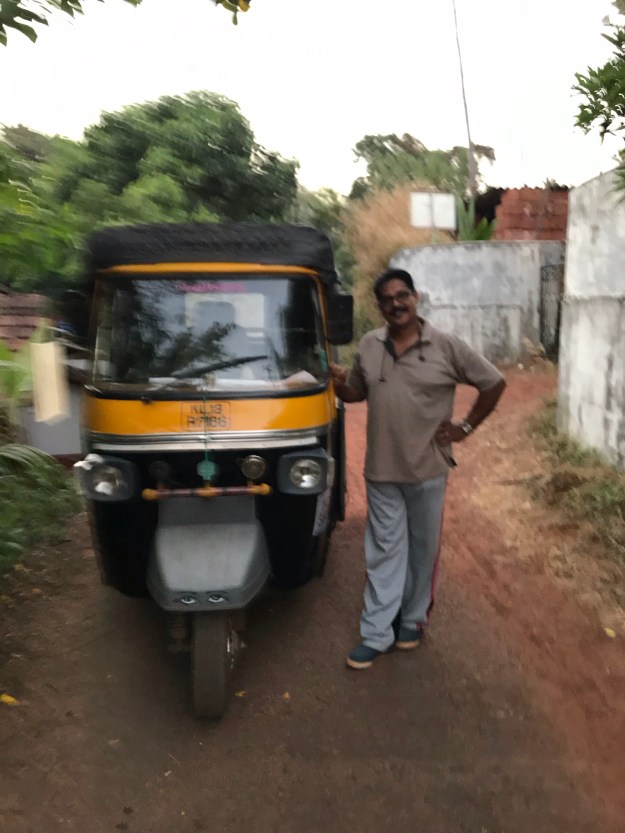
Vineeth, my trusted rickshaw driver and guide is already waiting for me outside. I put my pink cloth carry bag on the seat and off we go.
What’s in my bag? A banana and some biscuits, my camera and telephoto lens, iPhone, and last but certainly not least, a handy water spray bottle which brings down my body temperature quickly when the steamy tropical heat threatens to break my resolve to remain any longer.

The temple I am going to today is only 17km away but it not a paved road so I have no idea how long the journey will take. I ask myself if I should try to sleep on the way and I lie down in a fetal position on the plastic padded bench seat in the rickshaw.That idea is quickly abandoned after the first few bumps.

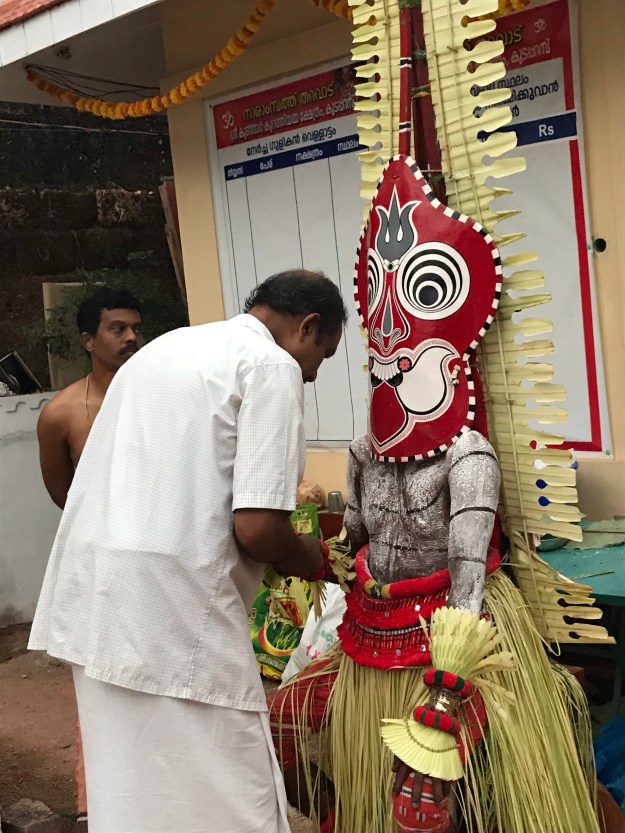
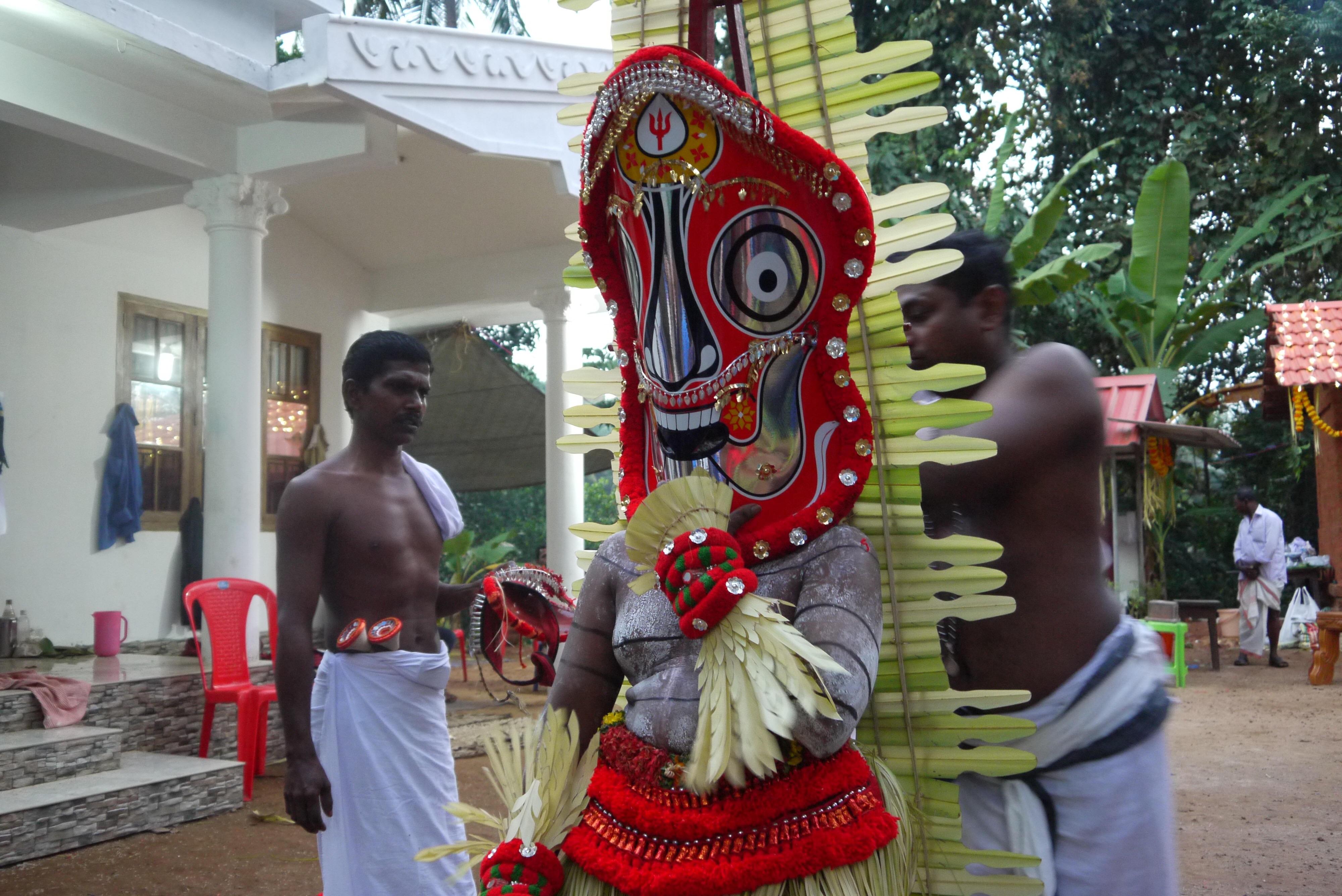
Forty minutes later we arrive and Golikan, the first deity, is making his appearance. The priest motions for me to wait until the blessings for putting on the mask are finished before I take any photos.I have seen this deity at other temples but this performer is more engaged and active than the others, walking on stilts and leaping around the courtyard wildly.

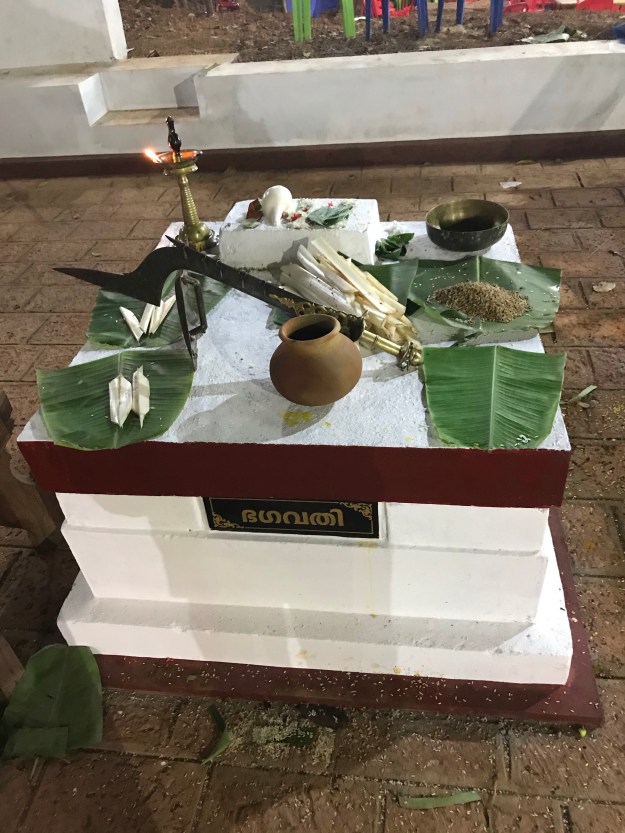
This temple is an older one dedicated to Shiva, and there are small shrines with offerings of rice and coconut.
Quite a crowd has gathered by now and there is an informal men’s and women’s section for seating.
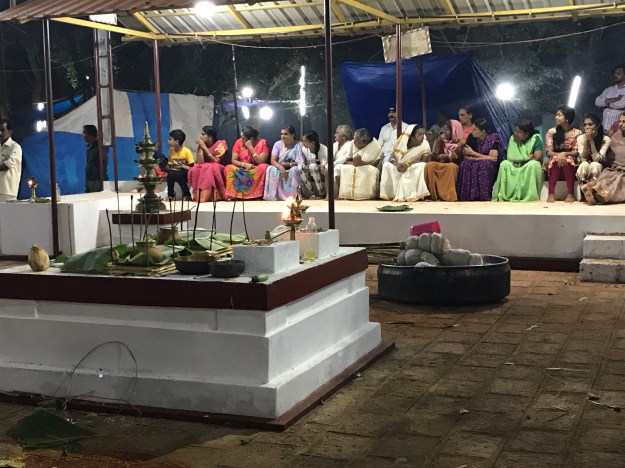
Beautiful traditional Keralan white silk saris banded with gold are worn by the older women, who have brass oil lamps which will be lit and blessed by the spectacular fire dancer deity who will be performing later.

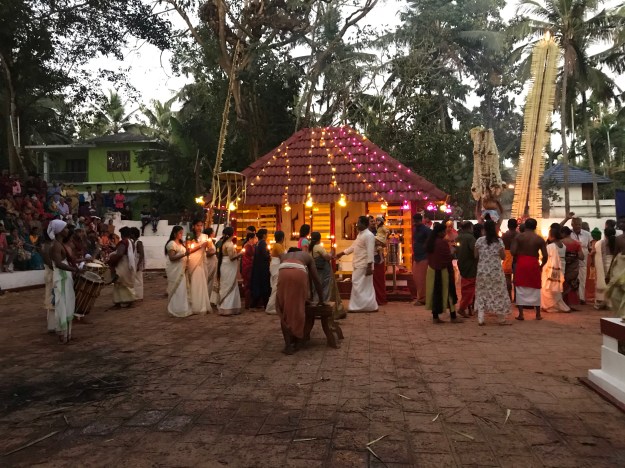
After the first three Theyyam have finished their performance there is a break. Seated on small thrones in the courtyard the Theyyam bless the villagers as they line up. Meanwhile, a loud speaker is advertising services by companies who have sponsored this ceremony. and like all things in India, is at high volume.

An aura of anticipation and excitement is in the air as we await the entrance of Agni Kandakarnan, the son of Shiva.

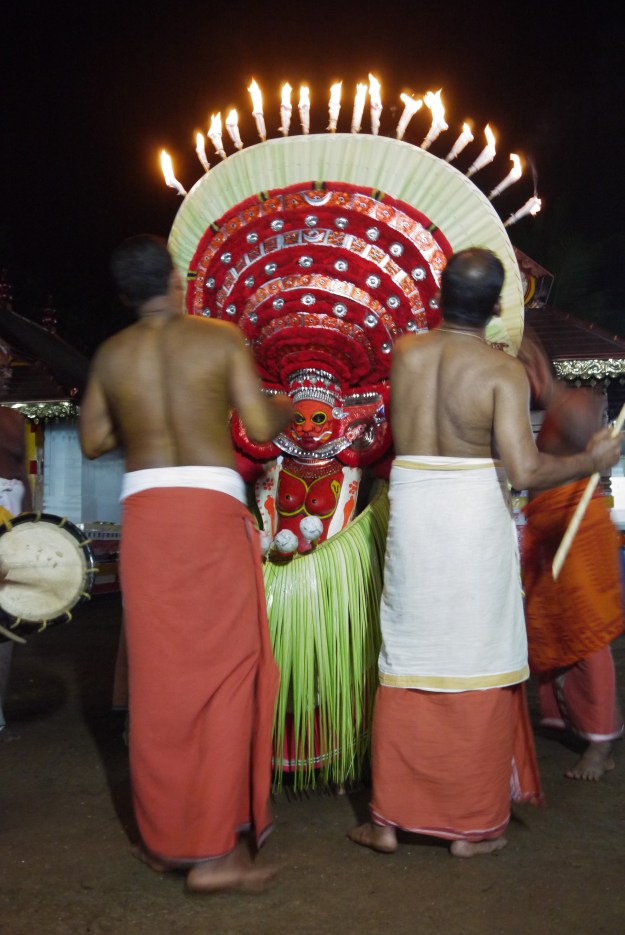
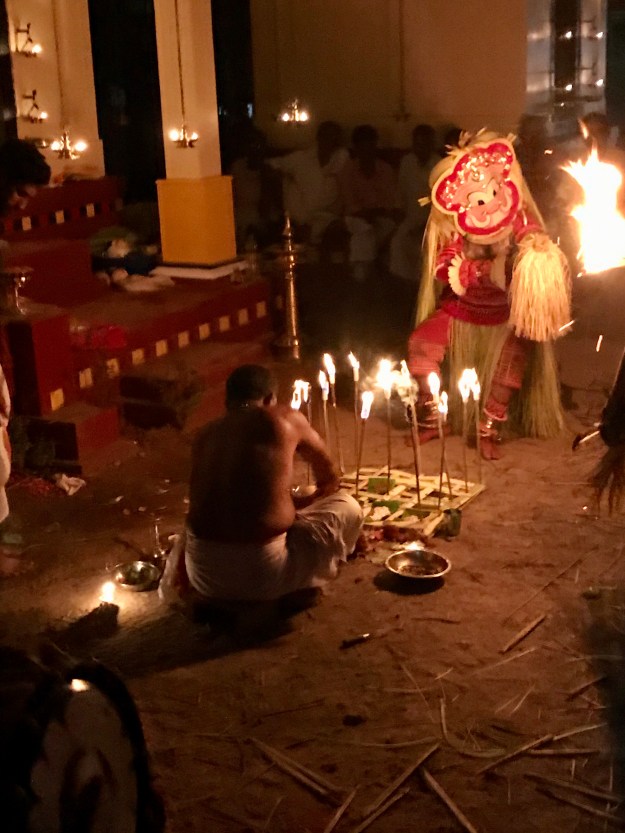
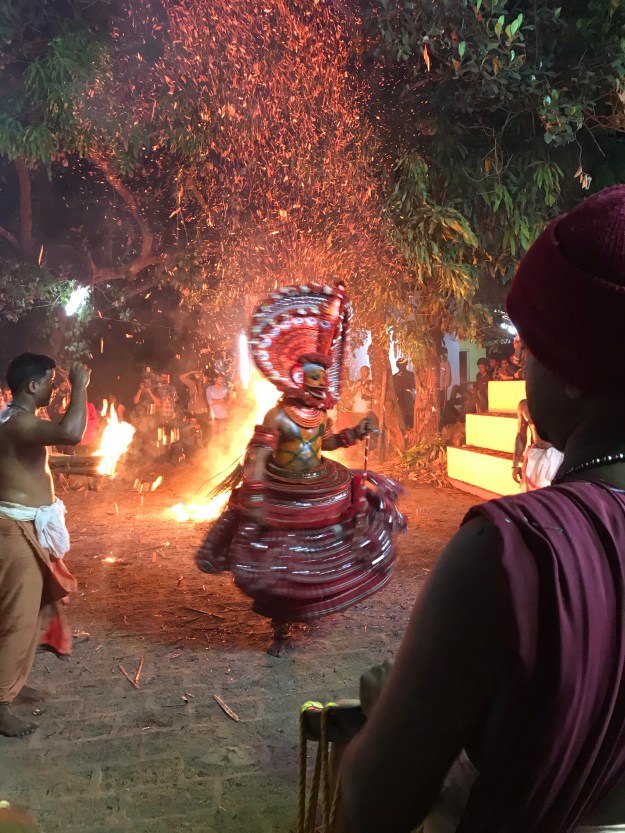
I am seated directly in front of the temple so that I have a prime view of the entrance of each deity. Agni Kandakarnan arrives and the temple attendants place the eight poles, each with a torch at either end, around his young coconut leaf skirt. When they are lit there is an audible hush and then a gasp.
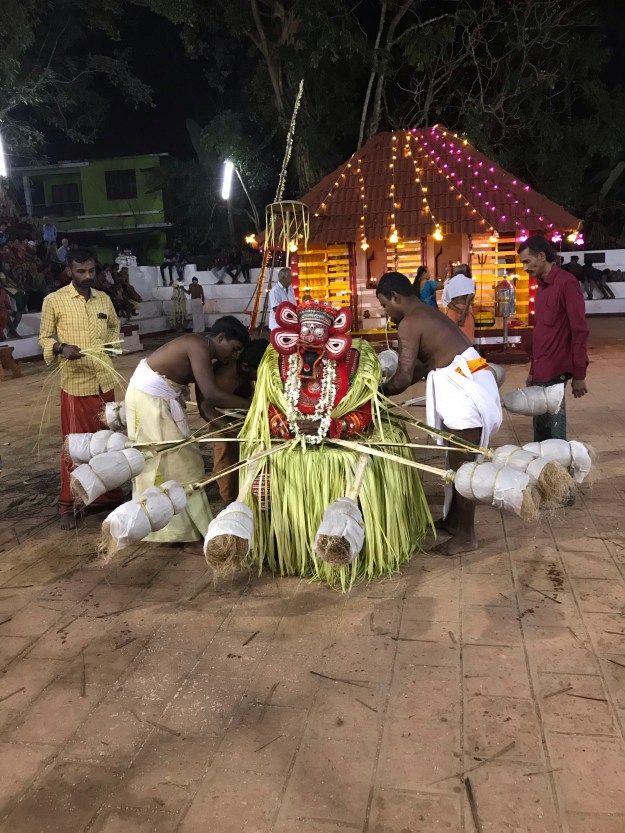
Each time Theyyam is performed, even if it is the same character, there is a sense of unpredictability. On this particular occasion it is both terrifying and playful. As the fiery Theyyam spins around, spreading balls of flames on the ground he is yelling angrily, running through the stands, stopping now and then to bless a man, woman or child. Then just as suddenly he leaps up to where a gaggle of young men are seated and grabs someone’s cell phone.

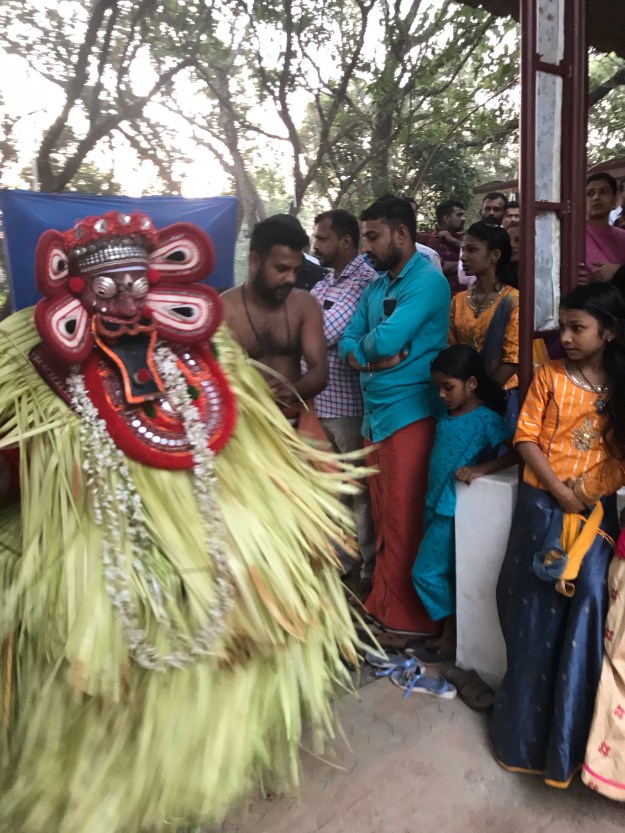
He runs around gleefully and mischievously displaying his prize, until he finally gives it to one of the drummers. The owner of the phone runs hurriedly to retrieve it.

By now the sun is rising and Vineeth has to bring his daughter to school and signals to me that it’s time to leave.

I arrive back at the guesthouse exhausted, exhilarated and unable to speak.

I will be forever grateful to my dear husband Gerald, who introduced me to India sixteen years ago. I could have never imagined what a profound impact it would make in my life.
In the Line of Fire/Between Man and God

Theyyam– An individual attaining a divine state of existence as a living god and morphing into a power that provides solutions for mans mental and physical problems is something that sets Theyyam apart and above all the other ritual art forms in India. –Shreekanth Trikaripur

To say that I am obsessed with Theyyam would be grossly understating my relationship with this unique ritual, and the emotions that I experience in its presence. During a visit to Cochin on the Malabar Coast of India in 2014, I first became aware of this annual ceremony that takes place in northern Kerala between November and April .Since then I have been returning to Kannur every two years . What can explain the magnetic draw which compels me to leave my beautiful guest house before sunrise every morning at three-thirty and again at six in the evening.? The unspoiled stretches of deserted beaches which draw visitors to spend days on end lying in the sun, only vaguely aware that such a powerful event is happening so close to them, is not my first priority. (Although we do enjoy a long walk and swim after returning hot and sweaty from the morning Theyyam) Is it the intense drumming that pulsates through my body as six or seven drummers vigourously pound out the rhthms that will help induce the trance that the Theyyam will experience in order to inhabit the body of a deity? Or is it the depth of emotion that can be seen and felt as the villagers approach the deities for blessings and advice, truly believing with all their heart that they are speaking directly to a god? Or could it be the gracious welcome with which the locals accept strangers and non-believers to this very intimate and emotional observance? I think it is all of these.

The ceremonies are a way for villagers to receive blessings for their temples and to consult directly with a god who can answer their questions and offer advice. They take place before sunrise and sunset in the courtyard surrounding a village shrine. There is a strict regimen to be followed for the Theyyam performer,-the prayers, face and body painting and the costumes. I arrive early so I can watch the preparation of the performers and become immersed in the entire process. Enormous physical and mental stamina is required both to wear and dance in the costumes, which can easily weigh fifty pounds or more, and to withstand the heat of the fires that some of the deities will endure. This tradition is passed from father to son, and although some of the thirty-five deities represented are women,performers are always men.

These rituals are being transformed with the changing times. At the weekend ceremonies there was a contingent of big city Indian tourists with expensive cameras around their necks, pushing and shoving their way to the front, blocking the view of others. They were more interested in getting that one “great shot” than the sacredness of the moment. A French woman held her selfie stick which went off with a flash in front of the eyes of one Theyyam in the midst of his deep concentration to achieve the trance like state necessary. Theyyam ritual is not a performance and should not be reagrded as such no matter how elaborate or spectacular it may be. I have heard talk of a tour company wanting to open a theater and bring in paying tourists to watch the “spectacle”. This purification and benediction ritual can only be experienced in its original venue with the local community. If it is isolated and performed out of context it loses its significance and power. True performers are dedicated to their roles as bearers of tradition and will perform only in kaavus (village temples).

Will the next generation of young men continue to have interest in maintaining this tradition or will they be lured into working in Abu Dhabi and Bahrain where many of their contemporaries go to earn high salaries?

My prayer as I leave Kannur is that this beloved ritual survives in its pure form for many years to come.

NB: For more information on Theyyam you can read some of my previous blog posts- Bonfire of the Deities, Burning Man Kerala and Seized by the Gods

Behind the Curtain/India Exposed

You won’t be able to take photos or watch the make up preparation, but to see the Theyyam Bagavathi Muttilotu is an experience not to be missed. She is one of the most powerful goddesses and the performer cannot eat meat, drink alcohol or have sex for forty one days beforehand. She stays behind a curtain and doesn’t come out until ready to receive the headdress. For some people it is scary because she can be unpredictable and start yelling and gesturing aggressively.

Kurian, my Theyyam authority, and owner of Costa Malabari Guest House in Kannur, explained this to me in an earnest tone. I have been coming here ever since I was first exposed to Theyyam in 2014.

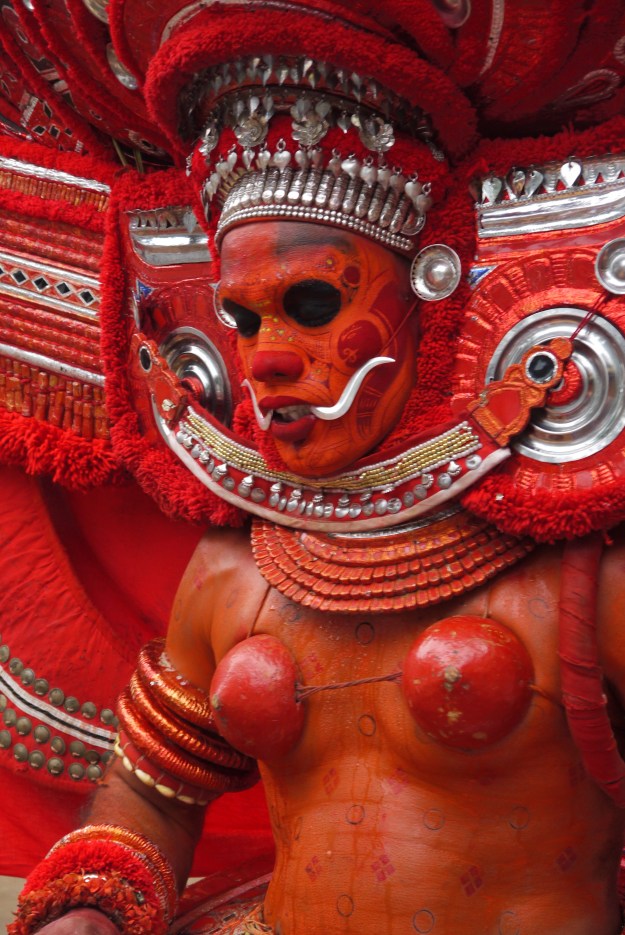
Theyyam is an ancient ritual practiced in the Malabar region of southern India and is performed exclusively by men who manifest the deities and goddesses while in a trance-like state. The ritual started out as a practice of the lower castes and later became absorbed into Hindu culture as a way of communicating directly with deities.

Malabar village shrines are dedicated to a particular deity and an annual ritual or festival is sponsored either by a family or the priests, and is open to the greater community at large.Theyyam season is between November and May. The more powerful Theyyam deities can attract thousands of worshippers to the ceremonies.

At nine in the morning we started out for the first village. It was later than usual because the ceremonies, which usually start at sunrise, had been going on all night. Plastic tarps were set up as booths , carnival style, to sell the various trinkets- plastic toys, balloons,bangles and other assorted useful objects which the attendees would inevitably buy. Bollywood music, interspersed with adverts for travel agencies, hair growth clinics and “fancy dress” shops, bellowed out of two loudspeakers positioned just outside the kavu ( sacred area around the shrine). It was early and we were among the first to arrive. I always like to have time for the villagers to become comfortable with our presence.

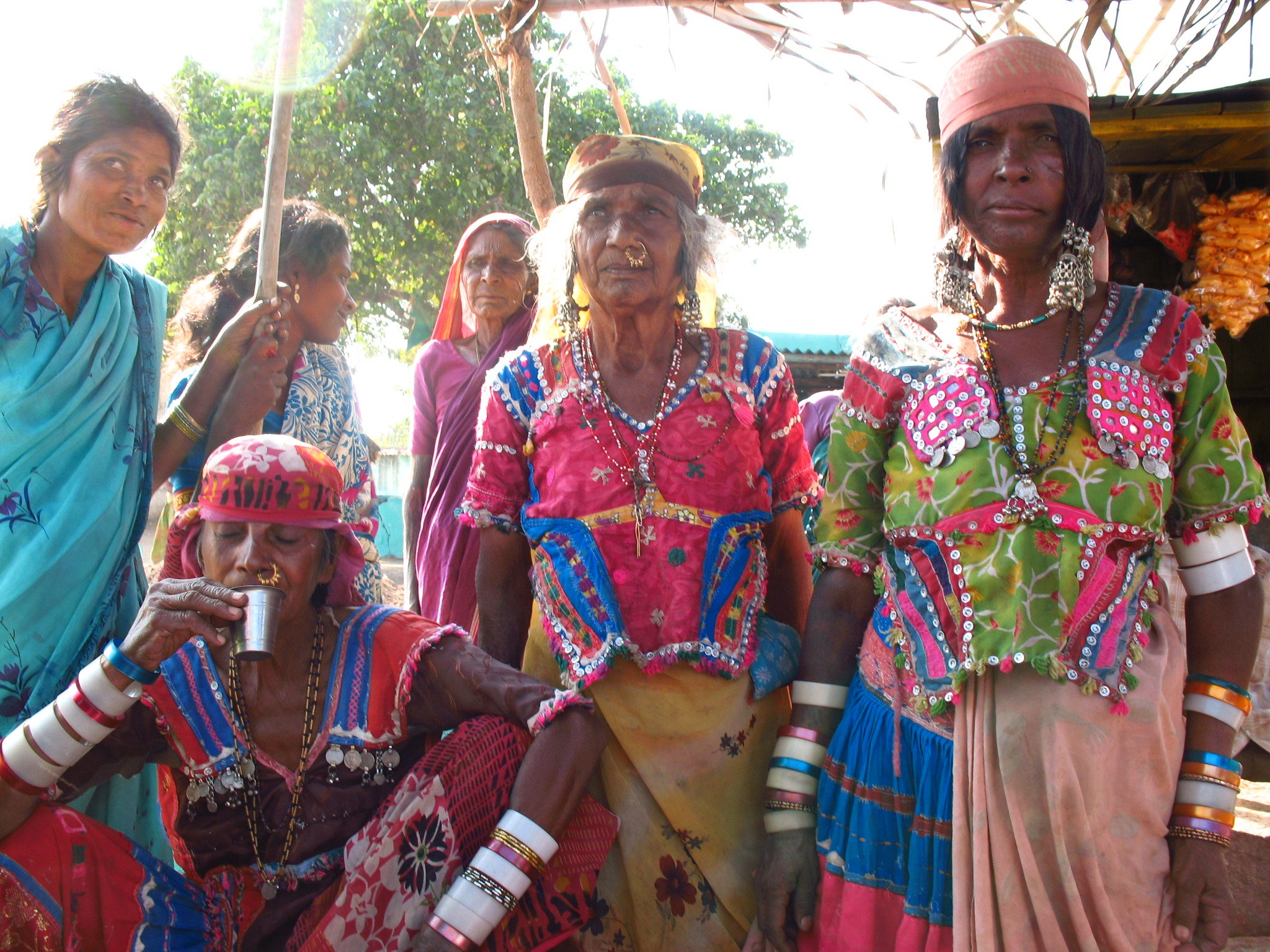
My flip flops, already muddied with the moist red dirt, and traces of the many people who had trampled over them, were placed outside the entrance to the shrine, and I hoped I would be able to find them again after the crowds stormed through. I attempted (vainly) to sparkle as much as the Rajasthani women and wore my best gold dangly earrings, bangles and mangal sutra ( Rajasthani marriage necklace).

Gerald and Richard had set their backpacks on the red plastic chairs in the front row to save the best seats. It wasn’t until later, when an old lady snarled at him did he realize they were in the women’s section, and had to move.

I immediately rushed over to the costume/make up preparation area. Each one of the eight deities that would be represented has a unique costume and intricate face painting design which can take hours to complete. After four hours in the tropical heat,watching the six drummers feverishly lead the deities into trance, and the mesmerizing dancing of the Theyyam, I was exhausted. We had seen four deities and there were four more getting ready. As the sun baked into my skin, even with the sensory overload of these rituals I knew that I absolutely had to go to the next village where Bhagavati would be the grand finale.

As we arrived at the next shrine- a much bigger venue with hundreds of people already milling about in the temple grounds, the anticipation was palpable. As in the other village we were the only non-Indians and were given a place of honor so that we could to see better.

An old man with bloodshot eyes- probably from too much toddy-approached me.

Bagavathi is a powerful goddess, coming soon. She will make you cry, I do.

I was anxious for the finale after waiting almost two hours .We had rushed to get there by 2 pm and my eyes were glued to the curtain covering the place where Bagavathi was preparing, waiting to see some movement that would indicate an appearance. The only food I had eaten was a packaged ice cream bought from a vendor. Although we were invited to share the feast that was prepared for the masses at each shrine, I had politely refrained from eating and drinking, knowing that the toilet facilities would be suspect. But there was no way that I would even think of leaving before seeing what I had come for.

A bonfire had been smoldering for hours. Suddenly the temple priests and attendants started running over the hot coals and encircling the shrine. A swell of women and men charged across the temple grounds to the corner where Bagavathi was ready to receive her headdress. I didn’t know whether I should join them or stay put in my prime viewing position. The women next to me kept on squeezing me in in order to make room for a badly misshapen young man, lying on a mat behind me. They pointed to a woman standing nearby who I assumed was his mother, and she motioned that she wanted him to be blessed when Bagavahti passed by. I knew if I left there would be no returning.

Fearful that if I stayed I might miss the action, I ran over, just in time to see Bagavathi, in brilliant red headdress and huge skirt,flaming torches in both hands. Worshippers were pushing and shoving to get close enough to pass their arms through the flames, a sign of receiving her blessings.

And then just like that it was all over.

The car was quiet on the way back to our guesthouse. A small window had been opened , exposing one of the many sides of Incredible India.

Bonfire of the Deities/Burning Man Kerala

A bonfire is blazing as we arrive at the village at 4:30 am. The stage is being set for what will be the most spectacular Theyyam we have seen yet.  The Kavu, or sacred shrine,in the courtyard of a wealthy Keralan landowner, is the setting for a seldom seen fire dance.  The three day Pottan Theyyam he has ordered as a blessing for his family and their new home is an expensive undertaking, and I am thrilled that we will witness this event. Theyyam looks similar to the more famous Kathakali dance theater of Kerala, but it is a religious event rather than a performance for entertainment. These rituals take place once a year during the months of December through March.

As dawn begins to break on this second day of the ritual,the temple attendants, dressed in lunghis(wraps), throw in another log each time the fire seems to be dying down. Sparks are flying and I move some distance away so as not to have my carry bag catch fire.  We are with two other westerners, who have been staying at our guest house, Angela and Annette from the UK.

It is still dark and the sun will not start to peek through until 7:00 am. The four young drummers, who played so vigorously last night for two solid hours, are snuggled together sweetly in the spoon position, on a blue plastic tarp in the “green room” ( the sacred space for Theyyam preparation).


Enormous pots are boiling in the back area of the house where a festive meal is being prepared for the throngs of villagers  who will attend the ceremony.We are offered tea with a typical Keralan sweet, and an invitation to enter the house.

Theyyam performers traditionally receive money from each person who lines up to ask for a favor or prayer, or  to thank the gods for wishes fulfilled. Last night two men personifed different aspects of the deity,Golikan.  Today there will be four deities,including the famous Vishnumoorthi  who will perform the fire dance.

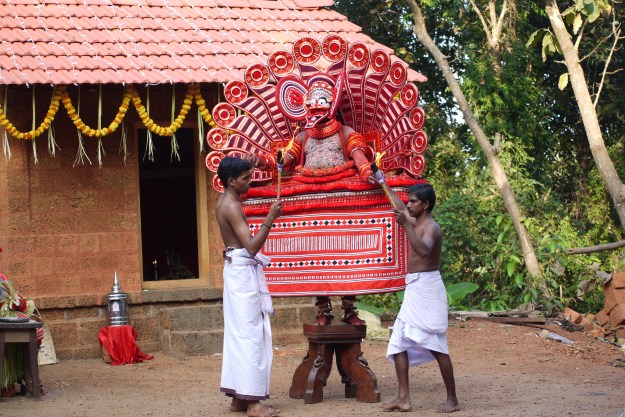
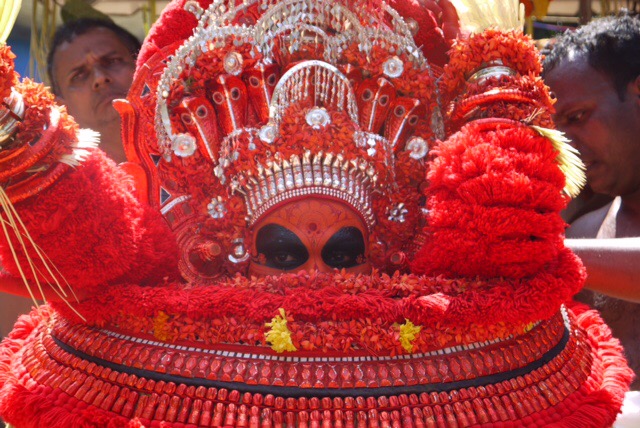
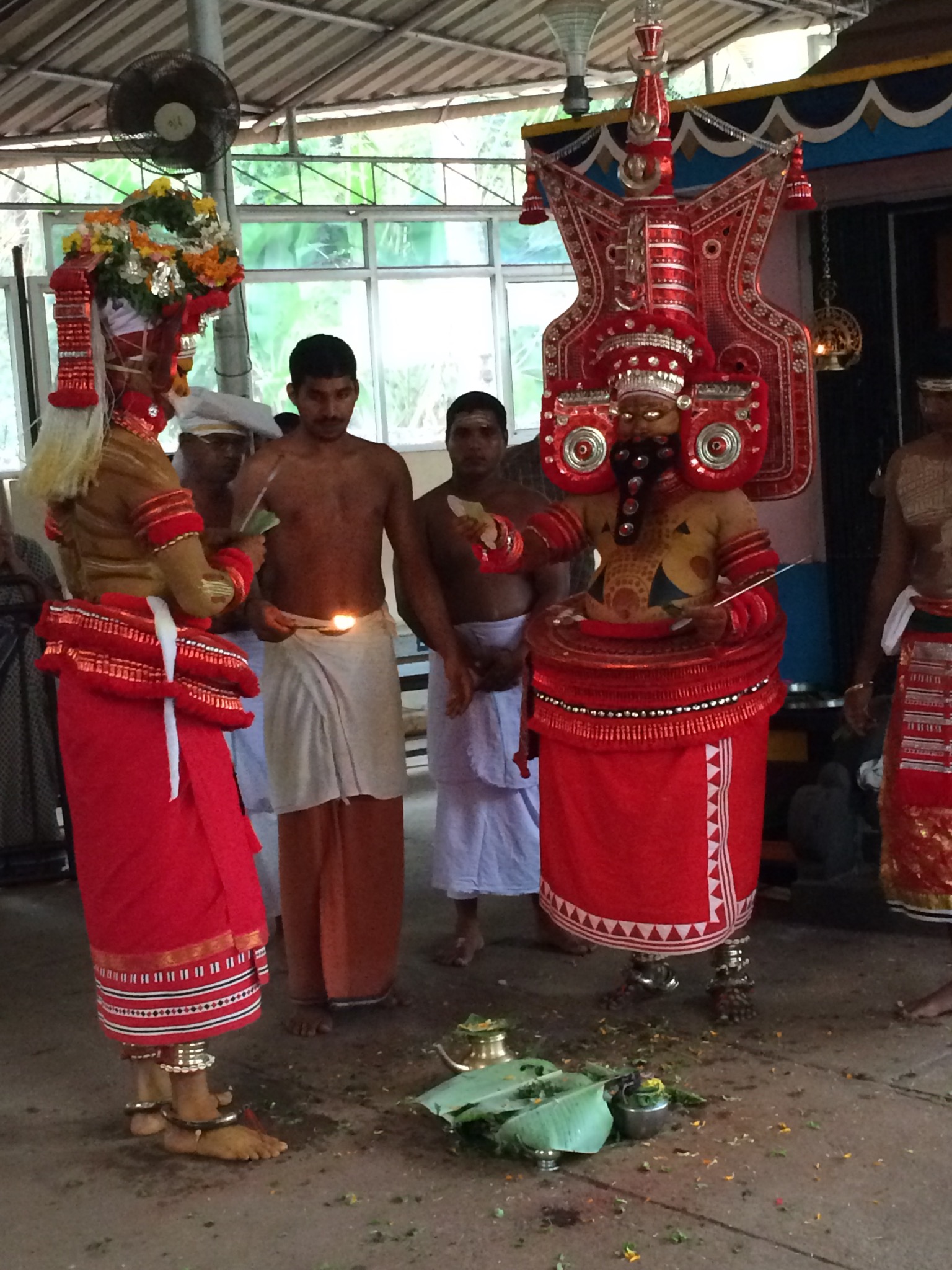
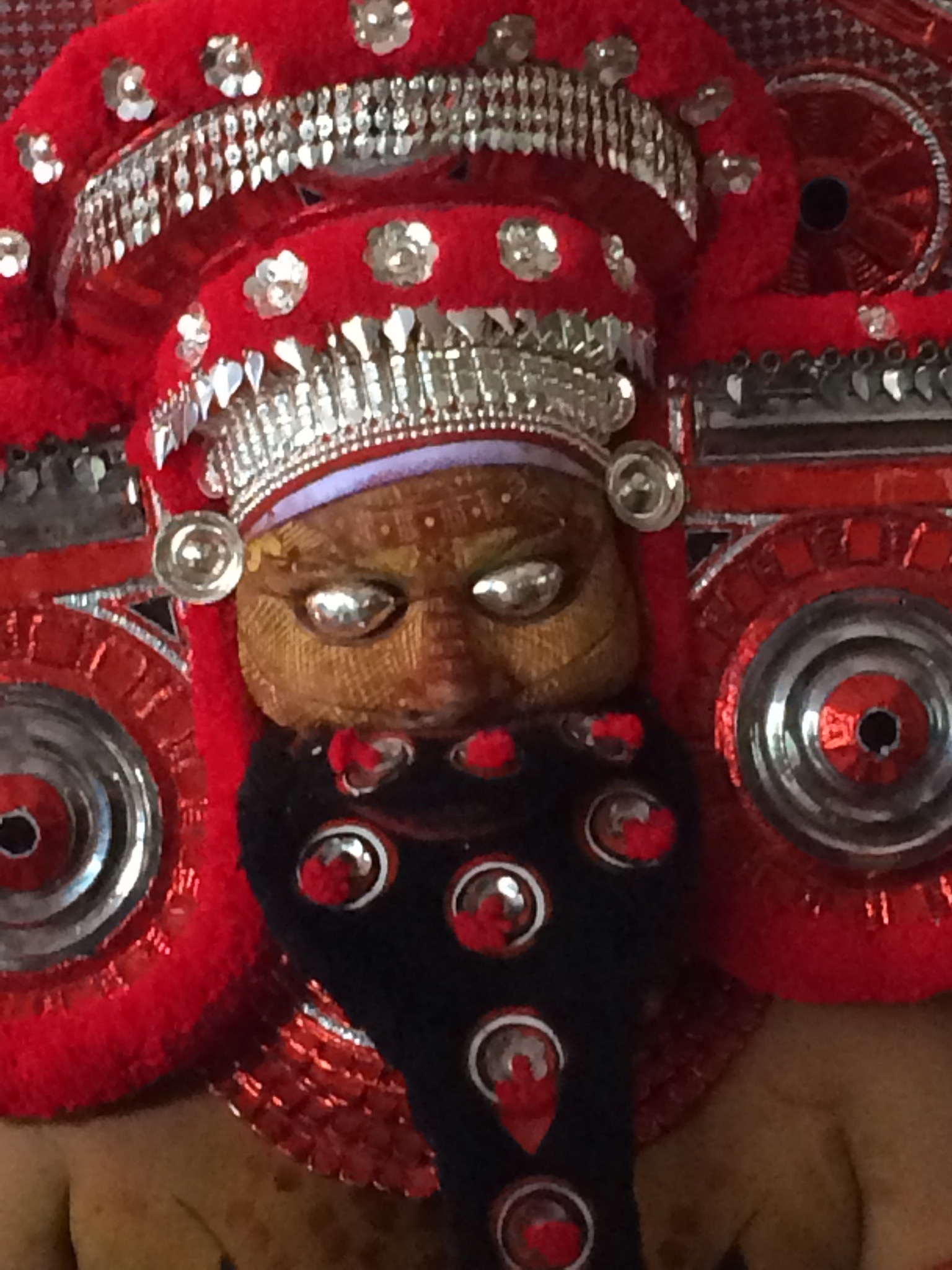
The first dancer comes out with a  20 foot headdress made out of banana leaves in the shape of a ladder.  He is wearing a large clown like mask painted a brilliant silver,red and black. First he blesses the shrine, then he encircles the Kavu,with the drummers leading the way. After an hour of dancing which includes highly skillful stilt-walking and recounting his story, he is seated on a type of throne, with his headdress resting against the wall.  Next comes a Theyyam with an elaborate red hemispheric shaped headdress bordered with peacock feather designs,a mask with large ear flaps and mouth,and  a skirt created over a rectangular frame.   I remind  both Annette and Gerald to make sure not to forget to stand when the deity passes by (a sign of respect).  The night before, Gerald was so engrossed in his drawing that he didn’t notice that Golikan was right in front of him, remained seated, and an angry deity glared and threw rice in his face.  The same with Annette who was so in awe of seeing Theyyam for the first time, that she,too,didn’t get up. She got the stink eye.


p1080119

Meanwhile the fire has been smoldering and the attendants make a neat pile of the burning hot coals, getting ready for the arrival of Krishnamurthi who will lay down on the ashes.  His mask has been resting in the house after having been blessed, surrounded by ghee lamps burning all night. Both the first and second deity are now seated, receiving villagers and talking with each one individually. The tension mounts as the drummers continue their fierce drumming, jumping in unison high into the air from time to time.  I can’t imagine how they can keep this up- it is now 10:30 in the morning and they have been going at it since 4.


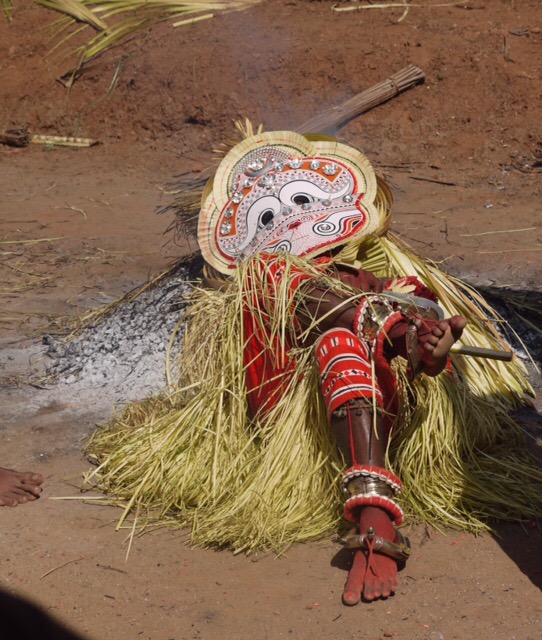
Krishnamurthi arrives in a grass skirt made out of young banana leaves, heavy metal ankle and arm bracelets, and a mask. When the moment arrives, he is led to the burning coals by the temple attendants, one on each arm.  I think it will be quick, but no, I am wrong.  After a bit of positioning, he lies down, crosses his legs, and makes himself comfortable.  Each of the other two deities approach, bend down and have a few words with him.  Then, suddenly he jumps up, changes direction, and lies back down.  This is repeated in all four directions.  The intensity of this Theyyam requires the performer to prepare for forty one days. Complete abstinence from sex,alcohol,tobacco and meat. His mind and body must be sharp and focused.


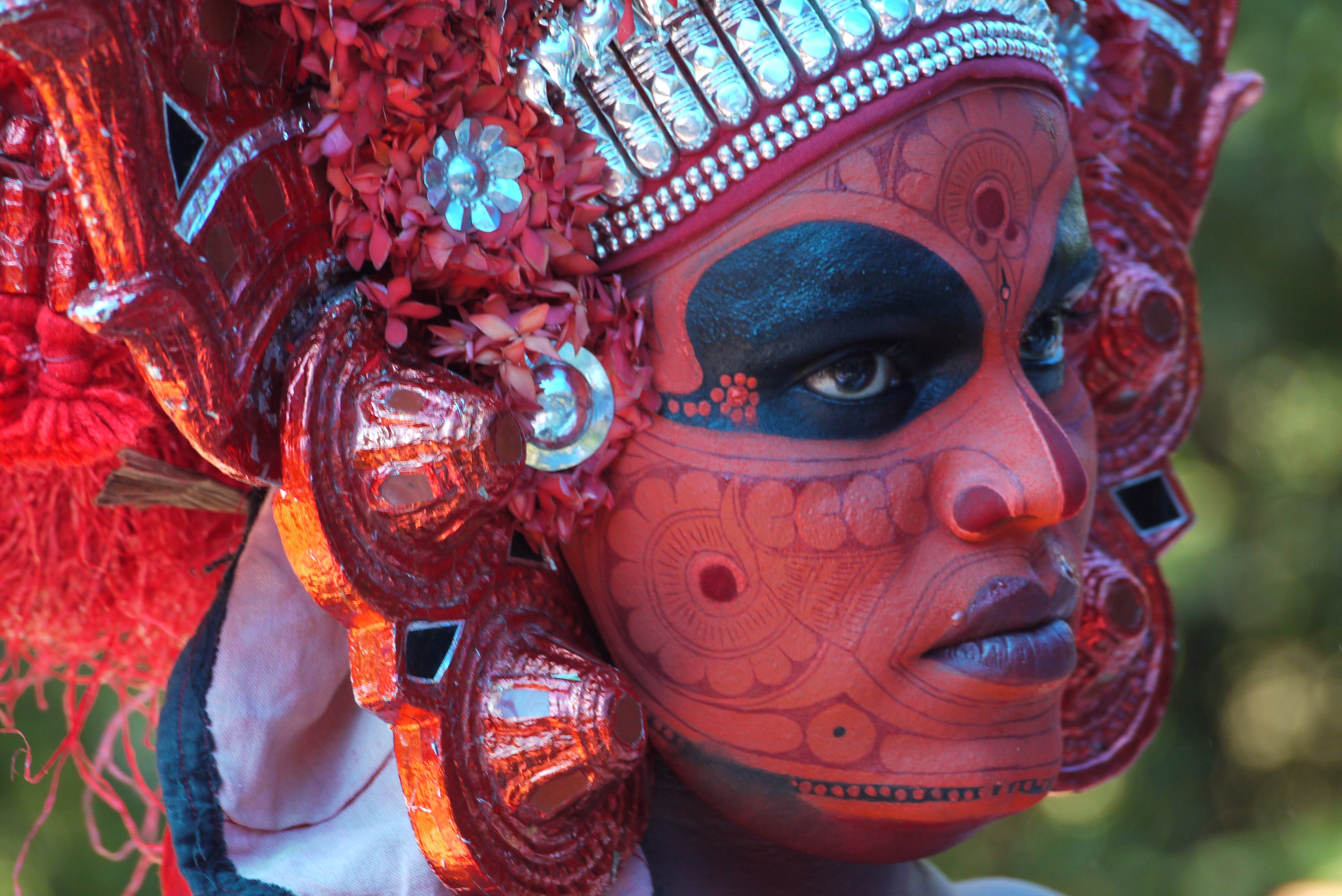
Preparation for the final dancer reveals a completely different facial design- with orange colored turmeric paste and black charcoal around the eyes. An intricate pattern, called “face writing” is drawn with a brush made from banana leaf. Only his head and arms stick out of a huge grass skirt. Red cloth bands are on his forearms and silver bracelets on his wrists.


The climax arrives with all four Theyyam interacting and dancing around the courtyard.  By this time it is noon and the sun is beating down on us until we feel like we will collapse.  It reminds us that although our minds and spirits have been transported  to an alternate reality, our bodies are still very much in the tropics of the Malabar coast. Hundreds of villagers are mulling about, eating, drinking tea, talking on their cell phones or standing and taking close up photos. We are treated as honored guests due to my blond hair, and Gerald’s size.  Chairs are set up for us directly in front of the action to ensure the best photos, and we are made to feel included at all times.  The women beckon to me to come on the steps of the home in order to get a better view, and push me almost directly into the path of Vishnumurthi as he enters to bless their home.

I am sad to leave tomorrow, but we are heading north to Ahmedabad where we will start our teaching at Gandhi’s ashram. The Theyyam has left an indelible mark on my psyche which I can never forget. And I will carry the vivid red of their costumes and the pulsating rhythms of the drums with me throughout the rest of the journey through India.

“I’ll Never Do It Again” Redux

Some people say that the letters I N D I A mean “I’LL NEVER DO IT AGAIN”, and yet here I am,ready to embark on my fifth (or is it sixth?) journey to that fascinating and infuriating land of enchantment. I must admit that after each one of my first three sojourns I returned with that same sentiment. While I’m there, days pass when I want to tear my hair out, or just find a nice, quiet place to chill. And then something happens…..a colorful procession replete with music and ritual, a delicious meal,-fragrant with pungent spices, or maybe just an invitation to visit someone’s home.

This last trip I was fortunate to enter the mysterious world of Theyyam in northern Kerala. I was “seized by the gods” in their full glory of painted bodies and faces,as they immersed themselves in the spirit of a  god, dancing and moving as one possessed. It was this mesmerizing experience,which takes place at sunrise and sunset during the months of December- February that draws me back. As soon as we returned from our last trip in December 2015 I was planning the next.

Pullurkali

Pullurkali

Yes, we will also be volunteering to work on an art project with scavenger children at Manav Sadhna, Gandhi’s ashram. How that will turn out, I know not.

We are also planning to go up to the mountains at Nainital and see tigers at Corbett National Park. How that will turn out, I know not.

Many friends are as anxious for our return as we are to rekindle their friendship. Gerald is excited about teaching more collage workshops at the Universities in Ahmadabad and Udaipur. How that will turn out,I know not.

IMG_2238

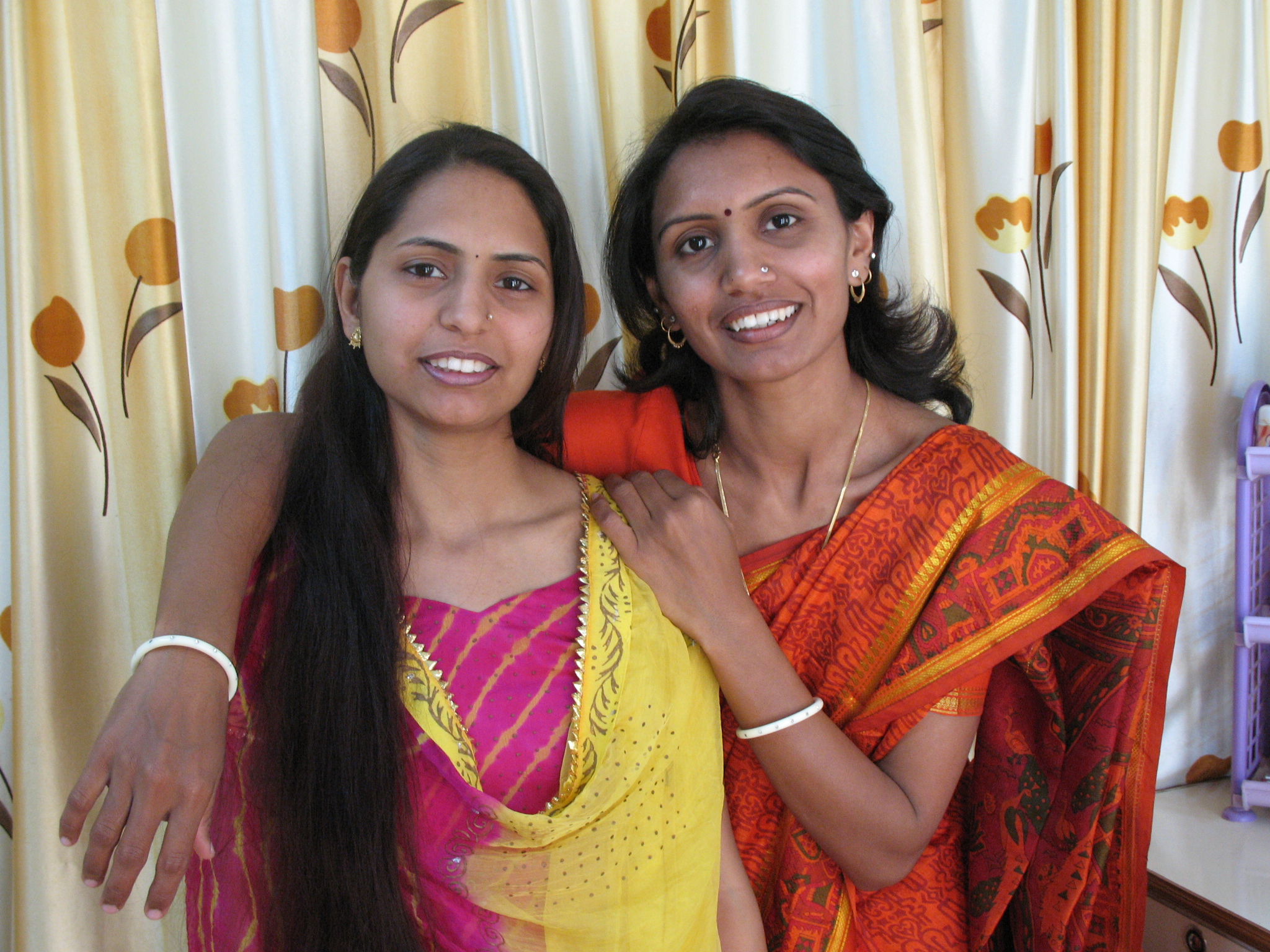
Shalena and her sister- my delightful Hairdresser in Udaipur

IMG_2160

Raji- the Puppetmaster of Udaipur

Francis at work

Francis- our master chef in Goa, at work

What I do know it that we are embarking on another adventure, and that is good.

Namaste

Seized by the Gods

image

Pullurkali

December 13

The sound of the waves crashing on the shore lulls me to sleep, but it is a fitful sleep. I am anxious for the day to begin, and wake up before the 3:00 am alarm.

We are in Kannur, six hours up the Malabar Coast from Kochin, and known for Theyyam ritual. It is performed during the annual festival of village temples in the region. Dancers who become “possessed” by a particular deity go into a trance and take on their persona. Once the deity has entered the body of the Theyyam dancer, the priest and the temple are blessed, thus purifying it for the coming year. This ritual is important for the spiritual and physical well being of the community, and the whole village pays for the temple and its maintenance

Theyyam is a unique supernatural event which allows villagers to have direct personal contact with a deity. It is interesting that only the “Untouchable ” caste is permitted to perform this ritual. Training starts at an early age,and is passed down through the male line in the family.

The ritual requires enormous physical and mental stamina. Elaborate headdresses can be over thirty feet tall, makeup can take from three to four hours to apply and metal anklets weighing two to three pounds each, are worn.

IMG_3724

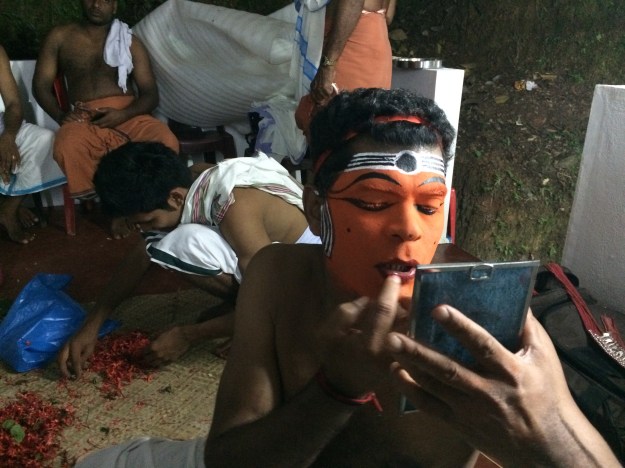
Preparing the make up

We arrive at 4:30 am and everyone is fast asleep in the courtyard surrounding the temple, where the ceremony will take place. There is a tent structure set up- called “the green room”,considered a sacred space for the dancers to prepare themselves. I peek in and one of the performers, with face make-up,is snoring loudly.

P1060733

calm before the storm

After thirty minutes the frenzy of preparation begins. There are to be three deities manifested today and two are goddesses. The drumming begins and out comes a fierce looking Pullurkali (Kali),with an enormous headdress sporting sixteen flaming torches and four more are hanging from the grass waistband of her skirt. Dancing starts off slowly with drummers and dancer encircling the two shrines. The face has metal fangs on each side, which look terrifying, and I find myself recoiling when “she” gets too close. The ritual goes on for about one hour and at the end, villagers line up to talk with the deities, ask questions and get blessed.

image

Goddess Pullurkali

image

Villagers lining up to speak to the deity

image

The. Goddess Pullurkaii with flaming headdress

Very few villagers have come at such an early hour, yet the air feels charged with energy.

We arrive at the next village at 5:00 pm (rituals start at sunrise and sunset), just in time for an unseasonal monsoon downpour.

When the rain ends twenty minutes later, the temple attendants clean out the water that has accumulated in the courtyard, with thick burlap bags. Many more villagers are here for this ritual then were this morning, and the mood is quite festive. An ice cream truck has arrived and parks on the temple grounds. Women and children are dressed in their finest clothes.

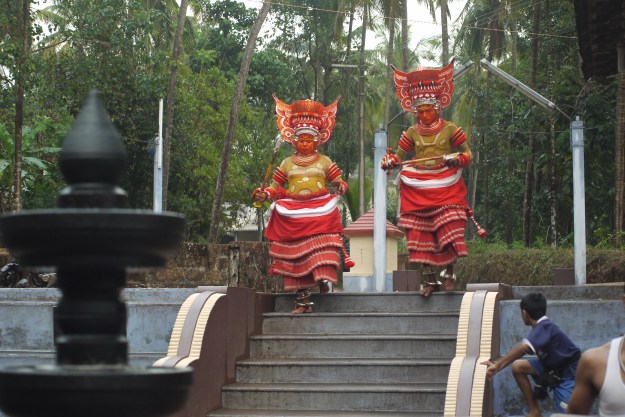
Tonight the deities are Ilamkaruvam (Vishnu), and Poothadi (Shiva).The dancing is more vigorous with both dancers battling each other with bow and arrows and sticks. Body make up is applied as well as on the face.

image

Deities Ilankaruvam and Poothudi

Turmeric, rice paste and lime are mixed to make the colors, and the paint is applied with a coconut palm reed as a brush.

The next morning we go to a simple roadside temple and it is the most personal. Watching the villagers line up to speak to the “gods” with such earnest expressions is an awe inspiring experience.

Illamkaryvam and Muttapan

Illamkaryvam and Muttapan

The God Thiruvappan

The Deity Thiruvappan

Tonight is our last ritual in yet another village. Lights are strung up around the temple grounds and garlands of marigolds hang from the buildings. It is obvious by the level of decoration that this is a wealthier community. We are offered food and snacks and told they are expecting five hundred people. Tomorrow is the climax of the three day ritual, but unfortunately we have to go back to Kochin.

A line of villagers forms on both sides of the seated deity, asking for blessings and advice, men on one side women on the other. Meanwhile, Golikan,(another deity)with long,black hair flying around, appears, held upright by an attendant on each arm. Immediately he starts dancing in front of the fire of burning branches- spinning and yelling. He moves so quickly it is hard to keep him in sight. I am mesmerized.

IMG_3740

Golikan at night

Illanparuvam and Poothoodi

Illanparuvam and Poothoodi

We are warmly welcomed to participate,  people wanting us to come back for the big twenty four hour finale. Of all the things I have experienced in my life so far, this has to be one of the most spectacular and fascinating.

Incredible India!