The first condition of understanding a foreign country is to smell it.-Rudyard Kipling
Take me away to a strange and foreign land and leave me be
Let me lay my head down upon the sand
We’re reaching out for something special our minds may never know
It’s the kind of place we dream of and then let go- Anonymous
Palaces, two century old Havelis, turbaned peddlers selling turnips,old women piling rocks on mules to transport who knows where, masala chai, samosas sizzling in a giant iron pot., and my favorite deity, Bheruji. This is My Udaipur.
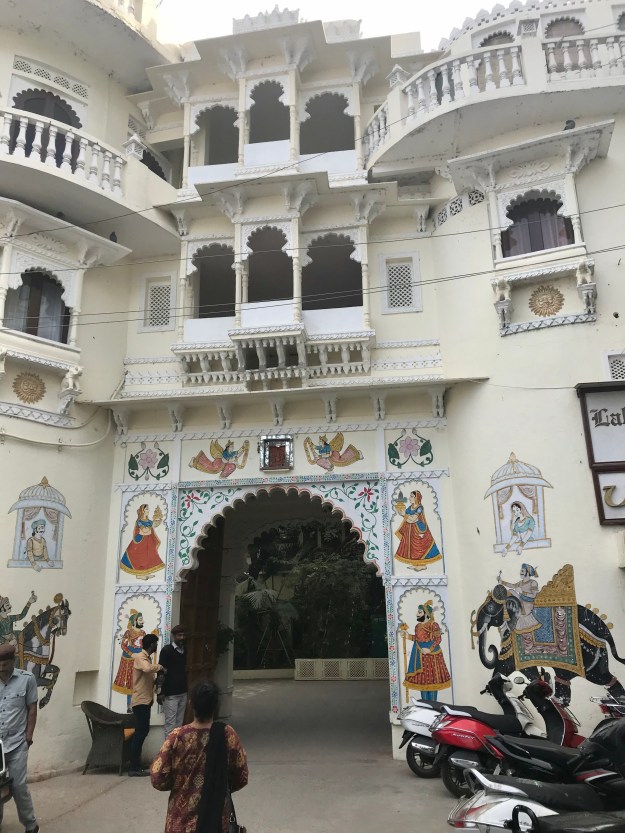
After the hustle and bustle of traveling in Indian cities, arriving in Udaipur is a most welcome respite. Clean air, roof top restaurants, parrots nesting in scalloped recesses of restored buildings once the residences of the royal family.
If a picture is indeed worth a thousand words, come along with me as I walk through the streets of Udaipur.
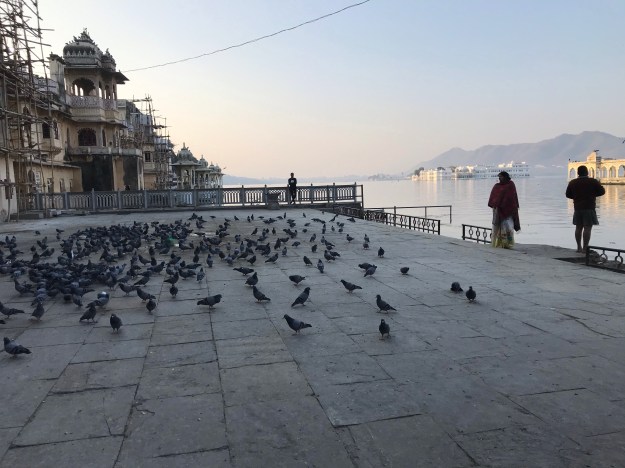
First stop Gangaur Ghat- a holy place by the lake where locals feed pigeons in the early morning to insure good Karma.
Shiva Shrine
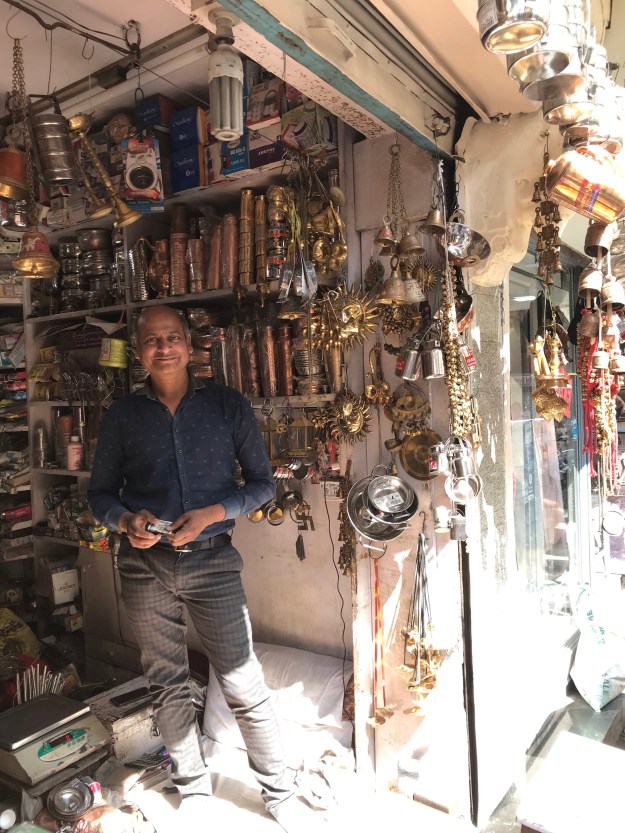
Shopkeepers are starting to open their stores. This one specializes in brass and copper kitchenwares. I bought several from him in years past.
Water seller
The woman in the pink sari in the doorway on the right is waiting patiently for customers.
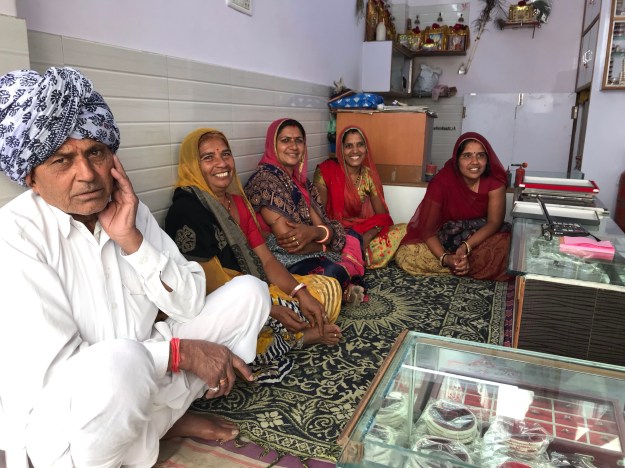
Jewelry Merchant
The head of the household looks none too happy about the money he is about to spend on jewelry for a forthcoming marriage, but the ladies are thrilled.
Village women working as day laborers transporting rocks with mules
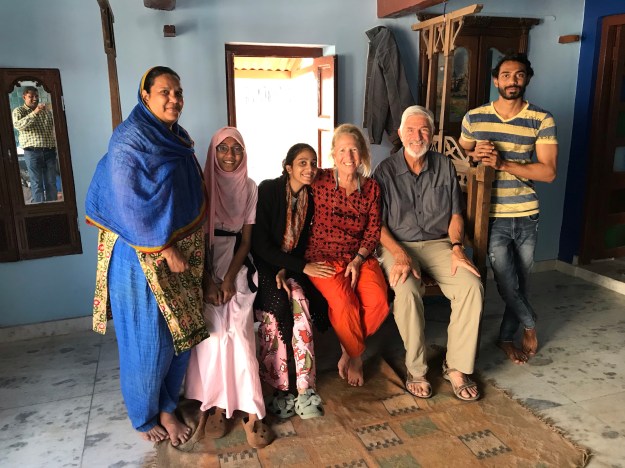
Our feet are weary and we’re thirsty. A stop for chai at our friends Prem and Kesar. After one hour of playing with the grandchildren and eating too many biscuits, we are ready to move on.
Prem and Kesar, our long time friends
Post funeral rituals by the ghats
I hear drums and see a long procession of women coming down the street. We change directions and follow them as we head to the ghats. They are celebrating the life of an elder in the village who died twelve days ago.
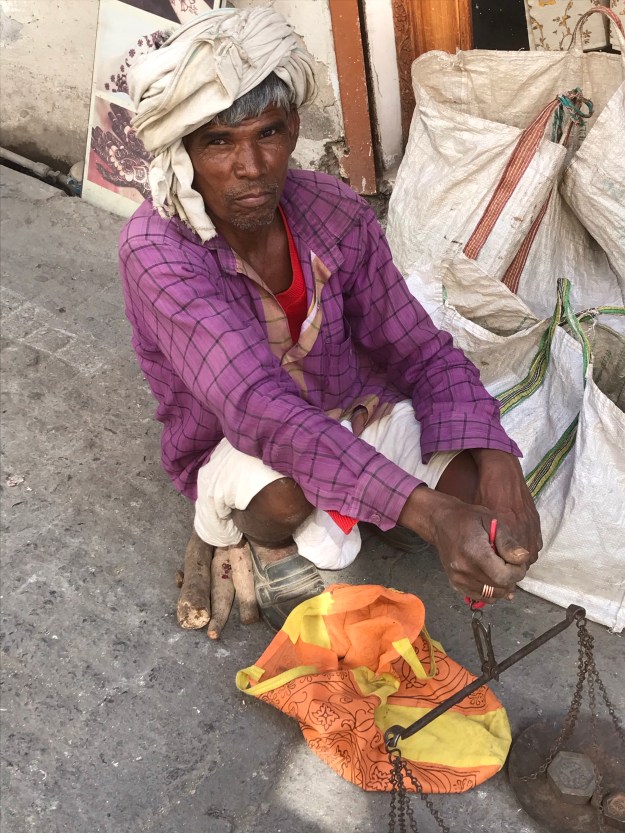
Turnip Seller selling his wares
Udai Koti Palace Hotel
Over the bridge to the other side of the lake for lunch at a former royal palace,Lake Pichola Hotel, passing magical palaces of a bygone era on the way.
Dining room of Lake Pichola Hotel
Lake Pichola Hotel
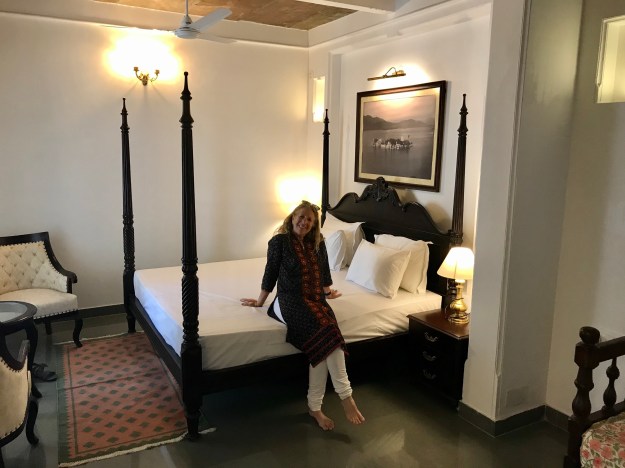
Time to go back to our lovely old haveli hotel, and pay my respects at one of the many shrines in town dedicated to Bheruji- a local deity favored by rural women.
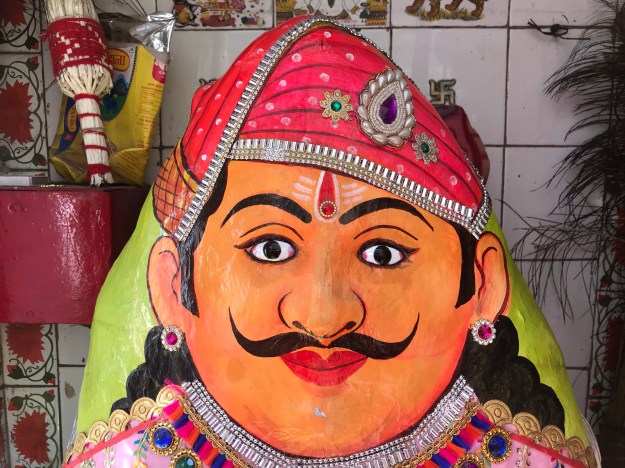
Bheruji
Sitting on the rooftop terrace all the troubles of the world seem very far away.
Yes, do buy a gown for the marriage, it’ll be so much fun! We’ll go shopping together.
Don’t buy a gown, you’ll only want it for one day, yes? I can bring you some to try on and see what you like.
You’ll be needing help with getting ready for the wedding, ma’am?
I can lend you jewelry and shoes if you like, ma’am. No worries.
Since arriving in India we have been “adopted” by numerous people and treated like members of the family. We are often asked, with a look of surprise, why we have not brought our children and their spouses with us. “Next time,” we reply sheepishly. Indians tend to travel in large family groups of eight or more, except when they go on a honeymoon. Grandparents on both sides as well as aunties,cousins and children go on vacation together. Two lone travelers are an unusual sight.
We were thrilled when our friend Shaikh Mukaram invited us to his niece’s marriage and that we would be part of the wedding party. Although we have attended many Hindu weddings, this would be our first Muslim one.
She is very poor, my sister, but there will be over 1500 people at the wedding.
Shaikh’s father has eleven brothers and three sisters and his mother has seven brothers and six sisters. He has one brother and four sisters and his wife has three brothers and three sisters. Ubed, his son, estimated that he has three hundred cousins!
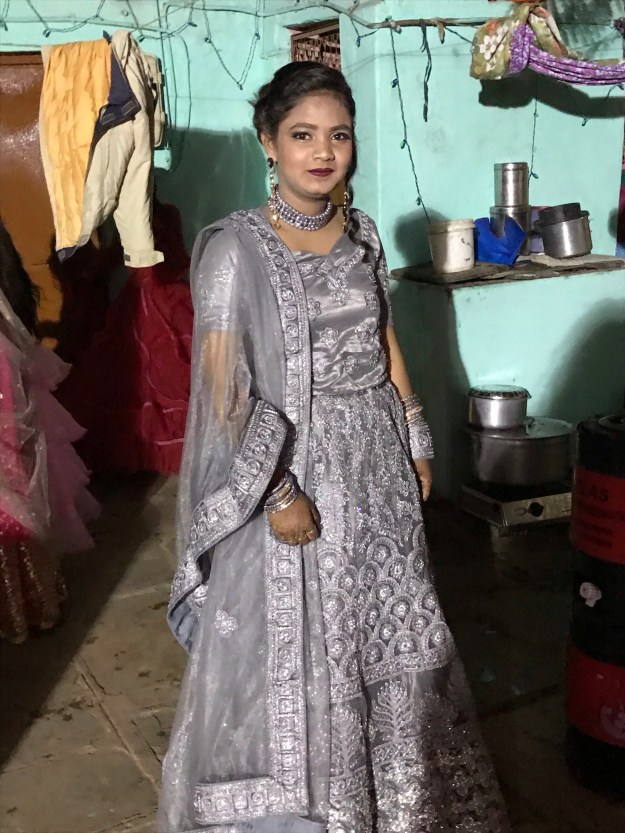
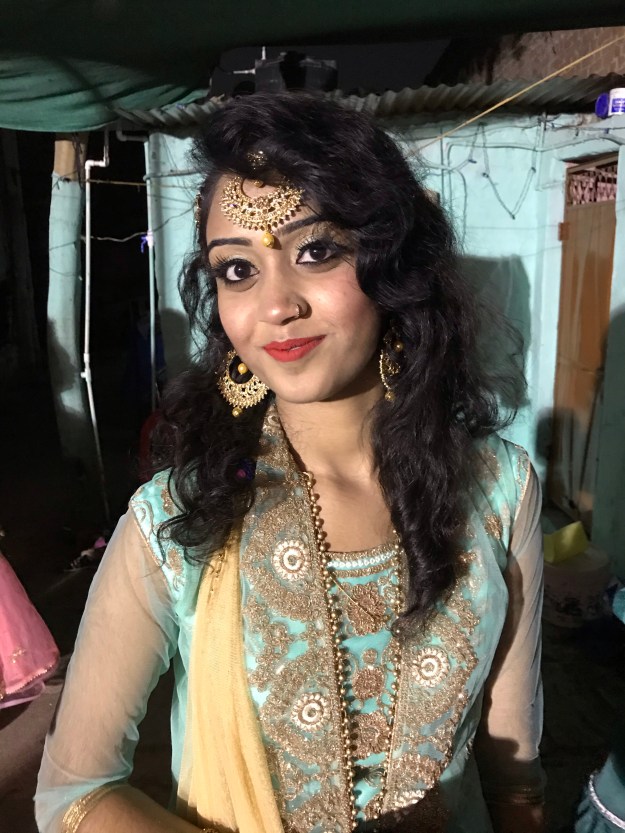
Nilam, one of the teachers at Manav Gulzar Community Center,offered to find a dress for me to borrow.
I have so many sarees but no gowns, I don’t know if you’ll like what I have.
Nilam
After teaching the workshops with the children I am usually exhausted so the thought of going to shop for a dress, no matter how much fun it might be, seemed overwhelming. I said that I was sure anything she had for me would be fine.
You need jewelry too, right?
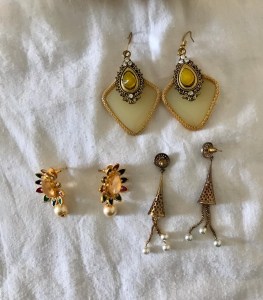
The next day a big bag with three beautiful gowns and masses of costume jewelry arrived.
How to decide? Ask my friends on Facebook of course and have a vote! With opinions pouring in from India, Cambodia,Italy, France, Germany, England and the USA, the festivities started off with a bang.
The red is more striking
Quello in alto a destra,oro (Italy)
No need to choose,because you always beautiful (Cambodia)
Even pink is gorgeous…but I would suggest U go in Red it has a festive look in my opinion Best for the occasion. (India)
When the tally came in with more than one hundred and fifty votes counted, Red was the surefire winner. I felt like a princess with all the gold and sequins and glitter. Rusda, one of Shaikh’s daughters, agreed to come shopping with me for shoes and go together for the Heena hand painting the day before the wedding.
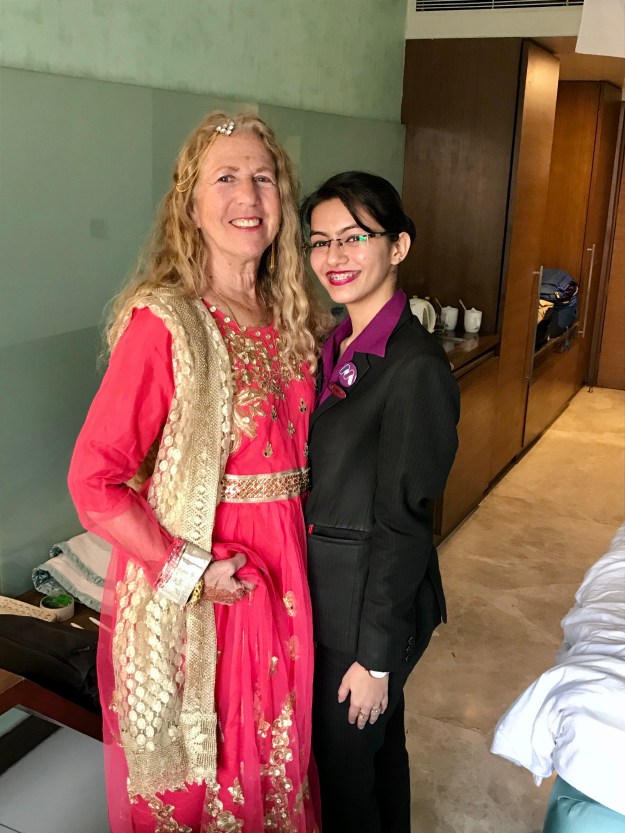
When Dhairya, one of the front desk managers at my hotel found out that I had no shoes she quickly piped in. “I have some shoes I can lend you. No worries. My Mummy and me have some pairs that we share for weddings. I’ll bring them by and you can see if they fit. “
Things were coming together quickly and it was the Friday before the wedding.
gown-check
earrings and bangles- check
gold sandal heels- check
Now it was time for the Heena.
Name and place where I will meet you tomorrow Rusda?
General hardas ngav nav lakhaa malek shaban ki dargah
Huh? Even with the Google map pinpoint I could tell it was complicated and I’d never find it.
I think maybe I won’t come. I’m afraid of getting lost.
Yaa it’s too far From your hotel.
I had resigned myself to not getting my hands painted and was commiserating with Jagat who runs the Earn and Learn program at Manav Sadhna.
Don’t worry. Nita can do it for you. I just have to send Kasturbhai to the market to get some Heena. Wait here.
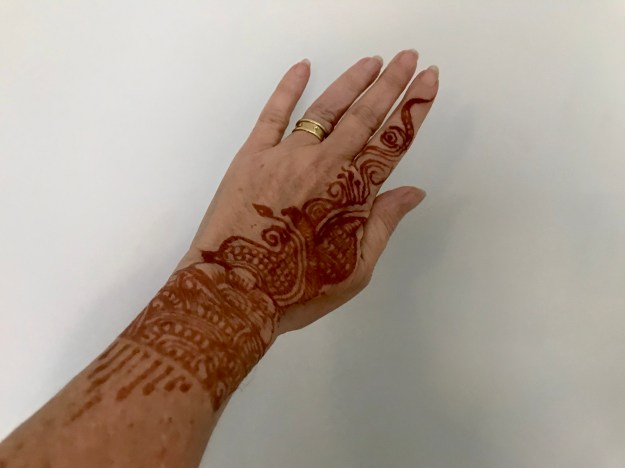
I waited for forty five minutes until he returned from the market, as the first market had no more Heena. It is wedding season and there is a big rush for the Heena coloring. It is a tradition for women friends and family members to get their hands painted . Nita is an artist and in twenty minutes she had finished two beautiful traditional designs on both my hands while Jagat sang songs extolling the love between Gerald and I. Don’t ask me why he decided to do this, but he was enjoying himself so much I didn’t ask.
Before
After
Jagat Bhai
Saturday arrived and Dhairya arranged her schedule to free up some time to help me get ready. She insisted on calling me ma’am and although it bothered me at first, like most things in India, I got used to it.
Ma’am you must wear the diamond earrings, more Indian, others too Western. And yes, the diamond jewels draped on your forehead.
I left everything for her to decide and reveled in the pampering-make-up, jewelry, perfumes, the works.Gerald didn’t have anything special to wear, especially on his feet, but he had a Kurta. No chance of borrowing anything his size from anyone here in India.
When I made my grand entrance in the lobby of the hotel, you would think a movie star had arrived. The Indians gave their thumbs up approval and insisted on taking endless selfies with me.
Since we had no idea what a Muslim wedding would be like, but had been told that it was a more restrained affair-without the exuberant music and dancing of the Hindus, we had no expectations.
The evening started off by going to the home of the bride’s mother to watch the last minute make-up preparation. It was in a poor section of town where in 2002 Hindu Nationalist riots were responsible for the burning of many homes in the Muslim quarter. Shaikh’s sister’s home was among those that were destroyed. The Indian government did nothing to quell the riots and did not pay to rebuild. It was the Muslim community that helped her.
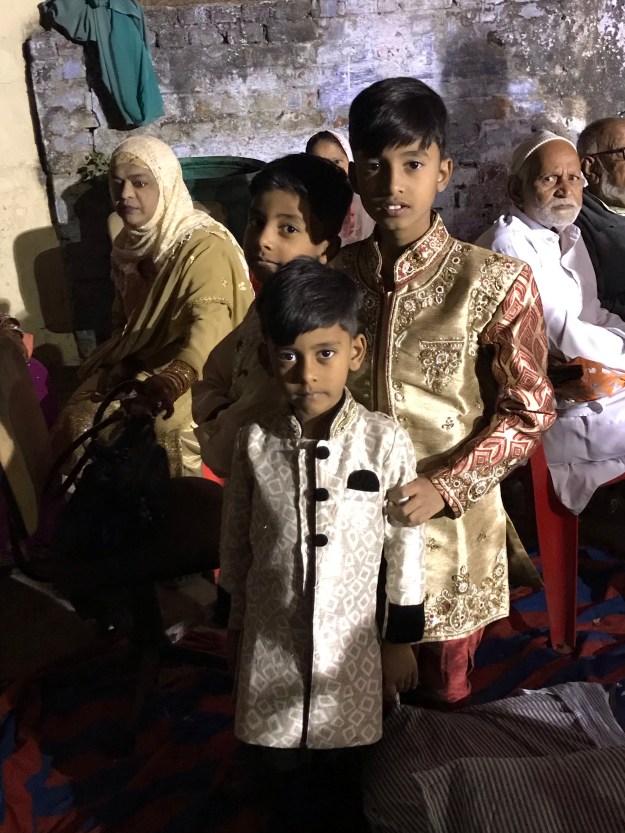
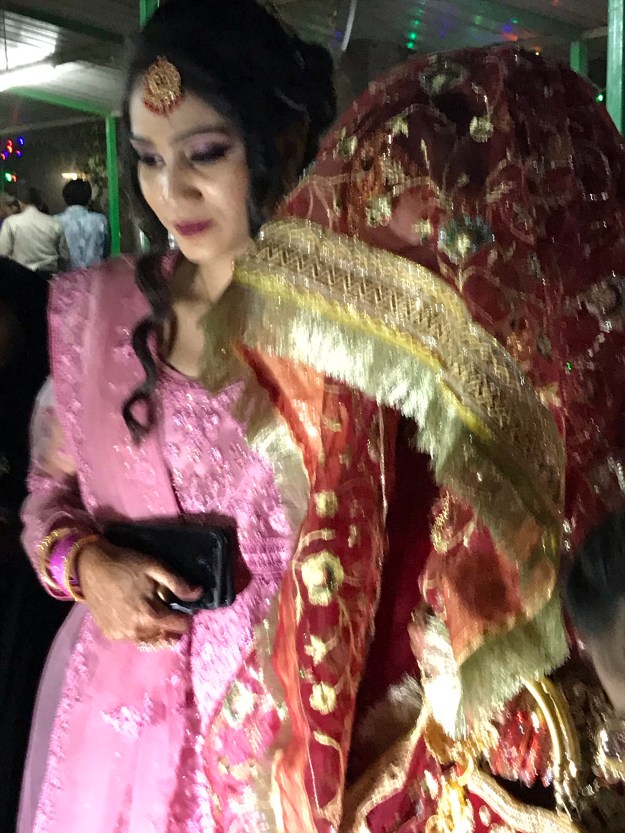
A type of canopy had been set up in the small courtyard of the quarter, and many neighbors were milling around as well as young cousins who were already dressed for the wedding. The housing quarters were tiny, barely enough room for three women to dress the bride. We stayed outside near the mosque.
Cousins
We then piled into Shaikhs car, leaving Rusda and her mother to come with the relatives. “It wouldn’t be nice if we didn’t stay with the family and go together with them. We will see you there.”
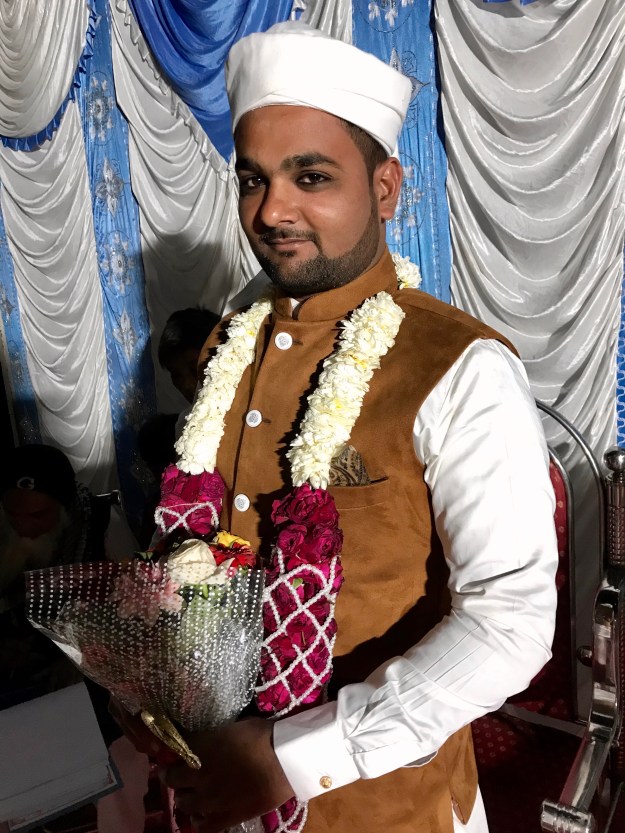
The earthen courtyard outside the mosque was dimly lit when we arrived, and it certainly did not look like a wedding venue. There was a stage set up with a throne, set against a blue and white striped curtain as back drop. The groom’s family (only about thirty five male members) sat below, looking glum and not talking to one another.We clabbered over the uneven dirt path with me holding my gown by the hem, trying not to trip over my heels while we crossed the courtyard into the bride’s section.
SPLAT! All of a sudden I felt the sole of one shoe detach from the heel. I limped awkwardly while lifting my gown off the ground in the futile hope of keeping it clean.
Shaikh’s brother to the rescue! When hearing of my dilemma he quickly appeared holding a tube of heavy duty glue. It just so happens he owns a clothing and shoe shop and was prepared for such emergencies.
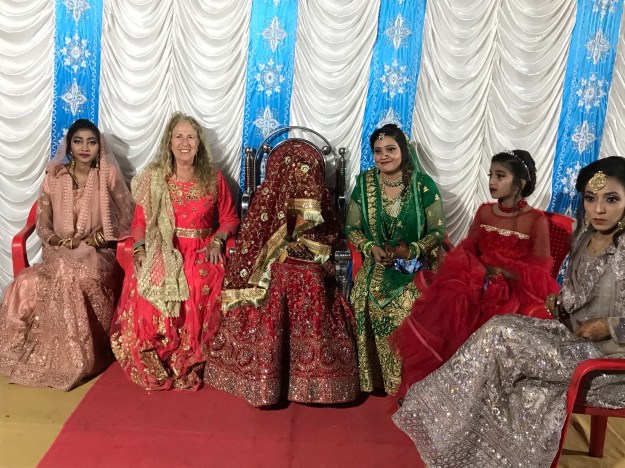
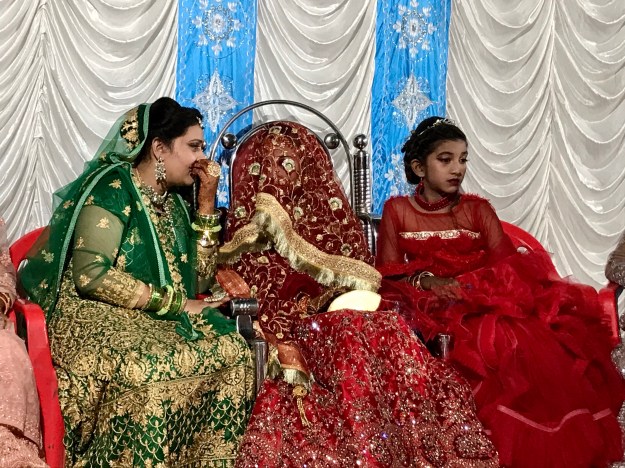
The bride’s section was a dazzling display of kitsch and bling, with women wearing earrings that looked like metal chandeliers , or sculptures that you might see hanging decoratively on a wall.
The bride arrived in a car, veil covering her face,and was immediately escorted by Rusda onto the stage where she remained for the next two hours. We were ushered onstage to sit next to her and have our photos taken, along with other relatives. At one point she started crying and her auntie leaned over and spoke soothing words and gave her a hankie. In India, after marriage the bride goes to live with the husband’s family and does not return to her family. It is a very emotional moment.
The groom arrived and took his place, far away from the bride.
Food was served on large platters to be shared communally- rice, dal and a mutton curry.
There was no Imam (priest). Shaikh’s brother brought the marriage contract onstage first to the bride and then to the groom, still seated in different parts of the courtyard. The “ceremony” was now complete. The couple, officially married,would see each other for the first time only well after midnight at the groom’s house,when a mirror would be placed between them and the veil removed.
The wedding, rather than an elaborate celebration was more a large family reunion. As Westerners it is difficult for us to fully comprehend the complicated role that family plays in Indian society. It encompasses a strong sense of duty, devotion to tradition, and is an enormous source of happiness.
Nestled between the Artificial Jewellery Shop and the Medical Supplies corner an elderly man sat on a high stool, fiddling with watches. He was surrounded by all manner of clock and watch parts and a small glass case displayed timing devices for sale, costing between a few dollars and several hundred. Gerald lives by the mantra “In India anything is possible”, but hopes for repairing his twenty year old travel alarm were fading.
Its a really cheap clock but its been a lot of places with me over the years and has sentimental value.
We approached the gentleman, asked if he repaired clocks, and he seemed to think it could be done. Of course, in India no one will ever admit that they cannot do something. We had spent the better part of two hours trying to get my IPad keyboard repaired or replaced ( it died suddenly), with no success. Each new person kindly shepherded us to the next “electronic shop” (nothing more then a tiny niche off the main market street crammed with plugs,memory cards,computer cords,etc.), but in the end , no go.
Do you mind waiting ten or fifteen minutes? He thinks he can do it.
I knew how much that clock meant to Gerald and I was enjoying watching the action on that very busy main street, so I said “Sure”.
It was after our dinner, about 8:00pm, and most of the Indian families who were spending their holidays in Udaipur were rushing around in rickshaws at dizzying speed or walking single file to avoid being sideswiped by a car. The evening was just beginning for them and the mood was festive with the whole family in tow- young couples with their children, in -laws on both sides and the occasional lone auntie or uncle.
I had the advantage of being able to see everything from my slightly perched position but not get in the way of the rush of bodies and cars. The main road was narrow, windy and not made for all the vehicles and cows that travel through.
Suddenly chanting and drums came from a loudspeaker nearby, and I craned my neck to see where it was coming from- a wedding procession perhaps? The last call to prayer from the mosques was over an hour ago. When I looked up I saw a Hindu shrine on the upper floor of a building across the road, where an evening puja was just beginning.
In the midst of all this frenetic activity, the clock man smiled at Gerald and said:
Clock fixed now.
The charge was 70 rupees (about a dollar) and we left, knowing that the clock still had many thousands of miles to journey in the future.
“Allah u Akbar, Allah u Akbar, Ashadu al la illaha ill Allah……”.
What a difference a day makes! Last week I was miserable in Ahmadebad and now it is 6:15 in the morning and the soulful strains of the Muslim call to prayer drifts in through the window of my room. I love waking up to this. Udaipur is in the heart of Rajasthan and is as wonderful as Ahmedabad was horrible. It is the city of Octopussy fame, where the James Bond movie was filmed in 1981. Palaces,fanciful,flowery Mughal designs painted on walls, shrines with incense burning, bells ringing- the stuff of fairy tales. This is the India I love. The India of Rudyard Kipling’s Maharajahs and mysterious, bejewelled women hiding behind silky sarees, is easily summoned up in the imagination.
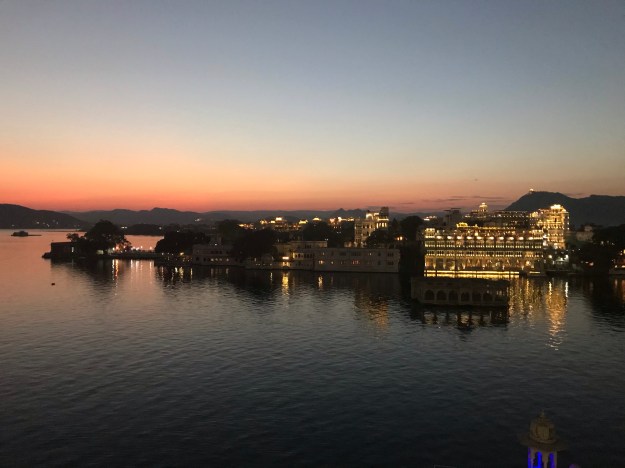
Wandering narrow lanes in the early morning- before the sleepy city comes to life at 10 or 11 am- I watch the light reflected on the spectacular Lake Palace Hotel, as the sun slowly makes its way over the peaks of the Aravalli mountains which surround Lake Pichola. I check out my beloved Bheru shrine- a god favored by rural Rajasthani women. Sometimes he is represented by an amorphous mound of tin foil, but today is his special day. An older man, the guardian of the shrine, is busy painting a smiling face with a mustache and a turban on the form. A piece of flowery blue fabric has been draped around his “body” and garlands of marigolds and roses are hanging around his neck. I admire his work, and he smiles in recognition and pride. I pass by several times a day to pay my respects.
The vegetable sellers are busily arranging their carts with cauliflower,carrots,eggplants.peas,tomatoes and other various fruits in season. Scooters and motorcycles are crowding around the popular food stalls selling warm breakfast snacks of samosa,and katchuri. (a type of small,puffy bread stuffed with potatoes and drenched in an eye poppingly spicy curry sauce. Shopkeepers are setting up their displays of copper pots and utensils, as they light incense in front of their small shrines to ensure a succesful and peaceful day.
I have been to Udaipur four times and it remains for me the most beautiful and magicial city in India.
The plaintive sounds of the muezzin calling the faithful to prayer at the local mosque drift into our room. It is 6 am and time to get up. Indians have dinner at 10pm and don’t go to sleep until after midnight, so the streets don’t come to life until about 11 am, when they start to rouse themselves out of bed. That’s the best time to wander, before the choking fumes of traffic and the mass of people make walking unpleasant.
Gerald is looking for great cow pictures and I monitor the changes in my favorite shrines. Morning time is when incense is lit and flowers are offered to the gods. It also presents a small window of opportunity to see/photograph the shrines while their little metal gate is open; otherwise it looks like the gods are imprisoned. This morning I realize that in my haste I forgot my camera.
At the end of the road,after cursing myself numerous times for not having my camera, we hear drums. Women are pouring into a courtyard where a drummer is playing and a puja (blessing ceremony) is being done in front of a shrine. It is Sri Mata- a mother goddess, and this is a pre-wedding ritual. Durga, another female goddess is in the same compound and the women pay homage to each goddess in turn. The attendant at the shrine is a priestess. This group is from a simple village , but soon afterwards a wealthier group arrives and this time two drummers appear. First it is the bride’s family who take turns pouring offerings of milk and flowers, and there are now two drummers. The groom’s family appears some minutes later, which presents a problem. They shouldn’t be there at the same time, but with IST (Indian Standard Time), the bride’s family was supposed to have been there much earlier. Four generations of women dance with abandon to the drums, and I of course am invited to join them, which I willingly do.
“Gerald, I want to go to that wedding tonight, please go talk to the groom”. There will be more than two thousand guests, and it will be a gala affair. Indians are notoriously hospitable. I am prepared with my best silk outfit and silver sandals for just such an occasion. Unfortunately this time we are not invited.. As we leave, people are arriving in cars, on foot, and rickshaw. The wedding season has begun!
Dates for marriages are chosen with an astrologer, and this weekend is apparently an auspicious one. Our friends and our guesthouse owner are all going to weddings with between 2000 and 4000 guests. When I ask Mr. Singh (owner of our favorite restaurant ) if they are going to a wedding this weekend, he replies “We will be going to a big royal wedding in January. All the Maharajas of each state will be present and we have two chartered planes to take our group.” Now that’s a wedding I’d like to be invited to.
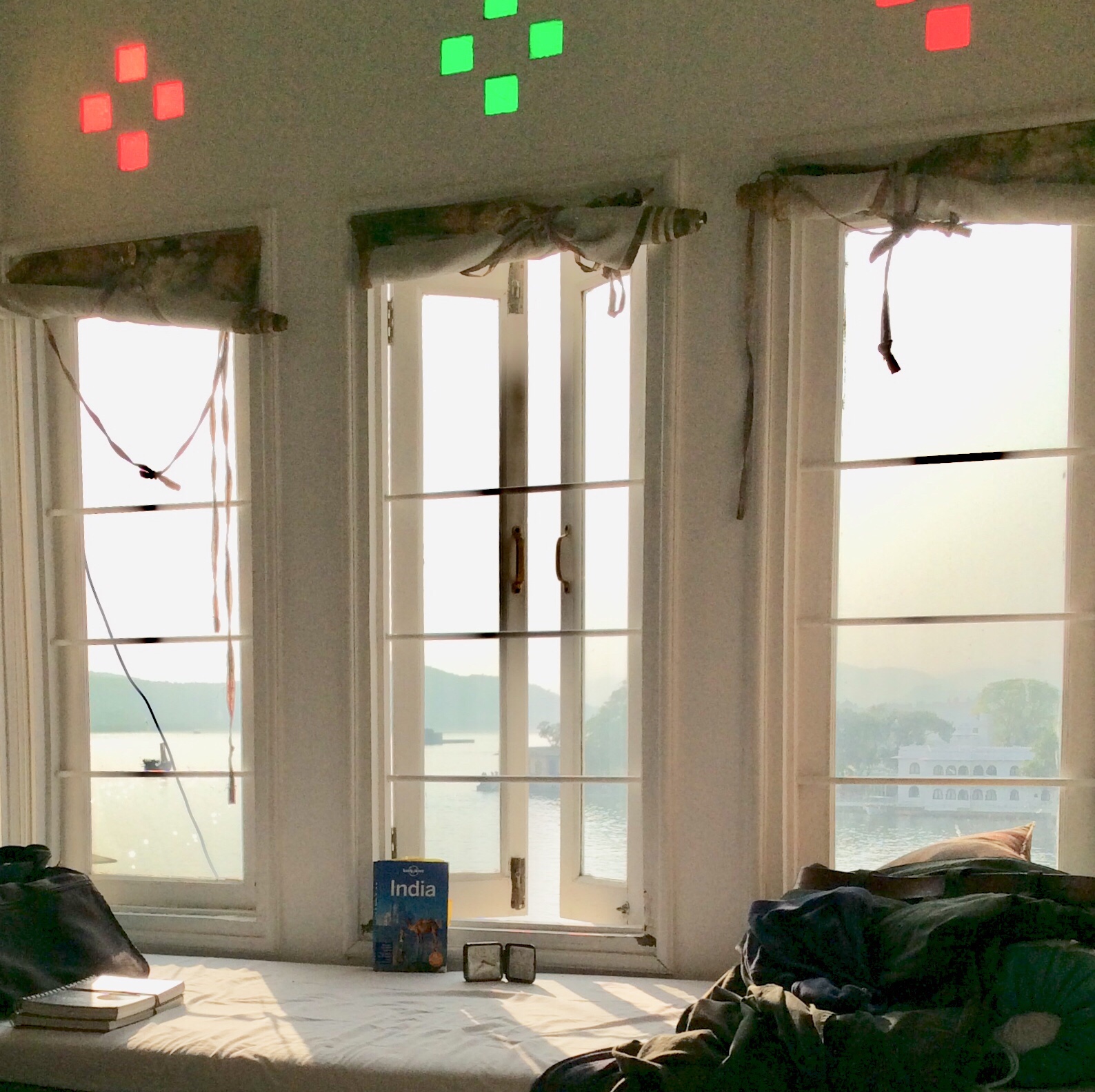
As we climb the six flights of stairs to our room the sounds of fire bombs exploding break the quiet. From our panoramic window we see the luxury hotel, on Jag Mandir, a private island,lit up like Las Vegas. Famous Lake Palace Hotel ( from the Bond movie “Octopussy’) is also ablaze with lights.
Our room is a bargain at $17 a night, with a painted stenciled ceiling and views of Lake Pichola on two sides,but the mattress is hard as a rock. I am hoping for a good night’s sleep because I am pooped. BOOM.BOOM.BOOM. There seems to be a wedding all over town tonight. Fireworks, drums, loudspeakers with disco music, people talking,laughing until the wee hours of the morning. And if that isn’t enough, at 3 am the ever-present stray dogs go on a howling binge (maybe frightened by all the fireworks) and don’t let up until dawn.
The daily spectacle of processions, ceremonies, and incredible flashes of colors is what makes India “The Greatest Show on Earth”.
It is our last night in Udaipur and I am going to Noya Guda, where six years ago I witnessed a hair-cutting ceremony of seven year old Iswah, and stayed in the village for two days. (If you want to see some highlights from that ritual you can go on YouTube and look up “BHERU-haircutting Ceremony” by tembigirl)
Iswah, in the front, left, now 13 yrs old
Preparations have to be made well in advance after my previous adventure. I have a large lunch, knowing that dinner in the village will be eaten very late, at 10 pm. Liquids must be consumed hours ahead of our departure, because there is no toilet,not even an Indian squatter. (Last time I visited, the headman drove me to his village where he had a toilet. Then someone waited outside the door until I finished!).
At 4:30 I go downstairs to Prem and Kesar and we load into the car. It wouldn’t be a proper Indian outing if there were only three people, so their 19 yr. old son, 13 yr. old nephew, and giant dog, Donny, come along as well.
It is only a forty five minute drive from Udaipur, but centuries away . We stop first at Prem’s village, where his family compound has an elaborate Bheru shrine, and with the help of the village priest, prepare offerings. The family joins in gathering wood branches for a small fire, pours ghee into a vessel, places incense and marigolds, and prostrate themselves in front of the god .
Priest doing puja in front of Bheru Shrine
Bheru Shrine
Meanwhile a camel, carrying a load of grasses passes by, led by a wizened, turbaned man. I feel as if I have been transported to another time zone a thousand years ago.
When we arrive at Noya Guda, I notice that nothing has changed since my last visit. There is no paved road, cattle roam in and out of stone houses, and the entry into Iswah’s home is inhabited by a water buffalo and some cows.
The two sisters, now 22 yrs and 19 yrs, are married and the eldest has a one year old son. They are here visiting the family for a week. One lives far away in Gujarat, and the other a few hours away. It is the custom for girls to live with their husband’s family. Prem tells me that the younger one, (who married at 16), is now six months pregnant, and asks if I can look at the medical record she got from her last doctor visit. I am not surprised to see that her hemoglobin is low, but the size of her fetus is only 11 weeks, and she is supposedly 24 weeks pregnant. I tell them that she needs to eat more and gain some weight. The daily diet of dal and chapattis is not enough for a healthy baby.
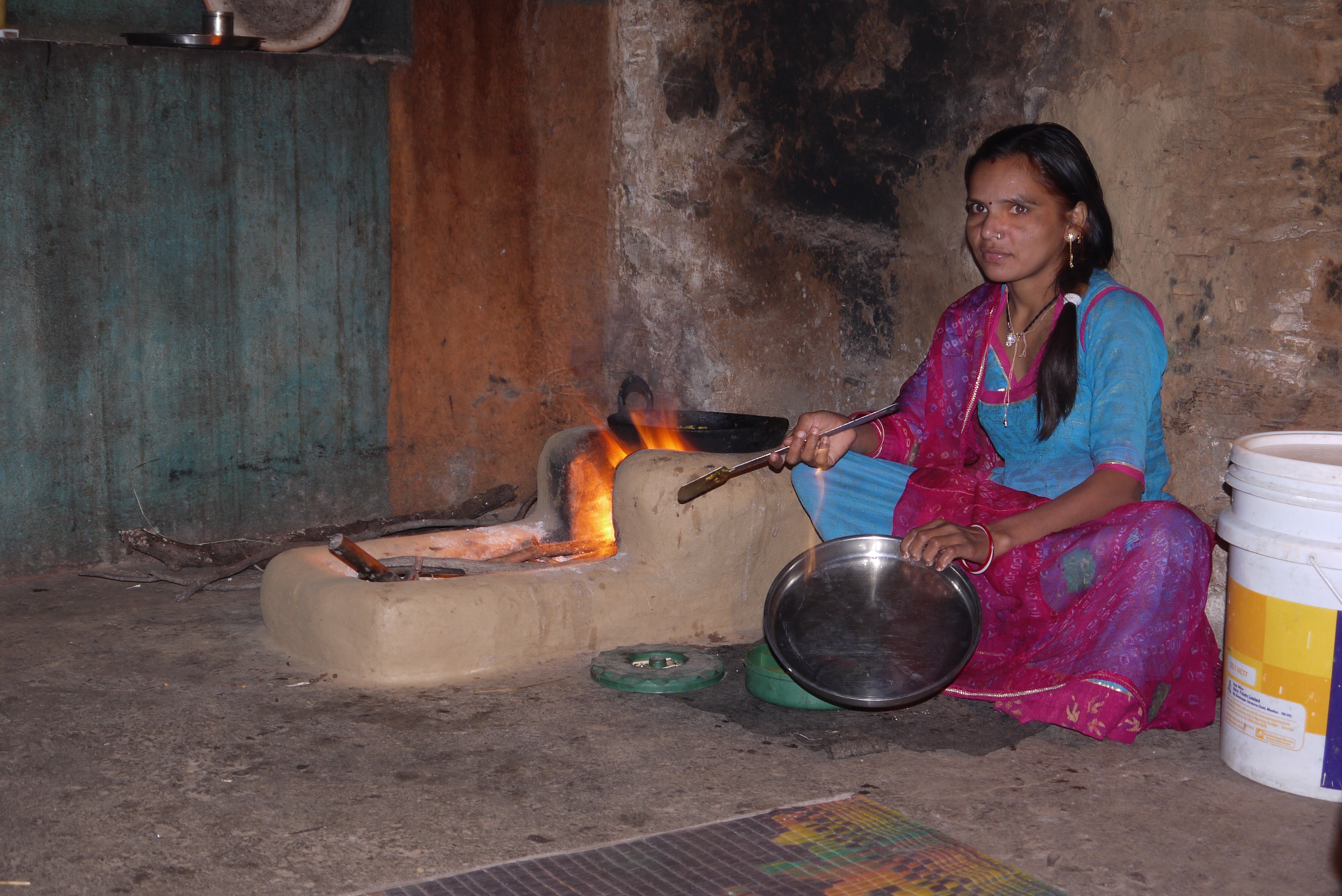
Making the roti for our dinner on a clay stove at the village
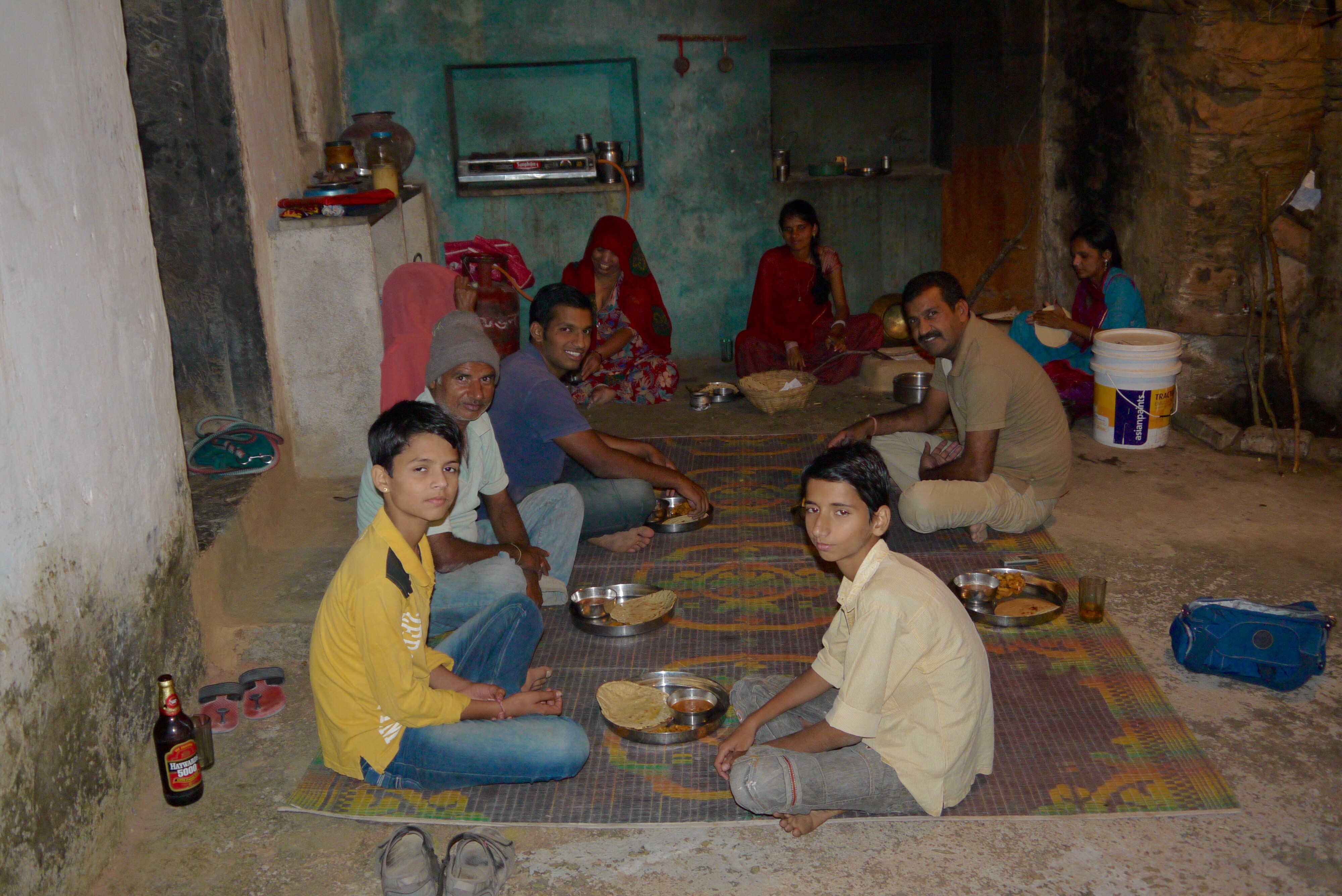
Dinner with Kesar and Prem and the family in the village
What concerns me more is a notation on her record. Last year she had a “voluntary termination of pregnancy”. India has 914 females to 1000 males. Although female infanticide has decreased, female fetuscide exists unofficially. The government has banned “sex determination” tests, but for baksheesh they are still available. I discreetly ask Prem about boy and girl babies, and he insists that it is illegal to abort and is considered a crime. I do not mention what I read. Girls are considered undesirable because their families must pay a considerable dowry at marriage, and since the bride always lives with the groom’s family, a valuable helper is also lost.
The streets in the old quarter of Udaipur are eerily quiet. Shops are shuttered and people are milling around . The incessant ZOOM, ZOOM of motorbikes and rickshaws is not to be heard. Blue sky reflects off the City Palace and Lake Pichola, the result of a day without diesel pollution.
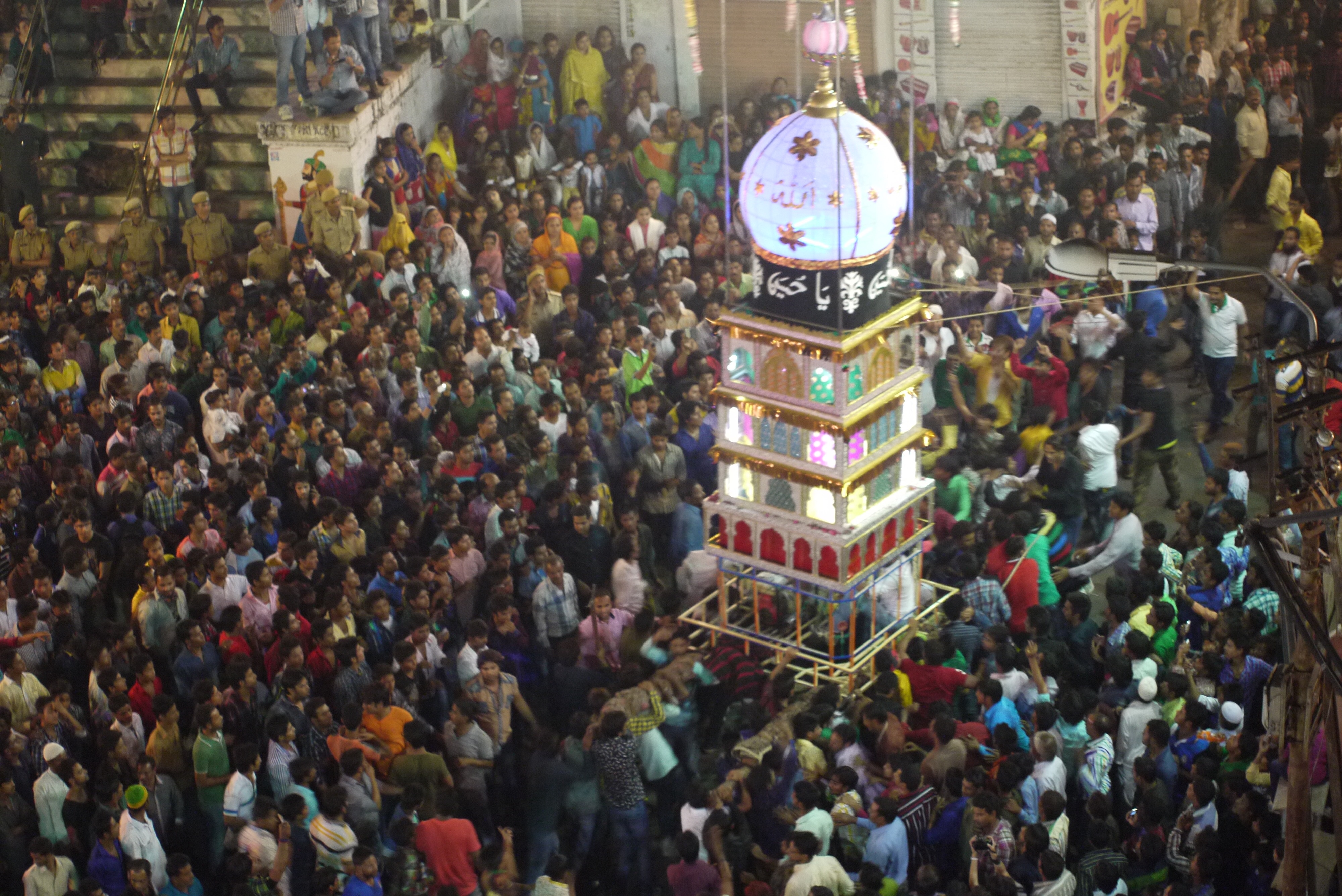
Today is the Muslim festival, Muharram. It commemorates the assassination of the Shia Muslim Hussein Ibn Ali, a grandson of Mohammed, and is one of the holiest festivals of the year. Gerald and I decide to forgo our plans to go out of the city and stay in Udaipur. We’ve been told that “sometime” in the morning and “sometime” in the evening there will be a procession. Each person we ask gives a different answer as to the starting time, and we find ourselves roaming back and forth on the the same streets following whatever seems to be a reliable lead.
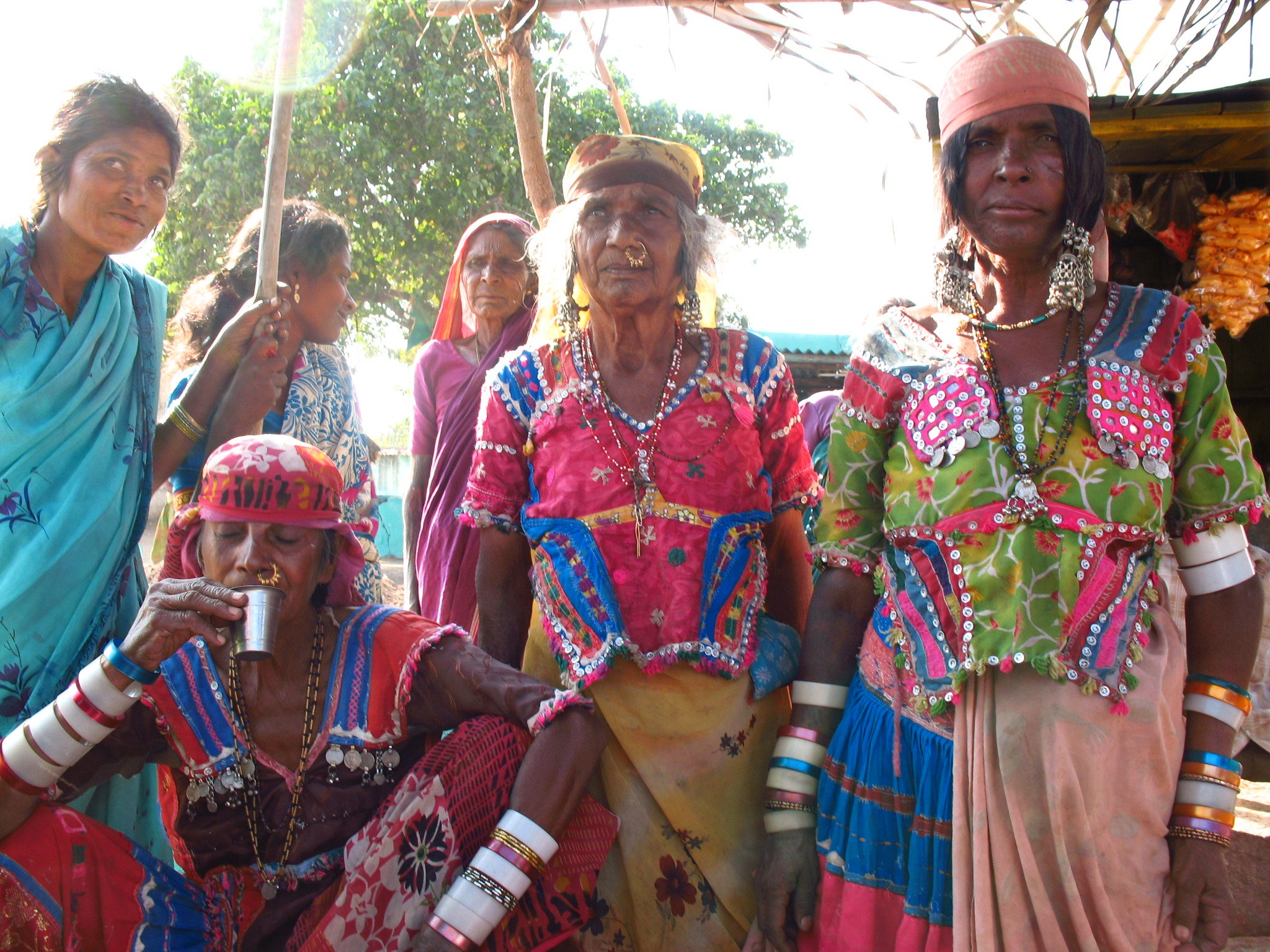
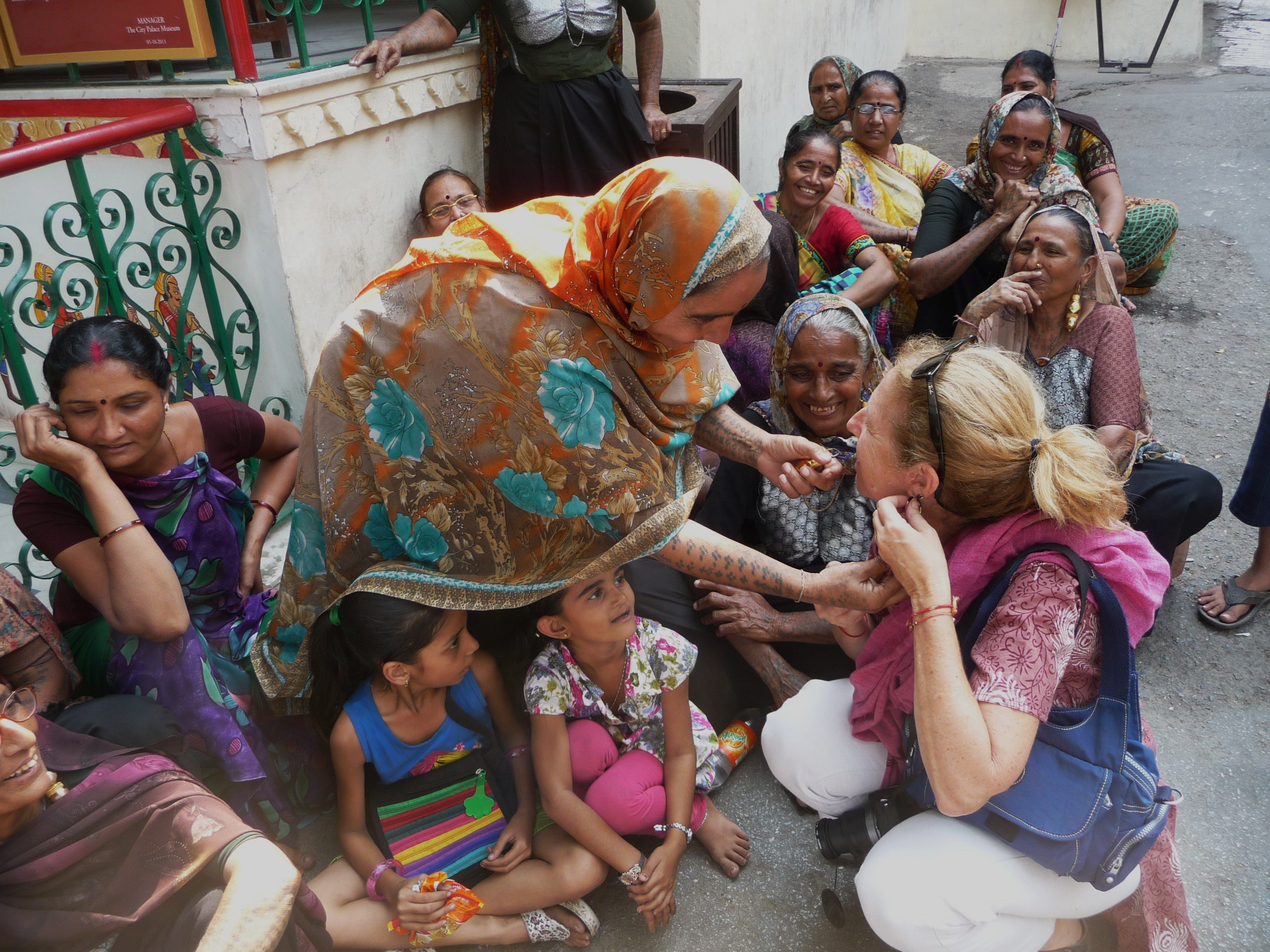
Finally we give in. It wil happen when it will happen. Just then I spot a group of village women wearing huge gold earrings. We saw the same ladies in Pushkar and I had all but given up hope of ever seeing them again, and being able to photograph them. I am so excited about being given a second chance that I run ahead, trying to catch up with them. They are moving faster, aware and amused that I am following them, but also afraid of losing the rest of their group. When they reach the entrance of the City Palace (their destination) I squat down on the ground next to them and we compare earrings. Before I know it,one woman takes off her earrings and puts them on me so G can take a picture.
Me trying on the earrings with the ladies from Porbander(in Gujarat)
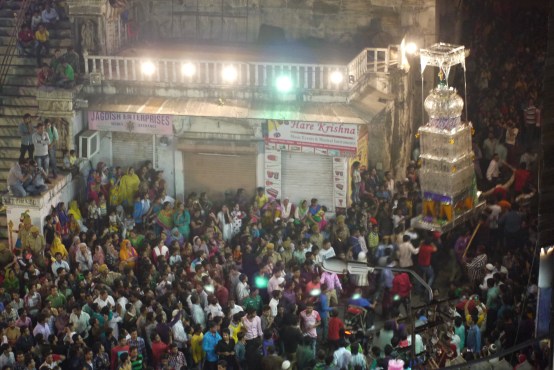
While eating a masala dosa we talk with a young Dutch couple, who tell us about this amazing procession they just witnessed! Determined not to miss the evening one, we stake out a prime spot in a rooftop restaurant overlooking Jagdish temple, where the procession will pass. It is only three in the afternoon, but policemen are already lining up, and women and children are setting out cloths to sit on along the route. G thinks it will start soon. “Believe me, they’re not going to hang around like that for another three hours.”I think otherwise.
Preparing a float for Muharram
Crowds of men dancing in the square for Muharram
It is now almost six in the evening .We have eaten a chicken tikka masala, drunk numerous fresh lime sodas, and still nothing. Down below in the square a sea of men is gathering. Slowly we hear chanting getting louder and louder, and see men forming small circles and doing a slow rhythmic dance with scarves waving in their hands . Then a rush of boys carrying a giant float of a glittering mosque comes into view as they spin around severals times, to cries of “HOSEIN”, followed by “ALI”. The procession continues, each float taller than the next. Groups of drummers incite the men to a feverish frenzy. In past years there has been some violence and the rows of police are on high alert. There are too many young men with nothing to do, and this can easily turn into a riot. But it doesn’t, and float after float of varying sizes of mosques (some 4 stories high,)pass by, preceded by groups of drummers.
At 9pm the last float has made its way down the narrow street toward the ghat, and the crowd disperses peacefully.


















 Nestled between the Artificial Jewellery Shop and the Medical Supplies corner an elderly man sat on a high stool, fiddling with watches. He was surrounded by all manner of clock and watch parts and a small glass case displayed timing devices for sale, costing between a few dollars and several hundred. Gerald lives by the mantra “In India anything is possible”, but hopes for repairing his twenty year old travel alarm were fading.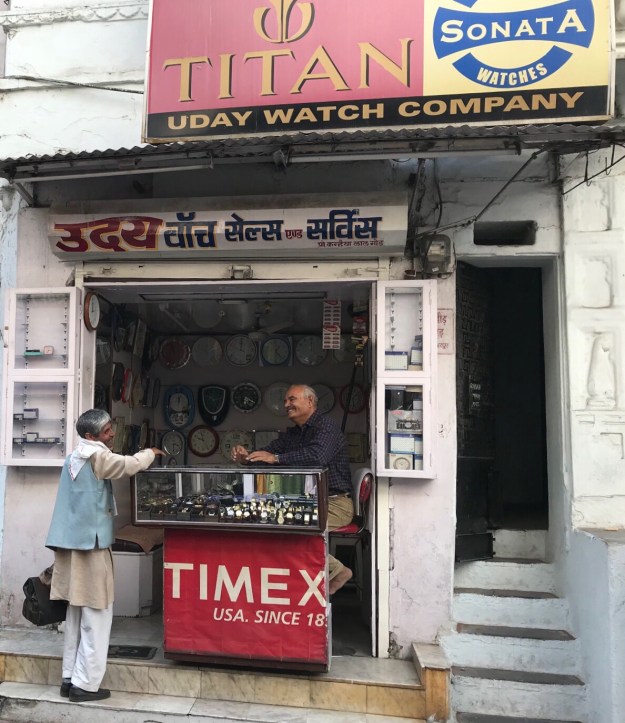

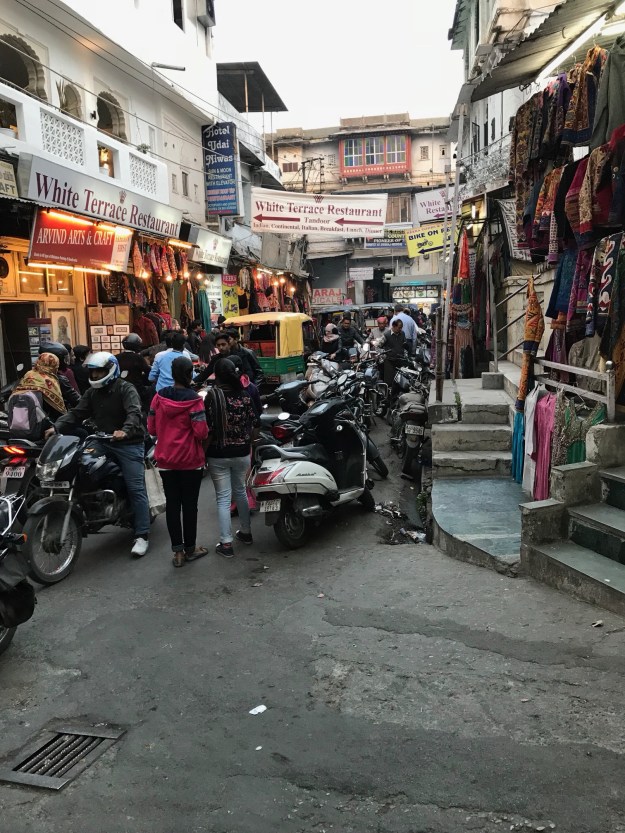 I had the advantage of being able to see everything from my slightly perched position but not get in the way of the rush of bodies and cars. The main road was narrow, windy and not made for all the vehicles and cows that travel through.







 THE DREAM OF DISTANT LANDS